Buddhist Statues in Japan (From the Asuka Period to the Kamakura Period) (For Educational or Commercial Use)
Transition of Buddhist statues in Japan
It is believed that the technology for producing Buddhist statues was introduced to Japan via China and the Korean Peninsula, and the construction of Buddhist statues in Japan began in the Asuka period (around the end of the 6th century). This section introduces a selection of representative Buddhist statues made from the Asuka period, the dawn of Buddhist statues in Japan, to the Kamakura period, when Buddhist sculptors of the Kei school including Unkei and Kaikei were active. Let's take a look at the characteristics of Buddhist statues from each period.
Buddhist Statues of the Asuka Period (592〜710)
The major techniques used to construct Buddhist statues in the early Asuka period involved gilt copper or bronze castings, or wood carvings made of camphor wood. In the late Asuka period, new materials and methods gained usage, allowing for the production of items, including clay statues, dry lacquer statues, and metal statues, the latter of which required a copper plate to be placed over a mold, while the image was hammered out. One of the most prominent Buddhist sculptors of this period was Kurano-Tsukurinotori (Tori-Busshi), who is mentioned in books, such as The Chronicles of Japan, as Japan's first full-fledged Buddhist sculptor. Born into a family of Chinese immigrants, Kurano-Tsukurinotori established the "Tori-style," which was influenced by the Northern Wei style. He is said to have produced many Buddhist statues, including the Shakyamuni Triad (statues of Buddha and two attendants) in the Golden Hall of Hōryūji Temple in Nara, and was a driving force in the early construction of Buddhist statues in Japan. The facial features of Asuka-period Buddhist statues include almond-shaped eyes and mouths with classical (archaic) smiles. In the late Asuka period, many Buddhist statues with child-like faces and bodies were produced, influenced by the sculptures of the Sui and Tang dynasties.
Seated Buddha
Standing Bodhisattva Kannon
Queen Maya and Heavenly Beings
The Buddha Amida Triad and Two Priests
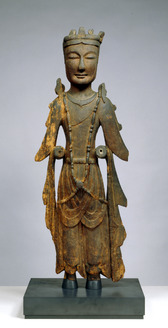
Bodhisattva
Bodhisattva with One Leg Pendent
Buddha

The Buddha Shaka at Birth
The Eleven-Headed Bodhisattva Kannon
Standing Kannon Bosatsu (Sk. Avalokiteśvara)
Standing Kannon Bosatsu (Sk. Avalokiteśvara)
Standing Kudara Kannon (Avalokitesvara) (copy)
Buddhist Statues of the Nara Period (710〜784)
During the Nara Period, in the Tempyo era of Emperor Shōmu's reign (729-749), a gorgeous aristocratic culture (Tempyo culture) with a strong Buddhist flavor influenced by the Tang Dynasty developed. In the year 752, the construction of the bronze statue Rushanabutsu (the Great Buddha of Nara), the principal statue of the Golden Hall of Todaiji Temple, was completed and unveiled to the public, as part of a national project at the wishes of Emperor Shōmu. The production of Buddhist sculptures became more popular, and more realistic and lively statues were created in reference to the Tang style. The sculptural features of the statues changed from the simple, child-like appearance of the Asuka period, to mature adult-like faces with rich expressions, and well-proportioned physiques. In order to depict such detailed expressions, " kanshitsu (dry-lacquer : a technique of making sculptures using clay and hemp)" and "sozō (clay sculptures)", both of which are easier to produce, became the mainstream materials and methods for making Buddhist statues.
The Bodhisattva of Sunlight
The Buddha Yakushi
Seated Yakushi Nyorai (Sk. Bhaiṣajyaguru)
Disciple (One of the statues of Hōryūji's pagoda)
Bodhisattva Avalokiteśvara
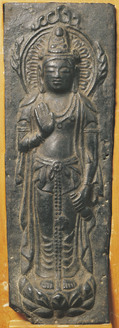
Standing Kannon Bosatsu (Avalokiteśvara)
Standing Sho-kannon Bosatsu (Avalokitesvara) (copy)
Standing Komoku Ten (Virupakusa) (copy)
Standing Shitsukongo-shin (Vajradhara) (copy)
Buddhist Statues of the Heian Period (794〜1185)
In the early Heian period, Saicho and Kukai, who had studied Buddhism in Tang, China, introduced Esoteric Buddhism to Japan, leading to the development of Esoteric Buddhist art centering on mandaras. Buddhist statues unique to Esoteric Buddhism, such as Dainichi Nyorai (Mahavairokana) and Fudō Myō-ō (Acalanatha), also appeared. In terms of statue-making techniques, "ichiboku-zukuri," in which the head and body are carved from a single piece of wood, became the mainstream technique. After the dispatch of Japanese envoys to the Tang Dynasty ceased in 894, Buddhist statues began to be made in the Japanese style from the mid-Heian period. Jōchō, a leading Buddhist sculptor of the mid-Heian period who produced the seated statue of Amida Nyorai (Amitabha), the principal figure of the Phoenix Hall of Byōdōin Temple, developed a graceful Japanese style of Buddhist sculpture known as "Jōchō style (Japanese style)". He also perfected the yosegizukuri technique, in which multiple pieces of wood are combined to make a Buddhist statue, and this technique has since become the basis of Buddhist statue- making in Japan. In the late Heian period, an end-of-the-world theory and faith in the Pure Land spread in the aristocratic society, and statues of Amida Nyorai, who guides people to the Land of Perfect Bliss, were actively produced. Buddhist statues in the Heian period are characterized by plump, stout bodies and gentle faces.
Seated Yakushi Nyorai (Sk. Bhaiṣajyaguru)

Seated Nyoirin Kannon (Sk. Cintāmaṇicakra)
The Wisdom King Fudō
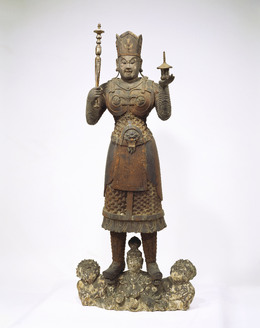
Standing Tobatsu Bishamonten (Vaiśravaṇa)
The Buddha Dainichi
Amitabha Buddha
Standing Eleven-headed Kannon (Jp. Jūichimen Kannon, Sk. Ekādaśamukha)
The Guardian God Bishamonten
Zaō-Gongen
The Buddha Yakushi
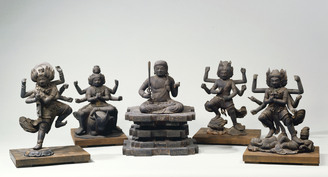
Five Vidyārājas
The Wisdom King Fudō
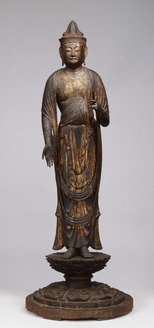
Standing Kannon Bosatsu (Avalokitesvara)
Seated Daiitoku Myōō (Yamāntaka)
Buddhist Statues of the Kamakura Period (1185〜1333)
In the Kamakura period, when the political power shifted from the aristocracy to the samurai warrior class, more dynamic and powerful Buddhist statues favored by the samurai appeared. With the trend of realism in Kamakura art and the maturity of wood carving techniques, Buddhist statues of this period pursued realistic expressions as if they were alive. The technique of using crystal eyes, in which crystals are inlaid in the eyes, became common, and many Buddhist statues were produced with detailed depictions of the human skeleton, muscles, and even blood vessels, based on the human body. In addition, the development of the yosegi-zukuri technique made it possible to effectively construct huge Buddhist statues. The representative Buddhist sculptors of the Kamakura period are Unkei and his disciple Kaikei, who produced the standing statues of Kongōrikishi in the great south gate of Tōdaiji Temple. The Kei school, led by Unkei and Kaikei, who established a new style of realistic and dynamic Buddhist statuary, had a great influence, not only on the sculpture circles in the Kamakura period, but also on later generations of Buddhist sculptures.
Bodhisattva
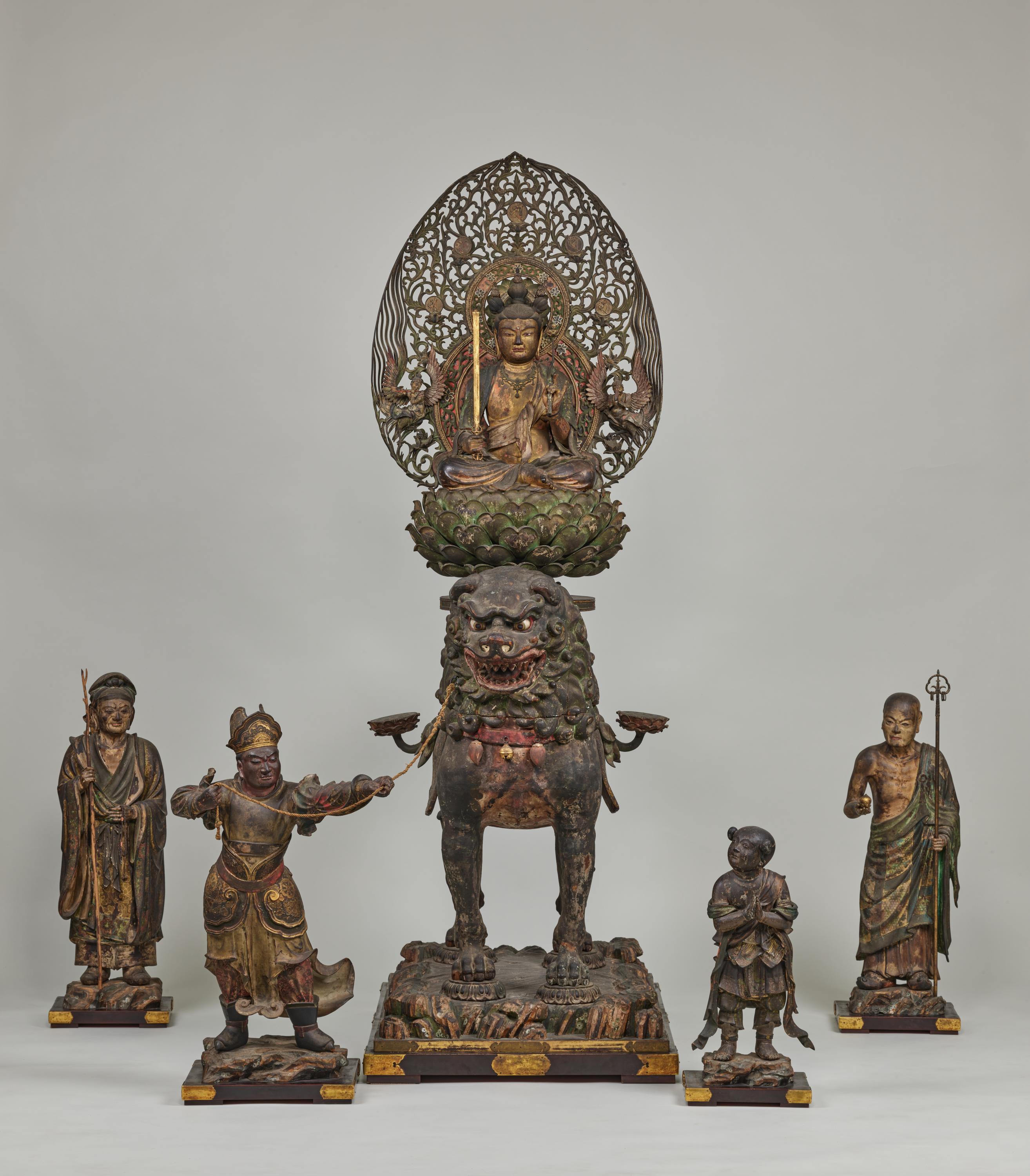
The Bodhisattva Monju Riding His Lion, Accompanied by Followers
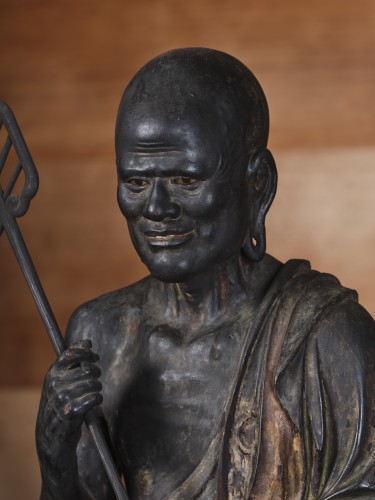
Daihoonji Temple
Standing Tamonten (Sk. Vaiśravaṇa)
Attendants of the Four Heavenly Kings
The Monkey General, One of the Twelve Divine Generals
Śākyamuni (Seiryō-ji type)
The Buddha Amida

The Bodhisattva Monju
Rāgarāja
Standing Bishamonten (Sk. Vaiśravaṇa)
Related gallery
References
- 辻惟雄 監修,美術出版社
- 河野元昭 監修,平凡社
- 山本勉 [著],平凡社
- 薬師寺君子,西東社