Description
This iconographic form of Bishamonten (Skt. Vaiśravaṇa) is distinguished by its Central Asian style, which is seen particularly in the tall crown with the design of a bird and his long coat of chainmail armor. He stands with both legs supported by the earth goddess Chintennyo, emerging from the ground and flanked by two demons. It comes from Kōfukuji Temple in Nara, and it copies an important statue enshrined at Tōji in Kyoto.
The body was decorated with crown and dressed in a coat-like armor with chained decoration. The right arm was covered with shrimp-shaped gauntlet (ebigote). Mounted on the pedestal in the form of goddess (chiten'nyo) hands. These features were derived from the statue of Tobatsu Bishamonten which came from China to Tō-ji Temple in Kyoto Prefecture. This work was faithfully modeled after the original statue compared to other examples.
This statue, which is kept in the Nara National Museum, is notable as the most precise copy of the statue of Tobatsu-bishamon-ten (Vaiśravaṇa) in Tō-ji temple, which was made during the Tang dynasty in China and was originally placed on the Rajō-mon Gate in the capital Heian-kyō (today's Kyoto city). Unlike other copies in Seiryō-ji and Kurama-dera temples, this statue in Nara features many details of the original such as the design of the phoenix on the front side of the crown and human figures with a stick on both sides of the crown, both of which are made in relief carving; other details are the unique armor-coat made of chains, the arm protectors and leg protectors in the shape of lobster-shells, etc. But this statue is standing in a static posture, whereas the original statue is slightly twisting its hips and legs. The eye-pupils of this statue are not made with inserted black stones, which gave it a gentler facial look than the one in Tō-ji temple. This description style of eyes is in common with the other copy of the same statue in Seiryō-ji temple and is an interesting point in studying these copied statues. This statue is made in the manner of assembling pieces of hinoki wood (Japanese cypress) and is colored.
{br=>[[]], content=>[Tobatsu Bishamonten differs from the usual form of the deva Bishamonten (Skt. Vaiśravaṇa). It is said to have originated in a kingdom in western China referred to as Tobatsu (Ch. Douba), though the precise location this is meant to refer to is unknown . Statues of Tobatsu Bishamonten were enshrined at castle gates to stand guard. This particular statue has several distinct features. A phoenix is carved in low relief on the front of the deva’s jeweled crown, with figures holding sacred staffs to the left and right. The deva is wearing a special type of gold chain mail as an outer garment, and its gauntlets and greaves are made of overlapping metal segments, called “prawn form” in Japanese for its resemblance to a prawn’s segmented shell. The deva is standing on the earth goddess Jiten (Skt. Pṛthvī)., A statue of Tobatsu Bishamonten was reportedly brought to Japan in the early Heian period (794–1185) from China’s Tang dynasty (618–907) and enshrined at the Rajōmon Gate, the southern gate of Heian-kyō (now Kyoto), before being moved to Tōji Temple. In the late Heian period, copies began to be made of Tōji’s statue. Many of these incorporated individual interpretations that differed from the original, such as those passed down at Seiryōji Temple and Kuramadera Temple in Kyoto, but this example is a notably faithful reproduction. Nevertheless, Tōji’s statue has a dynamic pose suggesting subtle movement in the hips and legs, while this one stands in a static pose. The statue also lacks the black stones inlaid in the eyes of the Tōji statue, giving it a more subdued appearance. It was created using joined block construction from Japanese cypress and painted in colored pigments.]}
Data source
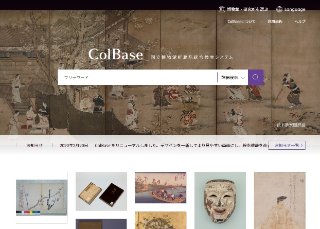
ColBase
"ColBase: Integrated Collections Database of the National Institutes for Cultural Heritage, Japan" is a service that enables a multi-database search of the collections in the four national museums (To...
Contents holder/Provider
Aggregator

National Institutes for Cultural Heritage
The National Institutes for Cultural Heritage (NICH) comprise four National Museums (Tokyo National Museum, Kyoto National Museum, Nara National Museum, and Kyushu National Museum) and two National Research Institutes for Cultural Properties (Tokyo National Research Institute for Cultural Properties, and Nara National Research Institute for Cultural Properties), as well as the International Research Centre for Intangible Cultural Heritage in the Asia-Pacific Region (IRCI) in Sakai City, for a total of seven institutions.
Last updated
July 20, 2026