Sogi
Sogi is renowned as the wandering poet of the renga (linked verse) world, on par with Saigyo, the waka poet, and Basho, the haiku master.
1421-1502
A renga master of the Muromachi period (1336 – 1573). His birthplace is said to be in Kii or Omi province. Sogi is also known under the literary names Jinensai and Shugyokuan. His family name is said to be Iio or Inoo, but it is not known for certain.
Around the age of 30, Sogi devoted his talent to waka and renga, and first studied under Sozei, then under Senjun. In 1466, he traveled to the eastern provinces to study under the famed renga poet Shinkei who was then living a rambling life across in Kanto region. By incorporating elements of the Shinkei style into the Sozei style, Sogi achieved great success as a renga poet. In 1471, he received instruction in the secret traditions of Kokin Waka Shu (“Collection of Ancient and Modern Japanese Poetry”), the so-called Kokin-denju) from Tsuneyori To in Izu. In 1473, he made his residence at a thatched hut, Shugyokuan, in Kamigyo, Kyoto, where he wrote the collection of renga stanzas Wasuregusa. Sogi also compiled a collection of verses by seven renga masters, which he titled Chikurinsho. After the death of Shinkei and Senjun, Sogi became the foremost authority of the renga world. In 1480, he visited Suo, Yamaguchi, upon invitation from Masahiro Ouchi, travelled across Kita-kyushu, an area under Masahiro’s jurisdiction, and wrote the travel journal Tsukushi Michi no Ki. In 1494, together with poets such as Kensai Inawashiro and Sanetaka Sanjonishi, he embarked on an effort to compile a renga anthology titled Shinsen Tsukuba Shu, and completed the task the following year. Sogi enjoyed traveling throughout his life, and was also known as a wandering poet. In 1500, he traveled to Echigo, and in 1502, on his way from Echigo to Mino, Sogi died at the foothills of Hakone, Sagami. His disciples led by Socho laid his remains to rest at Jorin-ji Temple in Momozono, Suruga Province (currently Susono City, Shizuoka Prefecture).
Among his renga collections are Wakuraba, Shitagusa, and Uraba. The renga Minase Sangin Hyakuin, which Sogi wrote with his disciples Shohaku and Socho, together with Yunoyama Sangin, a renga he wrote later, gained great popularity as renga series consisting of 100 poems. Sogi’s treatises on renga poetry include Choroku Bumi, Azuma Mondo, and Oi no Susami. He wrote interpretations of numerous works of classic literature, such as Kokin Waka Shu (“Collection of Ancient and Modern Japanese Poetry”) and Genji Monogatari (“The Tale of Genji”), and also left annotated editions of these works. Basho Matsuo refers to Sogi as one of the two poets (the other one being Saigyo) for whom he had great respect.
Related People, Things and Events
Saigyo
A poet of the late Heian period; he forsook his life as a warrior to become a monk, travel across Japan, and create his own style of poetry
Matsuo Basho
A haiku poet of the early Edo period who established the Basho style and greatly influenced succeeding generations
Sanetaka Sanjonishi
室町後期の公卿、学者。宗祇から古今伝授を受け、『源氏物語』『伊勢物語』の権威であり、当代一流の能書家としても知られた文化人。
Ikkyu Sojun
A rebellious and eccentric Zen monk of the Muromachi period
Yusai Hosokawa
戦国末期から近世初頭の武将、文人。大名細川家の基礎を築き、当代屈指の文化人でもあった。東常縁、宗祇、三条西実隆につらなる古今伝授を三条西実枝から受けたことでも知られる。
Kokin waka shu (Collection of Ancient and Modern Japanese Poetry)
Japan's first imperial anthology of Japanese poetry, completed early in the Heian period
Genji Monogatari (The Tale of Genji)
Genji Monogatari is a Japanese imperial tale written by Murasaki Shikibu during the Heian era. This fabulous story about Hikaru Genji, a royal prince, inspired many works of art.
Ise monogatari (Tales of Ise)
A mid-Heian period poem-tale structured as a biography thought to be of the poet Ariwara no Narihira
Hyakunin Isshu(One Hundred Poems by One Hundred Poets)
A collection of the best poems, one poem each, of 100 poets, especially the Ogura version
Ginkaku Temple
Common name for Jisho Temple built by the 8th Ashikaga shogun, Yoshimasa Ashikaga; a space of wabi and sabi aesthetics of transience and imperfection, it displays the sensibilities of Higashiyama Culture
Connoisseur Attendants (doboshu)
A group of cultured men in the service of Ashikaga shoguns who practiced art criticism and a wide range of performing arts during the Muromachi period
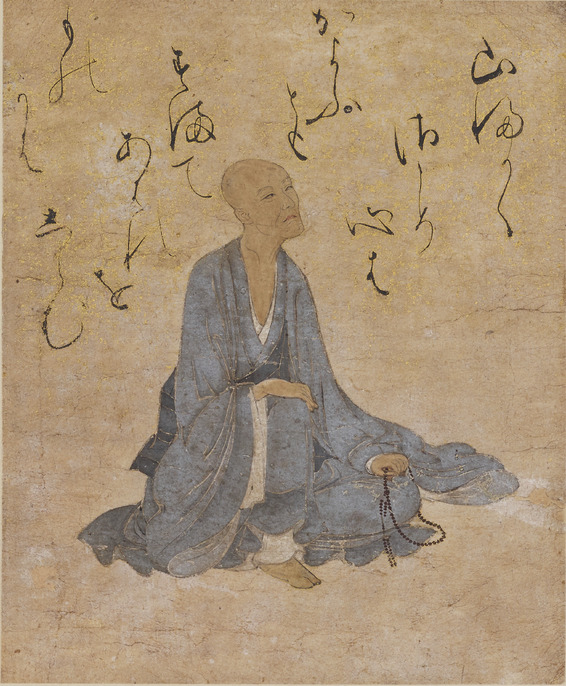
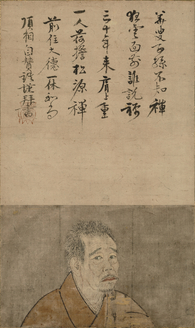


Books
伊勢物語肖聞抄
伊勢物語聞書 上巻
自讃歌註
自讃歌註 : 宗祇繪抄 上巻
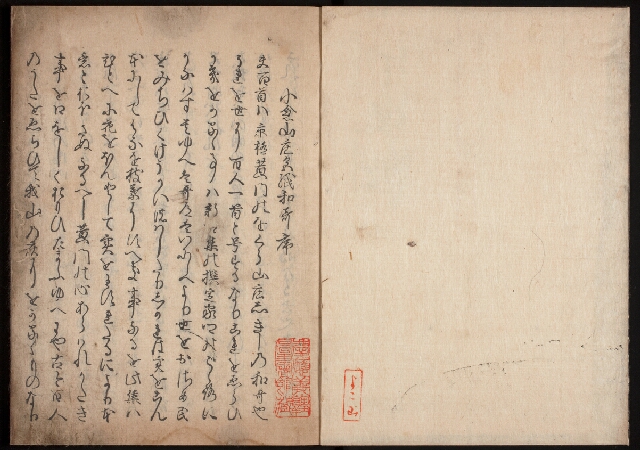
小倉山庄色紙和哥
宗祇小鏡
宗祇法師集


Renga collections, travelogues, and poetry collections
新撰莵玖波集 上
新撰菟玖波集(零本)
萱草(わすれぐさ)

竹林抄 上
老葉(わくらば)

筑紫道記

水無瀬三吟百韻
[連歌集]

湯山三吟

吾妻問答

老のすさみ
古今和歌集古聞 [1]
Related Works
月岡芳年 『新形三十六怪撰』宗祇
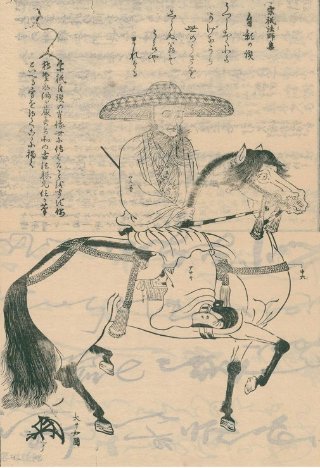
宗祇法師 『紀伊国名所図会』後編

宗祇水
宗祇像 『紀伊有田郡先賢伝記』第1輯
宗祇法師肖像 『先哲像伝』 第4冊
宗祇屋敷跡(『紀伊有田郡先賢伝記』第1輯)
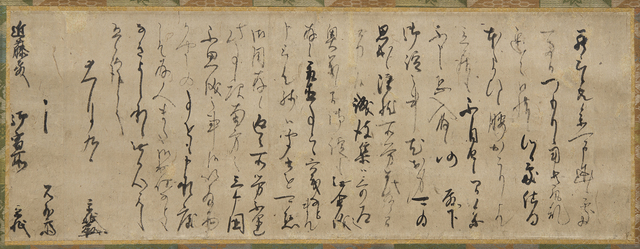
Letter by Iio Sogi

近衛尚通宛 飯尾宗祇書状
(飯尾宗祇書状写)〔詠歌合点〕
宛先不明 宗祇書状(『古文書時代鑑 上』 所収)


Disciples of Sogi and people related to him
The Poet Botanka Shōhaku
牡丹花肖柏の肖像画。畳の上で脇息によりかかり、片膝をたてる姿は柿本人麻呂像を模したもの。画面の半部ほどを占める、建仁寺の常庵龍崇(じょうあんりゅうそう)によって書かれた賛によると、本図は肖柏の没後に描かれた遺像。
宗長・宗碩 伊勢千句
大永2年(1522)に伊勢国山田(現三重県伊勢市)で、宗祇の弟子の宗長と宗碩によって、「太神宮法楽」のために興行された連歌の集成。本資料は、『伊勢千句』成立間もない天文4年(1535)の写本で、他に類をみない貴重なものである。
東常縁 古今伝授書
東常縁(とうつねより、生没年未詳)は千葉氏の一族で,室町時代における武家の故実家。宗祇に古今伝授を与えた人。
Waka Kaishi by Asukai Masachika
飛鳥井雅親は、室町時代の公卿。出家して栄雅(えいが)と号する。宮廷歌壇の中心的存在として、宗祇も指導を受けた。
Tanzaku by Ikkyu Sojun
室町時代の臨済宗の僧(1394-1481)。宗祇や宗長(1448-1532)と交友を結んだことでも知られる。
Tanzaku by Sanjonishi Sanetaka
Sanjonishi Sanetaka (1455-1537) was born the second son of Minister of the Center, Sanjonishi Kinyasu. He closely served three reigning emperors, i.e., GoTsuchimikado, GoKashiwabara, and GoNara. He was given the title of Senior Second Rank and eventually became Minister of the Center. Thoroughly versed in Chinese prose and poetry and Japanese literature, ancient anecdotes, and manners and etiquette, he contributed to the rise of academism favoring local flavor during medieval Japan. He studied the art of waka composition under Asukai Masachika (1417-90) and later exhibited wide-ranging talent. He also received oral instructions about the secret interpretations of the Kokin Wakashu (Collection of Ancient and Modern Poems) from Iio Sogi (1412-1502). Sanetaka and Botanka Shohaku (1443-1527) were fellow disciples, and Takeno Jo-oh (1502-55) was Sanetaka’s student. As a trained calligrapher, Sanetaka established his own style, named the Sanjo-In School (also Shoyo-In School) and attracted a large number of followers. He left behind The Diary of Lord Sanetaka and a private anthology, Setsugyoku Shu (lit. “Collection of Snowy Gems”). He retired to pursue Buddhism at age 62 (1516) and adopted the pseudonym “Shoyo-In Gyoku”.The exhibit “Last of Spring” poem is signed “Gyoku”. Although this Buddhist name should have been used after Sanetaka became a monk, he used it freely in the October 4th entry (1484) of his diary, when he was only 30 years of age. This means that one cannot determine the date of tanzaku using the poet’s signature as a clue. However, from the deeply impressive brushwork achieved by contrasting shades of Indian ink and by the steadfast movement of the brush, one can safely assume that this tanzaku was written in old age.


Videos
Institutions and External Links
- 連歌の世界へ(京都大学貴重資料デジタルアーカイブより)
京都大学貴重資料デジタルアーカイブによる平成12年度公開展示会図録。「連歌の世界へ」が掲載されており、その中で第3章として「宗祇とその門弟」が紹介される。
- 高画質画像資料ダウンロード(山口県立山口博物館HPより)
掲載資料の冒頭に安土桃山時代(慶長期)の「宗祇坐像」が載っており、画像を閲覧することができる。画像の利用については、山口博物館の利用条件がある。
References
- 『日本大百科全書(ニッポニカ)』(JapanKnowledge)「宗祇」の項
- 『改訂新版 世界大百科事典』(JapanKnowledge)「宗祇」の項
- 『国史大辞典』(JapanKnowledge)「宗祇」の項
- 『日本人名大辞典』(JapanKnowledge)「宗祇」の項
- 宗祇小西甚一 著,筑摩書房
- 連歌師宗祇島津忠夫 著,岩波書店
- 志賀太郎「ボストン美術館蔵伝宗祇像の像主考―伝来と像容―」(『美術史論集』6、2006年)
- 日本史年表(第5版)歴史学研究会 編,岩波書店
- 『全文全訳古語辞典』『日本大百科全書(ニッポニカ)』『改訂新版 世界大百科事典』(JapanKnowledge)サンプルページ「連歌」の項
- 『国史大辞典』『日本大百科全書(ニッポニカ)』『改訂新版 世界大百科事典』(JapanKnowledge)サンプルページ「竹林抄」の項
- 『国史大辞典』『日本大百科全書(ニッポニカ)』『改訂新版 世界大百科事典』(JapanKnowledge)サンプルページ「新撰菟玖波集」の項
- 『国史大辞典』『日本大百科全書(ニッポニカ)』『改訂新版 世界大百科事典』(JapanKnowledge)サンプルページ「水無瀬三吟百韻」の項
- 『国史大辞典』『改訂新版 世界大百科事典』(JapanKnowledge)サンプルページ「吾妻問答」の項
- 日本古典文学全集(Japanknowledge)サンプルページ『連歌集』
- JapanKnowledge所収コンテンツの最終アクセス日は、いずれも2023/02/10。