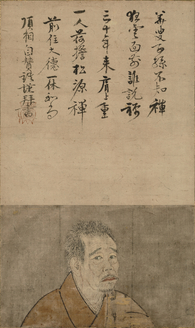
Ikkyu Sojun
A rebellious and eccentric Zen monk of the Muromachi period
1394-1481
Ikkyu Sojun was a Rinzai Zen monk priest of the Muromachi period (1336-1573). Sojun was his imina (personal name not used after death), and he was also known as Kyounshi, Katsuro, and Mukei, among other names. He is said to be have been the illegitimate son of Emperor Go-Komatsu, a view theory once questioned, but now accepted as fact. At the age of six, he entered Ankoku-ji Temple in Kyoto as an acolyte to the priest Shukan Zogai Shukan and was given the name Shuken. He left Ankoku Temple-ji and sought tutelage in a Rinzai Zen rinkamonastery outside the (as opposed to the gozanmonasteries of the Five Mountain temple system temple system under the protection and control of the shogunate. He first studied), which wasalso a Rinzai Zen temple, studying under Soi Kenno Soi, and later under Sodon Keso Sodon in Katada, Omi Province in Oumi-no-Kuni (present- day Otsu-shi, Shiga Prefecture). Both Soi and Sodon Keno and Kesofollowed the Zen teachings of Daito Kokushi (Shuoho Myocho, (1282-1337). Ikkyu Sojun He received the name Sojun from Kenno, and from Keso he received the dougou Buddhist name (a name given to one who attains enlightenment) Ikkyu, which means a pause, that is, a pause between the suffering owing to attachment to the passions and enlightenment. from Keso. Ikkyu means "one pause," referencing the rest in the space between suffering and enlightenment. After the death of his teacher, he traveled the country without settling in one place. Yet However, when the Onin-Bunmei war broke out in 1467, he fled, ending up in the fires and Yamashiro Province, where he revived Myosho-ji Temple, and later the temple Shuon-an Temple. He used this latter temple as his base for his religious activities., in Yamashiro-no-Kuni, using the latter as his base. The emperor, by decree, made him In 1474, he was made abbot of Daitoku-ji Temple in 1474, and he by order of the Emperor and worked assiduously to restore the temple's dilapidated buildings. Ikkyu died at Shuon-an on the 21st of the Eleventh Month in November 21, 1481, according to the lunar calendar, and. He is buried at the temple.
His books, which display an innate sense of style, include Kyoun -shu ("Crazy Cloud Anthology, "Crazy Cloud" being one of Ikkyu's sobriquets), Jikai shu ("Self Admonitions"), and Ikkyu gaikotsu (Ikkyu's Skeletons"Portrait of Bodhidharma"). At a time when the Zen world followed strict discipline, he was an iconoclasticunconventional monk. with an innate sense of style who He openly drank alcohol, and had relationships with many women. , and was known as an unconventional monk at a time when the Zen world followed strict discipline. Even in his later years, when he was into his 70s, he fell in love with a beautiful blind woman named Shinjija or Shinjo (woman of the forest)(also known as Shinjo).
In later Years later, he became a familiar figure known as "the witty "Ikkyu-san." of the tonchi stories," tales in which a young Ikkyu uses his wit to get the best of the adults. This notoriety resulted from came with the book Ikkyu-banashi ("Tales of Ikkyu"), published in 1668 by an unknown editor. Though some of these stories about him may be true to his life, others are likely invented, and many are thought to be based on tales of other people's eccentricities and wit, which that were then falsely attributed to Ikkyu.
Related People, Things and Events
Books
Biographies and critical biographies
Related Works
Paintings and calligraphic works by Sojun Ikkyu
Ikkyu in ukiyo-e paintings
Search for Important Cultural Properties
Videos
Past Exhibitions
| Title | shusai | Place | open | close |
|---|---|---|---|---|
Institutions Holding Related Materials
The National Diet Library (NDL), founded in 1948, is the library which belongs to the Diet. The NDL assists the activities of the National Diet. The Library collects and conserves materials and information both from Japan and abroad, serving as a foundation of knowledge and culture and providing library services to administrative and judicial entities and Japanese citizens.
As Japan’s representative museum, Tokyo National Museum collects, preserves, displays, and researches the cultural properties of Asia with a focus on Japan, and also provides educational programs.
Nara National Museum collects, preserves, displays, researches and provides educational programs about cultural properties with a focus on Buddhist art.
The National Archives is an organization for preserving, as historical materials, public records and archives of importance transferred from state organs, and providing them for public use, with the aim of achieving appropriate preservation and use of such public records and archives that are kept in the National Archives or state organs as historical materials.
Keio Museum Commons [KeMCo] functions as a "hub" of Keio's cultural assets, which spans a variety of fields including art, archaeology, literature, history, and medicine, and the educational and research activities behind it. At KeMCo, we aim to create a place where various communities can interact and generate new discoveries and ideas based on cultural properties (objects) in an environment where digital and analogue technologies are fused together.
The Art Research Center was established in 1998. Since then, the Center’s mission has been not only to conduct historical and social research and analyses of both tangible and intangible human cultural properties such as visual and performing arts and craftsmanship, but also to record, organize, preserve, and disseminate the research outcomes. To make the vast amount of database of resources on Japanese culture kept at the Art Research Center available to joint researchers in and outside of Japan, while providing the hitherto accumulated digital archiving and database management technologies as the basis for research project activities to promote information archiving and the circulating of joint research on knowledge. Through these undertakings, the Center aims to “become a world class research center” in the field of Digital Humanities.
The University of Tokyo is promoting the construction of digital archives. The University of Tokyo Archives, The University Museum, Information Technology Center, and University of Tokyo Library System collaborate on this project.
This institution strives to serve researchers in the field of Japanese literature as well as those working in various other humanities fields, by collecting in one location a massive archive of materials related to Japanese literature from all corners of the country.
京都府京田辺市薪里ノ内に所在する寺院。初め妙勝寺と称しており、鎌倉時代に臨済宗の高僧、大応国師(南浦紹明[なんぽしょうみょう])が中国で禅を学び、帰朝後に禅の道場を建てたのが始まりといいます。その後、元弘の戦火にかかり、復興されなかったのを、一休宗純が康正年間(1455-1457)に宗祖の遺風を慕って堂宇を再興、師恩に酬(むく)いる意味で「酬恩庵」と命名しました。
大阪府泉北郡忠岡町忠岡中に所在。コレクションとして、室町時代の「一休宗純と森像(しんぞう)」を所蔵しています。
東京都世田谷区上野毛に所在。コレクションとして「梅画賛 一休宗純筆」「一休宗純墨跡 偈頌」を所蔵。HPからも、前者はコレクション>絵画>日本絵画、後者はコレクション>書跡>墨跡へと進むと、作品を見ることができます。
東海旅客鉄道株式会社が運営するサイト「そうだ京都、行こう」のスタッフブログより。一休宗純の生涯を画像とともに紹介しています。また、一休宗純没後、延徳3年(1491)に一休帰依者の堺(大阪府堺市)の豪商尾和宗臨らによって、一休の塔所(たっしょ)として創建された大徳寺塔頭(たっちゅう)の真珠庵についても紹介されています。
External Links
日本仏教アソシエーションが運営するサイト「仏教ウェブ講座」より。一休宗純のとんち話とその生涯などを解説している。
公益財団法人「関西・大阪21世紀協会」HPより。
奈良国立博物館HPの収蔵品データベースより。
正木美術館が所蔵するコレクション「一休宗純と森像(しんぞう)」について解説している。
「文化遺産オンライン」より。根津美術館所蔵とされる重要美術品。長禄元年(1457)64歳の作。署名は「宗順」。
インターネットミュージアム事務局が運営するサイト「IM(アイエム)」のIMレポートより。2015年に開催された五島美術館での展覧会について解説している。
『集古十種』の画像を紹介している。
References
- サンプルページ「一休宗純」の項
- 「一休」の項
- 「一休」の項
- 「一休宗純」の項
- 「一休ばなし(仮名草子)」
- 「狂雲集」の項
- 西田正好 著,講談社
- 日本文化の会 編集,平凡社
- 今泉淑夫 校注,平凡社
- 歴史学研究会 編,岩波書店
- 一休 [著],校註: 中本環,現代思潮社
- [一休] [著],柳田聖山 現代訳注釈,早苗憲生 釈文・解題,禅文化研究所