Genji Monogatari (The Tale of Genji)
Genji Monogatari is a Japanese imperial tale written by Murasaki Shikibu during the Heian era. This fabulous story about Hikaru Genji, a royal prince, inspired many works of art.
Genji Monogatari, or ‘The Tale of Genji’, is a classic novel by Murasaki Shikibu written in the early 11th century. This 54-chapter novel presents the fabulous lives of the aristocracy during the Heian Era. The story recounts the life of Hikaru Genji, a royal prince, and the last 10 chapters, called Uiji Jujo, show the lives of his descendants after his death. He enjoys love affairs with many women, and by the end of the story attains a position of power after passing several obstacles. Hikaru Genji also experiences the darkest time of his life during his later years after he loses his dearest wife, Murasaki no Ue.
A literary critique in the Kamakura era, Mumyo Zoshi raved about the author Murasaki Shikibu saying, “Only an extraordinary person can write such a work.” The novel was not only enjoyed by the Heian nobles, but also inspired many artworks called Genji-e such as the Genji Monogatari Emaki (illustrated scrolls of the tale) and the Genji Monogatari-zu Byobu (folding screen with scenes from the tale). In modern days, many novelists and playwrights continue to retell the tale. The novel has also been translated into modern Japanese and other languages, and is highly regarded internationally.
The author of ‘The Tale of Genji', Murasaki Shikibu, was born in 975 as the daughter of Fujiwara no Tametoki, a poet and a scholar of Chinese classics. Growing up in this environment, she was also highly educated. Her older brother Nobunori, who was a poet like their father, died when he was young. Murasaki Shikibu married Fujiwara no Noritaka in 998 and they had a daughter, Kenshi, but sadly she lost her husband after only three years of marriage. Around 1005-1006, she served as a lady-in-waiting to Shoshi, a consort of the Emperor Ichijo, and she journaled about the life of the Imperial court in Murasaki Shikibu Nikki (The Diary of Lady Murasaki). She also left a collection of poems, Murasaki Shikubu Shu. It is believed that Murasaki Shikibu died around 1014.
Related People, Things and Events
Books
Ancient books
Emaki
Research books and other references
Major modern translations
Related Works
源氏の意匠
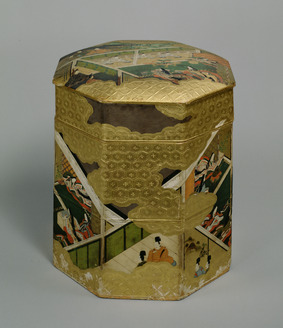
Boxes for the Shell-Matching Game with Scenes from The Tale of Genji
<p>Boxes like these held painted seashells for a shell-matching game. They were important in the wedding rituals of feudal lords, as shells with two hinged parts symbolized fidelity.<br /></p><br /><p>These are boxes for storing the pieces for a shell-matching game. The game involves matching up pairs of bivalve shells. At the start, 360 shell pairs are divided into left and right. The shells on the right are placed face down. The players pick a shell on the left and try to find the matching shell on the right. The player who finds the most pairs is the winner. Identical images of flora, fauna, or figures are drawn on the inner side of each pair to aid the matching process.<br /><br />Each bivalve shell has only one match, so the pairs were also used to symbolize faithfulness. This symbolism explains why these boxes for shell-game pieces played a large role in the wedding ceremonies of warrior families during the Edo period. The boxes featured prominently at the front of Daimyo bridal processions and were handed over to the groom's side as part of the ceremony.<br /><br />The boxes are extravagantly decorated in a manner befitting a lavish wedding ceremony. Gold leaf is pressed onto a coat of gofun, a pigment made from the shells of clams and other shells, with colorful, vivid scenes from The Tale of Genji painted on the surfaces.</p>
源氏物語貝合せ
『源氏物語』の場面が描かれた貝合わせ。「澪標」帖における住吉詣での場面が描かれる。
源氏歌加留太
『源氏物語』の54帖の各場面が描かれたかるた。各帖にちなんだ歌が読み札・取り札として書かれている。桐壺帖では、「いときなき初もとゆひになかき世を 契るこころはむすひこめつや」とある。
源氏かるた
『源氏物語』の各帖をモチーフとした絵と歌が描かれたかるた。本図は「空蝉」帖で、「うつせみの身をかへてけり(る)木のもとに なほ人からのなつかしきかな」という歌が書かれている。
Tebako (cosmetic box), Hatsunemotif from the Tale of Genji in maki-e lacquer
<p>画中に葦手の手法で書き込まれた文字から、これが『源氏物語』初音の帖にみえる歌「年月を松にひかれてふる人に けふ鶯の初音きかせよ」を主題とした意匠であることが知られる。慶賀の意を表わした、正月にふさわしいデザインである。 <br />(2004/12/07 or 2006/10/11 or 2008/01/02_h081 or h132) <br /></p>
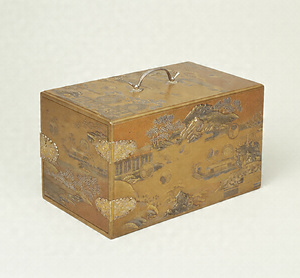
胡蝶蒔絵掛硯箱
胡蝶蒔絵も初音蒔絵調度と同じく千代姫の婚礼調度のひとつ。十件存在する。『源氏物語』胡蝶に基づく意匠で、六条院の春の庭で楽を奏し舟遊びをする様子が描かれている。
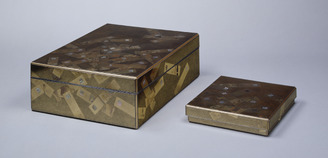
Writing Box and Writing-Paper Box with Paper Strips and Genjikō Symbols
<p> 川之辺一朝(かわのべいっちょう)は江戸浅草に生まれ、幕末から明治時代にかけて活躍した蒔絵師。明治期漆芸界の重鎮の一人であり、帝室技芸員に任ぜられている。この料紙硯箱は一朝晩年の作であり、円熟のきわみともいうべき上品で落ち着いた趣をみせている。<br /></p>
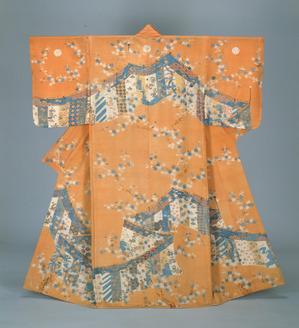
Kimono (Kosode) with Curtains Featuring Autumn Leaves
<p>This garment, called a kosode, or “small sleeve,” for its small wrist openings, became the model for the modern kimono. Its motifs of curtains and autumn foliage make use of indigo for a striking contrast with the orange ground. Long curtains like those pictured were made of many joined pieces of cloth and used to enclose areas. In combination with autumn leaves, they evoke the chapter “An Autumn Excursion” from the Heian-period (794–1192) novel The Tale of Genji. Basing clothing designs on a work of literature is characteristic of Japanese artistic expression.<br /><br />The curtains are decorated with auspicious overlapping circles, scale-like waves, and other traditional patterns that were used at the imperial court since ancient times. The detailed patterns on the curtains and autumn leaves were created using a dyeing technique called yūzen. In yūzen dyeing, the outlines of patterns are drawn using fine lines of paste. Colored dyes are then brushed onto the fabric so that the dye stays within the paste outlines to create pictorial designs. Even flower petals are depicted with colorful gradations. The front and back of the garment form a single continuous pattern. It was likely designed to be displayed as well as worn.<br /><br />This garment is thought to have been worn by a wealthy townswoman. The design on the sleeves cuts off partway, suggesting that it was originally a long-sleeved garment for an unmarried woman and that the sleeves were cut short after her marriage.</p><br /><p>The design of this kimono was hugely popular in the latter half of the Edo period (1603–1868). Featuring curtains with fall foliage, it is based on the chapter titled An Autumn Excursion from the 11th-century Japanese literary masterpiece, [The Tale of Genji].<br /></p>
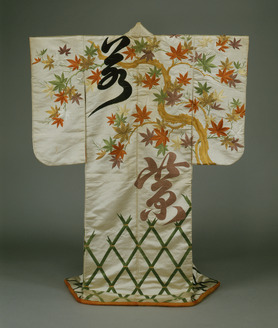
Kimono (Furisode) with Maple Leaves, Bamboo Fences, and Calligraphy
<p>『源氏物語』の若紫帖(わかむらさきのじょう)がモティーフです。紅葉の模様は、光源氏が紫の上を自邸に迎えた季節を意味するのでしょう。江戸時代に刊行された小袖のデザインブック『当流模様 雛形松の月』(元禄10年〈1697〉刊)には同じデザインが掲載されています。<br /></p>
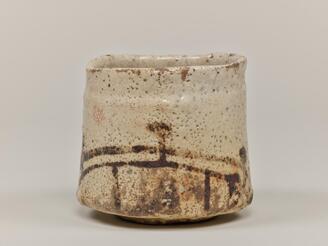
Tea Bowl, Named “Hashihime (Princess of the Bridge)”
<p>This large, cylindrical tea bowl was used for drinking powdered green tea. The unique colors and textures of the ground can be glimpsed through the semi-transparent white glaze. It is also decorated with free, unrestrained drawings of a bridge and a simple hut with thatched roof. This is why it is known as 'Hashihime,' which translates as 'Bridge Maiden.'<br /><br />When viewed from the side, the bowl appears short and stout, with the base wider than the body, while the mouth presents a warped elliptical shape when viewed from above. The best way to appreciate a tea bowl is to imagine taking it in your hands and drinking from it. With its grand size and warped mouth, this rugged bowl must feel quite hefty and perhaps it would be difficult to drink from. Its production dates from the Azuchi-Momoyama period to the start of Edo period. This was a time when tea ceremonies were popular among the warrior class. The powerful, unconstrained shape probably reflects the aesthetic sensibilities of that time.</p>

Videos
Past Exhibitions
| Title | shusai | Place | open | close |
|---|---|---|---|---|
Institutions Holding Related Materials
愛知県名古屋市に所在。「源氏物語絵巻」や『源氏物語』「初音」の意匠をあしらった婚礼調度品「初音の調度」(いずれも国宝)を所蔵している。
京都府京都市に所在。重要文化財の「源氏物語絵色紙帖」のほか「源氏物語図」などを所蔵。
京都府宇治市に所在。『源氏物語』に関する資料の収集・保管のほか、復元模型や映像の展示を行っている。
東京都立川市に所在。『源氏物語』をはじめとする多くの古典籍を閲覧できるほか、関連サイト「古典選集本文データベース」には「絵入源氏物語データベース」もある。
早稲田大学図書館九曜文庫(くようぶんこ)の「源氏物語」関係コレクション。古写本、版本、絵画資料などを閲覧できる。
References
- 小学館