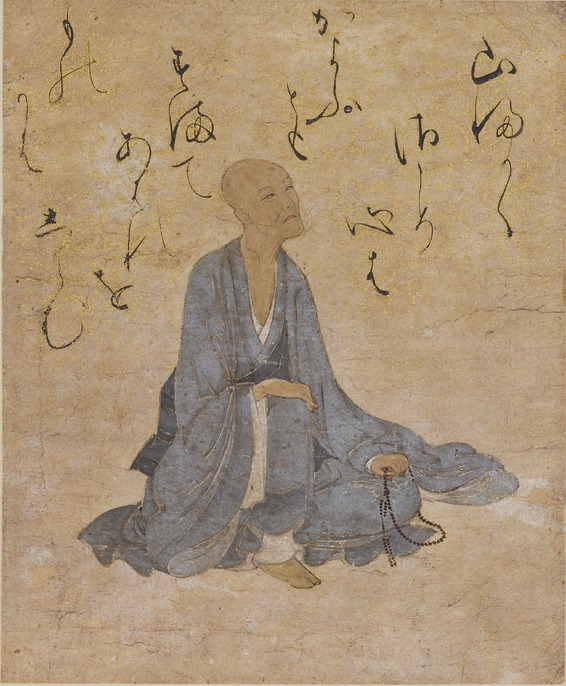
Saigyo
A poet of the late Heian period; he forsook his life as a warrior to become a monk, travel across Japan, and create his own style of poetry
1118–1190
Saigyo was a poet and monk in the late Heian period. His secular name during his time as a samurai was Norikiyo Sato. After he became a monk, he took the name Saigyo. His religious name was En’i. He served as a northern guard under Emperor Toba, but at age 23 he shocked the public by becoming a monk. While there are many theories as to why he chose to do so, the answer remains unknown. Saigyo showed talent in poetry from a young age and is highly esteemed in the treatise on poetry Gotoba-in on kuden (The Oral Teachings of Cloistered Emperor Gotoba). After becoming a monk, Saigyo set up a simple home outside of Kyoto and made numerous pilgrimages, traveling on foot to places from Mutsu Province in northern Japan to the Chugoku and Shikoku regions. He enjoyed traveling throughout his life and wrote about his emotions and experiences with nature in his travels, creating his own unique style of poetry. Partly for this reason, traveling to many places, or individuals who do so, are often called “Saigyo.” Saigyo’s poetry collections include Sanka shu (Poems of a Mountain Hermitage), which contains about 1,500 poems, Saigyo shonin shu, and Kikigaki shu. He also wrote the essay on poetry Saigyo shonin dansho (Conversations with Saigyo).
The waka Japanese poetry anthology Shin kokin waka shu (New Collection of Poems Ancient and Modern) contains 94 of Saigyo’s poems, more than those of any other poet. Saigyo monogatari emaki (Illustrated Scroll of the Story of the Monk Saigyo), a picture scroll created in the Kamakura period (1180–1333), depicts Saigyo’s life and achievements. One famous image, Fujimi Saigyo, shows Saigyo from behind, wearing a sedge hat and straw cape, gazing at Mount Fuji.
Related People, Things and Events
Books
Books written by Saigyo
Bibliographies
Related Works
西行筆と伝える古筆切
Videos
Past Exhibitions
| Title | shusai | Place | open | close |
|---|---|---|---|---|
External Links
大阪府南河内郡河南町に所在。西行の八百年遠忌を記念し、入寂の地である弘川(ひろかわ)寺に建設されました。西行に関わる弘川寺伝来の寺宝をはじめ、弘川寺を訪れた文人墨客の名品を多数展示しています。館内には西行文庫が併設されており、歌人や俳人から寄贈された私家集を収蔵しています。
京都大学図書館機構が運営するサイト「京都大学貴重資料デジタルアーカイブ」より。奈良絵本(朱・緑青・金・銀などで色彩あざやかに描かれた挿絵がついた、物語の本。室町時代半ばから江戸時代初期に作られた)の『西行物語』全4冊を閲覧することができる。
上掲と同じ京都大学図書館機構が運営するサイト「京都大学貴重資料デジタルアーカイブ」より。『西行物語』のあらすじを挿絵とともに解説している。
大阪府和泉市に所在する和泉市久保惣記念美術館のHPより。デジタルミュージアムの「キーワードから探す」で、作品名に「西行」と入力して検索する。
静岡県熱海市に所在するMOA美術館のHP。トップページの「コレクション」をクリックし、キーワードに「西行」と入力して検索すると、俵屋宗達筆の「西行物語絵巻断簡」と鎌倉時代の「西行像」の画像を見ることができる。
和歌山県観光振興課が運営するサイト「わかやま歴史物語100」より。トップ画像右側の人物をクリックし、「さ」を選択すると「西行法師」が閲覧できる。その中の「諸国行脚の歌人 西行が歌い歩いた道を行く」がお勧めコース。
大阪府南河内郡の河南町HPより。河南町は西行入滅の地。西行の生涯が、平易な文章で解説されている。
References
- 目崎徳衛 著,吉川弘文館
- 小松茂美 編,中央公論社
- 「西行」の項
- 「西行」の項
- 「西行」の項
- 「西行」の項
- 歴史学研究会 編,岩波書店