Sanetaka Sanjonishi
A courtier and scholar of the late Muromachi period (c. 1467 – 1573). Received instructions in the secret traditions of Kokin Waka Shu (“Collection of Ancient and Modern Japanese Poetry”) ,the so called Kokin-denju from Sogi, and emerged as an authority on Genji Monogatari (“The Tale of Genji”) and Ise Monogatari (“The Tales of Ise”). Sanetaka Sanjonishi was a literary figure also known as one of the best calligraphers of his generation.
1455-1537
A courtier and scholar of the late Muromachi period (c. 1467 – 1573). Born on April 25, 1455 as the second son of Kinyasu Sanjonishi. His given name was Kimiyo. His maternal grandfather was Fusanaga Kanroji. The Sanjonishi Family was a branch of the Ogimachi-Sanjo Family, which in turn was descended from the Sanjo Family. In the society of court nobles of that period, the Sanjonishi Family belonged to the upper middle class, and its name originates from the fact that the Sanjonishi estate was located on the west (“nishi” in Japanese) side of the Ogimachi-Sanjo Family estate.
In 1458, after the early death of his older brother Sanetsura, Kimiyo was conferred peerage at the age of four and took the name Kiminobu. In 1460, his father Kinyasu passed away, and in 1469, at the age of 15, Kiminobu conducted a ritual to celebrate his coming of age, and took the name Sanetaka. He served four emperors—Gohanazono, Gotsuchimikado, Gokashiwabara, and Gonara—and reached the position of naidaijin (literary “Inner Minister”). As a court noble, he scrupulously performed his duties of connecting the Emperor’s Court with the Shogunate, and at the same time applied his knowledge of court rules, ceremony, decorum and records of the past in order to preserve the traditions and rituals of the imperial court. Sanetaka also worked to revive the classics by gathering and copying Japanese and Chinese books dispersed or lost during the wars.
He studied Japanese poetry under Masachika Asukai using the pen name Chosetsu, and listened to Sogi’s lectures on Genji Monogatari (“The Tale of Genji”) and Ise Monogatari (“The Tales of Ise”) with Shohaku Botanka as an intermediary. In 1501, Sanetaka received instructions from Sogi in the secret traditions of Kokin Waka Shu (“Collection of Ancient and Modern Japanese Poetry”), the so-called “Kokin denju”), and also cooperated in the compilation of Sogi’s Shinsen Tsukuba Shu (an anthology of renga (linked verse) poems). Sanetaka also possessed profound knowledge of Chinese poetry and prose achieved through communication with Ryutaku Tenin, Jukei Gesshu, and other Zen monks from the Five Mountain System. These qualities made Sanetaka one of the preeminent literary figures of that period, respected both by court nobles and warriors. He entered into priesthood in 1516 under the Buddhist name Gyouku. Upon achieving enlightenment, Sanetaka was awarded the name Koin, and his posthumous Buddhist name was Shoyoin. He was also known as a skilled calligrapher, much of it preserved to this day, including on both tanzaku (strips of paper) and shikishi (square pieces of paper for writing poetry), on which he replied to requests from local lords, as well as copies of classic texts, captions to picture scrolls, draft poems, letters, etc. His works include Genji Monogatari Sairyusho (an annotated edition of the “The Tale of Genji”); Tatara Mondo (a manual on court rules, ceremony, decorum and records of the past); the private poetry collection Setsugyoku-shu; and the poetry diary Saishoso. Sanetaka passed away on October 3, 1537, at the age of 83. He was laid to rest in Nison-in Temple in Saga, Kyoto. Sanetaka had three sons, including his successor Kineda, and two daughters.
Sanetaka Koki (literary “Lord Sanetaka’s Diary”) is a diary that Sanetaka began writing in 1474, when he was 20 and kept for 63 years, until 1536, the year before his death, when he was 82. The diary is a basic historical source of information about the political and social issues of the late Muromachi period (c. 1467 – 1573). The handwritten original, which consists of 106 rolled scrolls, one folded book, and 44 booklets, is preserved in the Historiographical Institute of the University of Tokyo, and has been designated an important cultural property.
Related People, Things and Events
Sogi
室町時代の連歌師。三条西実隆は宗祇から古今伝授を受け、宗祇の『新撰菟玖波集』編纂にも協力した
Tosa Mitsunobu
Worked as azukari in the bakufu (military government) Painting Office, and brought the Tosa School to its apogee 1434?-1525?
Connoisseur Attendants (doboshu)
A group of cultured men in the service of Ashikaga shoguns who practiced art criticism and a wide range of performing arts during the Muromachi period
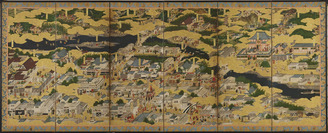
Rakuchu Rakugai-zu: Views in and Around the City of Kyoto
Rakuchu Rakugai-zu are paintings that depict the landscape of Kyoto and its suburbs from a bird's eye view.
Books
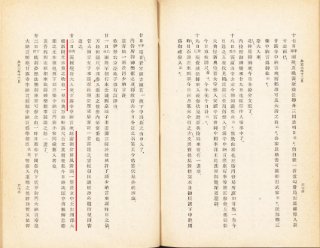
実隆公記 永正3年12月22日
三条西実隆 弄花抄
三条西実隆 細流抄
三条西公条 明星抄
惟清抄
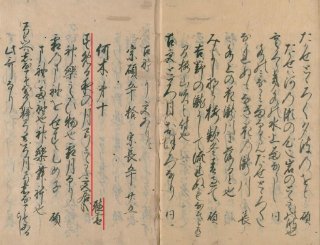
伊勢千句註
源氏物語系図
高野参詣日記(『群書類従』 紀行部12)

雪玉集


A copy of Sanjonishi Sanetaka's own handwritten manuscript
三条西実隆等書写 源氏物語
三条西実隆書写 伊勢物語
三条西実隆書写 本朝文粹 巻六
三条西実隆書写 本朝文粹巻六奥書
三条西実隆書写 古今和歌集
Related Works
Part of Volume 30 of Governing Principles of Ancient China
星光寺縁起絵巻 詞書巻上
Three Poems on Waka Kaishi by Sanjonishi Sanetaka

Kakinomoto no Hitomaro by Tosa Mitsushige
三条西実隆墓(『京都府写真帖』)口絵
肖像(『大日本名家肖像集』)
letters,strip of paper
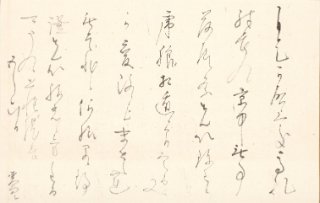
九条家宛 三条西実隆書状
九条家宛 三条西実隆書状
Letter by Sanjonishi Sanetaka
Letter by Sanjonishi Sanetaka
Letter by Sanjonishi Sanetaka
中院通秀宛 三条西実隆書状

Tanzaku by Sanjonishi Sanetaka

Tanzaku by Sanjonishi Sanetaka

Tanzaku by Sanjonishi Sanetaka
Tanzaku by Sanjonishi Sanetaka
Tanzaku by Sanjonishi Sanetaka
August 21, the first year of the KyouRoku era,Sanjonishi Sanetaka's
Institutions and External Links
References
- 『日本大百科全書(ニッポニカ)』(JapanKnowledge)「三条西実隆」の項
- 『改訂新版 世界大百科事典』(JapanKnowledge)「三条西実隆」の項
- 『国史大辞典』(JapanKnowledge)「三条西実隆」の項
- 中古文学資料解題①(国立公文書館「北の丸」49号所収)『惟清抄』。
- 中古文学資料解題②(国立公文書館「北の丸」50号所収)『弄花抄』『細流抄』『明星抄』。
- 三条西実隆芳賀幸四郎 著,吉川弘文館
- 柴田真一 「関西大学図書館所蔵三条西実隆書状について」 (中世公家日記研究会編『戦国期公家社会の諸様相』)
- JapanKnowledge所収コンテンツの最終アクセス日は、いずれも2023/02/10。