Celadon (Seiji)
Ceramics based on blue and green colors, representing the East.
Celadon is ceramics with blue coloration created by firing the iron contained in the glaze and clay in a reducing flame. Originating in China, the technique was introduced throughout East Asia and exported to West Asia and Europe. This section introduces celadon from China, the birthplace of celadon, from the Korean Peninsula, where the elegant "Goryeo celadon" blossomed, and from Japan, where firing began in the early Edo period.
Chinese Celadon
The origin of celadon is said to have dated back to plant ash glazed ceramics in the early Shang (Yin) Dynasty (16th century B.C.-11th century B.C.) in China. Ash glazed ceramics of this period, which are grayish brown or dark brown in color, are also called "primitive celadon", in the sense that they are the prototype of celadon. With improvements over the years, such ash glazed ceramics were developed into celadon after gaining a beautiful blue-green hue.
Full-scale celadon manufacturing began in the Yue-zkou kilns in northern Zhejiang Province during the Later Han Dynasty (25-220). Old celadon wares from the Yue-zhou kilns are called "Old Yue ware", and a wide variety of wares were produced in celadon from the Three Kingdoms period (220-280) to the Western Jin Dynasty (265-316). In particular, many burial goods from the tombs of aristocrats have been excavated, and unique shaped forms such as Shenting (spirit pavilion) jars and Tianqi (chicken head) jars can be seen. After that, the Yue-zhou kilns temporarily stagnated, but after the Middle Tang Dynasty (late 8th - early 9th century), the new-born Yue-zhou kilns emerged, and during the Five Dynasties period (907-960), under the protection of Wuyuan Country, they produced graceful celadon called "hisoku (secret color)" and presented them to the Imperial court.
During the Song Dynasty (960-1279), considered the golden age of Chinese ceramics, celadon wares with more brilliant colors and refined designs were produced at kilns in various regions. During the Northern Song Dynasty (960-1127), Yao-zhou kilns in Shaanxi Province produced celadon wares featuring olive green glazes, and Ju kilns in Henan Province produced elaborate celadon wares for the Imperial court. During the Southern Song Dynasty (1127-1279), the official kilns established in the capital (present Hang-zhou) produced refined celadon wares. In addition, the Longquan kilns in Zhejiang Province produced celadon with a powder blue glaze that resembled jade. Many powder blue celadon wares of the Longquan kilns were brought to Japan from the Kamakura period (1185-1333) to the Muromachi period (1336-1573), and were called "Kinuta celadon," and were highly prized as the finest of celadon.
Korean Celadon
Celadon on the Korean Peninsula is thought to have emerged in the early Goryeo period (9th-10th century) under the influence of the Yue-zhou kilns of China. Later, while absorbing various elements of Chinese ceramics, "Goryeo celadon" was perfected in the mid-Goryeo period (12th century), with the beautiful glaze tint called "hishoku (jade color)" and graceful decoration that reflected the aesthetic sense unique to Goryeo. In the mid-12th century, "inlaid celadon porcelain", in which patterns were carved into the base material and then inlaid with white or red clay, developed rapidly. In the 13th century, "cinnabar celadon porcelain", in which red patterns are painted on a base with copper-based pigments, was born.
Kiseto ware
Japanese Celadon
Celadon porcelain brought from China and Korea, has long been cherished in Japan, but it was the Imari wares of Arita (Saga Pref.), the oldest porcelain in Japan, that initiated full-scale celadon firing in the early Edo period (17th century). At kilns directly managed by the Saga Domain (Nabeshima Domain), "Nabeshima celadon" was invented using a unique technique of adding blue patterns to celadon, and was used as a tribute to the shogun family. In the late Edo period, celadon was produced at kilns in Kyoto, Sanda (Hyogo Pref.), Kotou (Shiga Pref.), Zuishi (Wakayama Pref.), and other areas, and was popular for a time. After the Meiji period (1868-1912), potters studied Chinese ceramics and reproduced old ceramics, and eventually began to create their own unique expressions of celadon.
Large Footed Dish with a Peony
Dish with Gourds
Large Dish with a Tiger and Bamboo
Incense Burner, Celadon glaze with design in openwork
Incense burner, Koto Ware, Design of peony scroll with celadon glaze
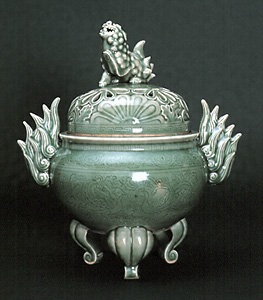
瑞芝焼 青磁鳳凰文獅子鈕香炉
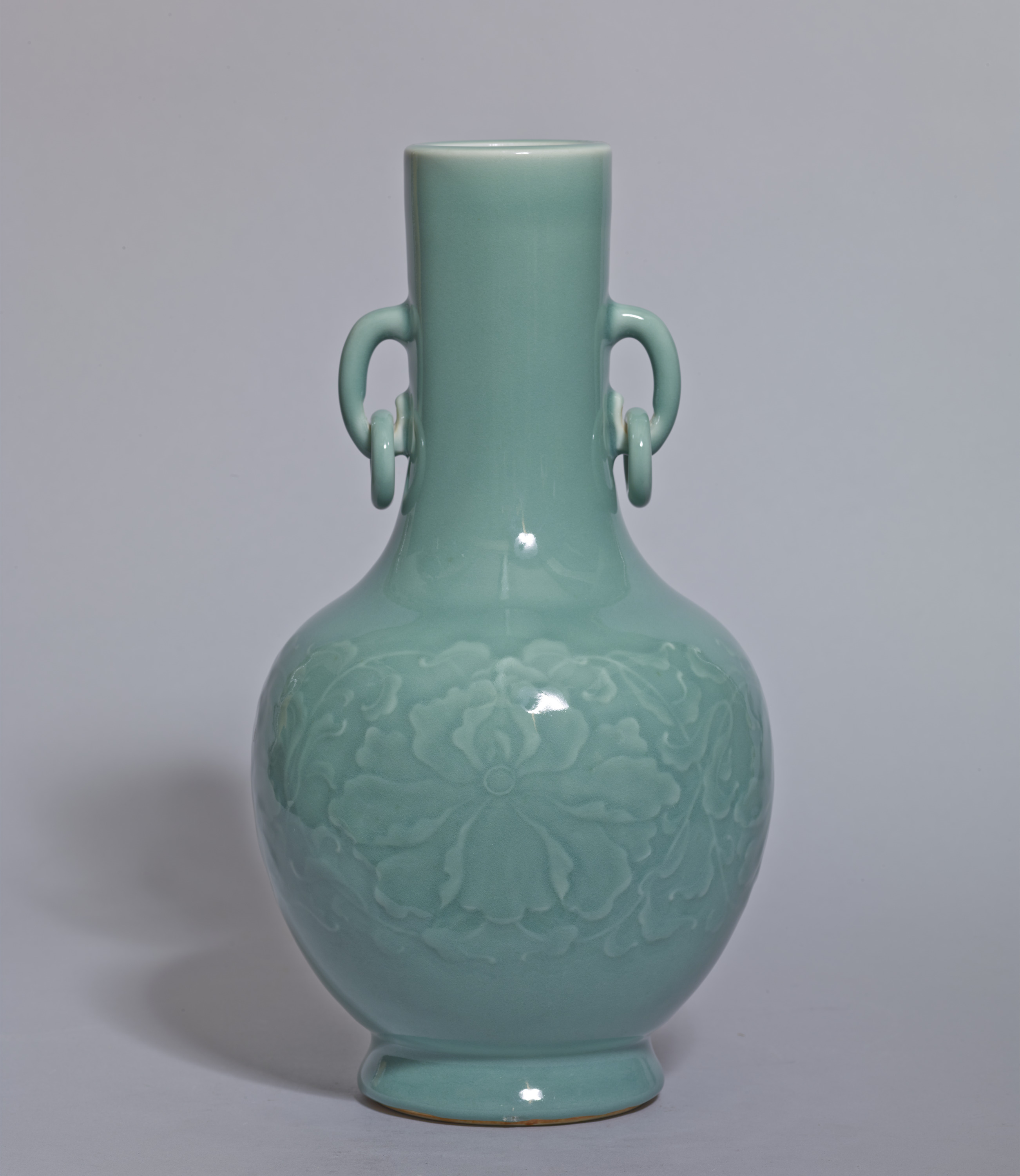
Vase with Handles
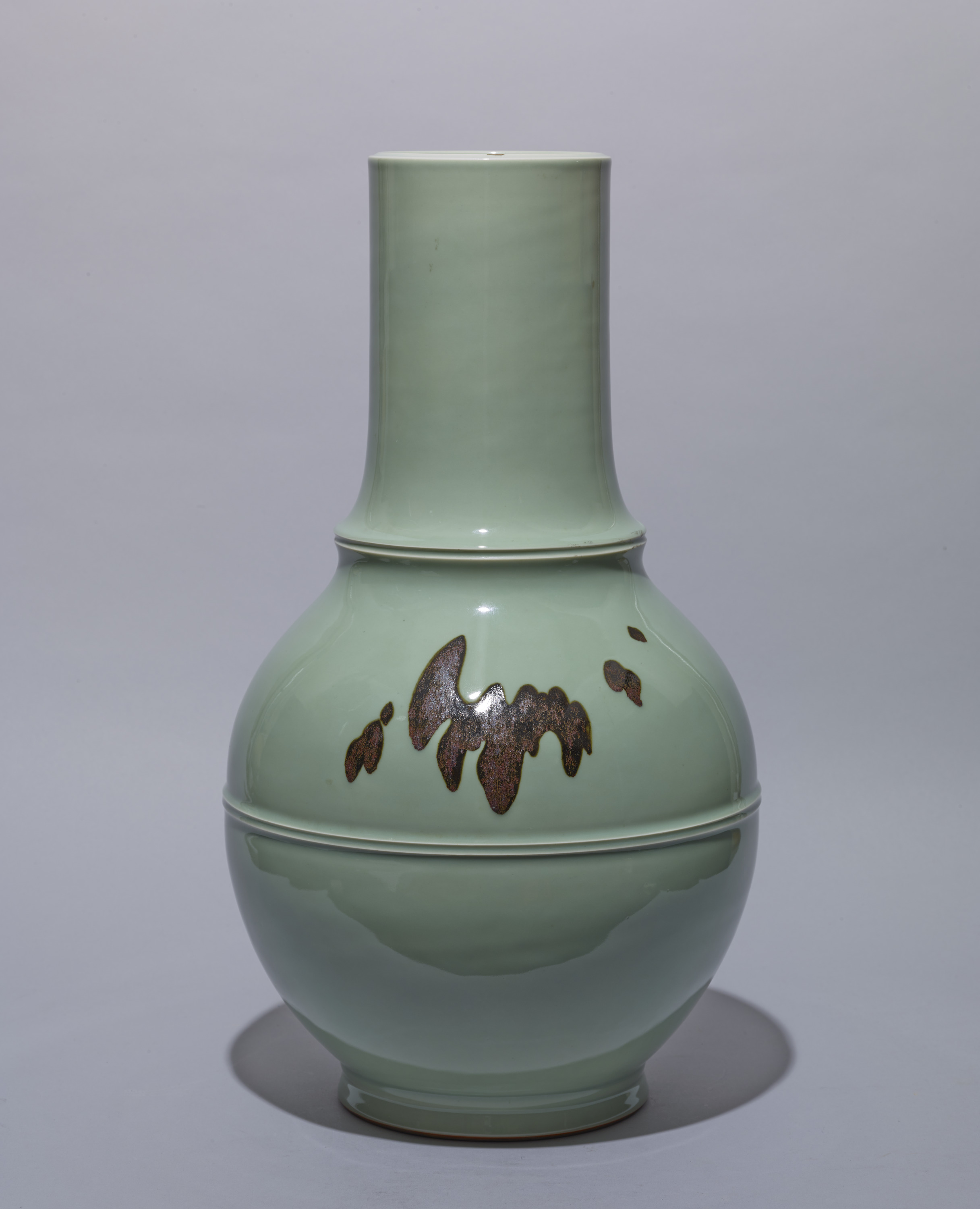
Large Vase with Marks in Iron Pigment
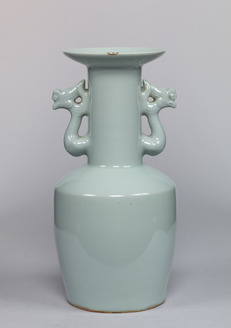
Vase with Phoenix Handles
Related People, Things and Events
References
- 長谷部楽爾 監修,平凡社
- 赤沼多佳, 伊藤郁太郎, 片山まび 編著,講談社
- NHK「美の壺」制作班 編,日本放送出版協会
- 阿部出版