The Landmarks of Edo (For Educational or Commercial Use)
Famous sightseeing spots in Edo (present-day Tokyo) seen through nishiki-e (multi-colored woodblock prints) from the Edo period (1603-1867)
With improvement and development, the city of Edo attracted visitors as sightseeing spots sprang up one after another. Seasonal excursions to temples and shrines, cherry blossom viewing, etc., which had been enjoyed only by the samurai class until the beginning of the Edo period, eventually spread to the townspeople as well. We would like to show the vibrant notable places of the city through works of "meisho-e" (woodblock prints of landscapes), which were supported by the Edo citizenry's interest in its sightseeing spots, as it became one of the main genres of nishiki-e.
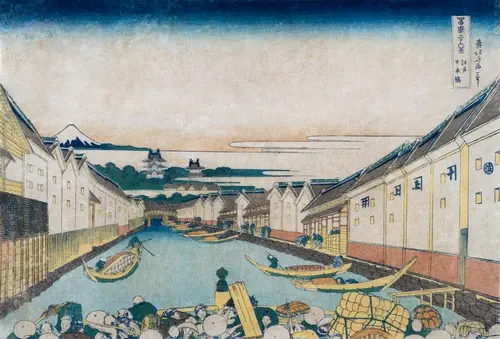
Nihon-bashi Bridge
In the Edo period, Nihon-bashi Bridge was designated as the starting point of the Five Highways (Tōkai-dō, Nakasen-dō, Nikkō-kaidō, Ōshū-kaidō, and Kōshū-kaidō). Many people came and went over the bridge, and cargoes brought by ships from various places were discharged on the surrounding riverbanks. The Nihon-bashi area was developed as a key point for transportation and distribution for land and sea. A wholesale district was formed in the area, and white-walled storehouses of wholesalers stood side by side along the Nihonbashi-gawa River. In the fish market on the east side of the north end of the bridge, fresh fish caught in Edo-wan Bay and Sagami-wan Bay were lined up in front of stores, where they were energetically traded. Meanwhile, from the south end of the bridge, Tōri 1-chome, the main street of Edo, extended and was lined with large stores including Shiroki-ya, one of the three major kimono stores in Edo, and Suhara-ya, a book wholesaler. Mitsui Echigoya, a kimono store known for its "cash only, no discounts policy", was originally located on this street, but in 1682 relocated to Suruga-cho, where it had a direct view of Mt. Fuji.
Asakusa
Sensō-ji Temple has long been famed for its belief in the Kannon Bodhisattva. During the Edo period, the temple received the patronage of the Tokugawa shogunate government as a place of prayer, and became one of the major sites of the Kannon pilgrimage in the Kanto region, popularly known as "Asakusa Kannon". The area around Sensō-ji Temple, often crowded with visitors, flourished as a temple town, and gradually became the foremost amusement quarter in Edo after the Yoshiwara red-light district was moved to Nihonzutsumi in the northern part of Asakusa in 1657. In 1842, three kabuki theaters, Nakamura-za, Ichimura-za, and Morita-za, moved to Saruwaka-cho, northeast of Sensō-ji Temple, to form the largest theater town of Edo and spur Asakusa's prosperity. Many seasonal events were held in Asakusa, such as the Asakusa Festival in March held jointly by Sensō-ji Temple and Asakusa Shrine, the Hōzuki (chinese lantern plant) Fair in July, and the December's Year-end Fair held inside the precincts of Sensō-ji Temple, there was cherry blossom viewing at the Matsuchiyama-shōden Shrine, and the Rooster Fair at Ōtori Shrine in November.
江戸名所 猿若町芝居顔見世繁栄の図
猿若町芝居之略図
Ueno
In 1625, Tenkai, a high priest of the Tendai Buddhist sect, built Kan'ei-ji Temple with the help of the Tokugawa family in order to pray for the protection of Edo Castle. Later, after the mausoleum of the fourth Shōgun Tokugawa Ietsuna was built there, the temple was also expanded, with a vast temple area of approximately 245 acres, as a family temple of the shogun family. Kan'ei-ji Temple was built in the image of Enryaku-ji Temple in Mt. Hiei, which protects the demon's gate of the Imperial Palace in Kyoto. Therefore, the temple's buildings were modeled after famous temples in the Kyoto area, such as the Kiyomizu Kannon Hall which resembles the Kiyomizu-dera Temple in Kyoto, and the Shinobazuno-ike Benten Hall which resembles the Hōgon-ji Temple on Chikubu-shima Island in Lake Biwa. In addition, cherry trees were planted throughout the temple precincts, many of which had been transferred from Mt. Yoshino in Nara, and the temple became famous as a cherry blossom viewing spot. A fire prevention area was built in Yamashita, in front of the Kan'ei-ji Temple gate, and from there, crossing the Sanmai-bashi Bridge over the Shinobu-gawa River, one can reach Shitaya Hirokoji (Ueno Hirokoji). This neighborhood was a lively place filled with restaurants, teahouses, freak-show tents, etc.
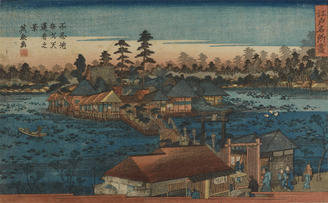
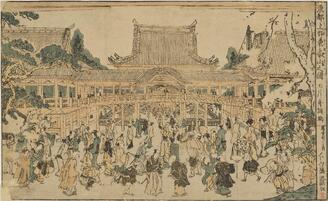
Kan'eiji Temple in Ueno of the Eastern Capital
Ryogoku
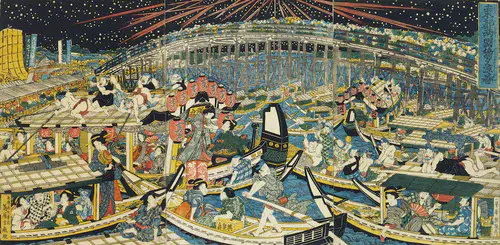
Following the great fire of Meireki, the Ryogoku-bashi Bridge was built in 1661 to connect the provinces of Musashi and Shimousa, and became a new landmark in Edo. Ekō-in Temple was built at the east end of the bridge to bury those who perished in the fire, and a hirokōji (wide street) was built at the west end as a firebreak. Later, this area was developed as one of the busiest amusement spots of Edo, which was filled with show tents, freak shows, teahouses, etc. From May 28 to August 28 of the lunar calendar, a cooling down period of the Sumida-gawa River, where food stalls and freak shows were allowed to open at night along the main street and the river. The river was filled with boats for banquets run by shipping agents and restaurants, and fireworks were set off on the first day of the river festival, which became a summer tradition of Edo. From the mid-Edo period onward, masters of big stores sponsored the fireworks display which lit up the night sky almost every night during the evening cooling down period. In the latter half of the Edo period, kanjin-zumō (sumo tournaments to raise funds for the construction of temples and shrines) started on the grounds of Ekō-in Temple, and from 1833, became regular events held twice a year in spring and fall, as they were very popular.
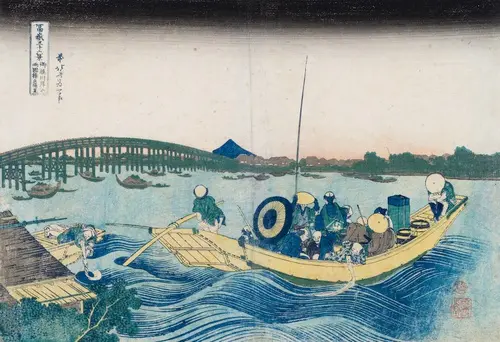

“Fireworks at Ryōgoku Bridge” from the Series One-Hundred Famous Views of Edo
Asukayama
The name Asuka-yama is said to have originated from the medieval lord Toshima, who made a branch shrine of the Asuka-myōjin Shrine of Kishu (present-day Wakayama) there. The area is located on the Ueno Plateau, and from the top of the cliff, the Ara-kawa River lowlands below were able to be seen as far as Mt. Tsukuba and the Nikko mountain range. By order of the 8th shogun, Tokugawa Yoshimune, approximately one thousand cherry trees, azaleas, red pines, maples, etc., were planted so that the common people could easily enjoy cherry blossom viewing, and the area became one of the representative cherry blossom viewing spots of Edo.
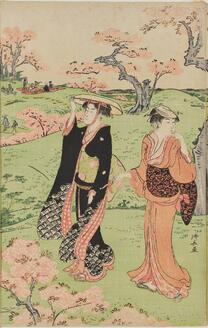
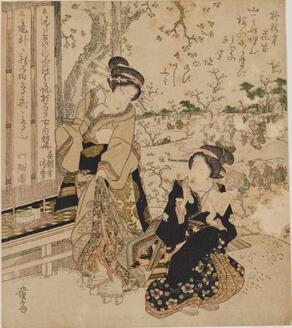
Blossoms on Asuka Hill in the Eastern Capital from the Series Outstanding Views of Snow, Moon, and Flowers
Kameido
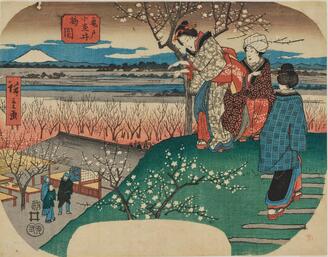
Kameidozaifu-Tenmangu Shrine (present-day Kameido Tenjin), a branch of Dazaifu-Tenmangu Shrine in Fukuoka, was built in 1663, where a god of learning was worshiped by the common people of Edo. The Shinji pond in the precinct has two arched bridges, one large and one small (or a male and a female), and was known as one of the best wisteria viewing spots in Edo. Umeyashiki in the villa of Iseya Kiemon, located behind Kameido Tenmangu Shrine, was a famous ume plum garden with about three hundred ume trees planted, and was particularly famous for its "Garyūbai", an old tree in the shape of a dragon crawling through the ground.
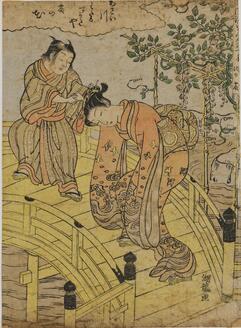
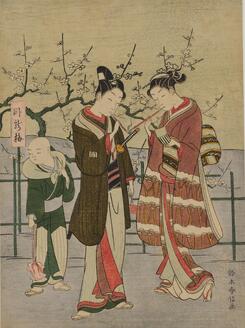
The Plum Garden
Shinagawa
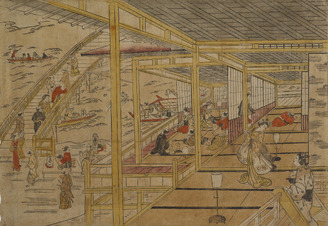
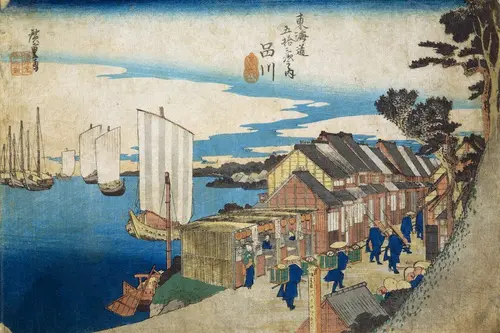
Shinagawa has prospered as a port town since before the Edo period. In the Edo period, Shinagawa was designated as the first post town on the Tokaido Highway, which was lined with inns, restaurants, and brothels, and was crowded with many people. From the second floors of the restaurants and brothels on the east side of the highway, visitors were able to enjoy a magnificent view of the sea, and Shinagawa was the second largest after Yoshiwara, in terms of the scale of its red-light district. In the Edo period, Shinagawa was a year-round resort where visitors could enjoy all four seasons: clam digging in the shallow sea in early spring, cherry blossom viewing at Gotenyama in spring, and autumn leaf viewing at Kaian-ji Temple in fall.
関連するひと・もの・こと
Paintings of Famous Places (Meisho-e)
A paintings of a famous site, often painted continuously across different panels of a folding screen or latticed sliding doors in the same room—a tradition passed on from the Heian to Edo period
Nishiki-e
Nishiki-e is the generic term for the Ukiyo-e multi-colored woodblock prints which were developed and popularized during the Edo era.
Meisho Edo hyakkei (One Hundred Famous Views of Edo)
A series of woodblock prints of famous views of Edo from the final years of Hiroshige Utagawa I, one of the great print artists of the Edo period
Fireworks at Ryogoku
Fireworks near Ryogoku Bridge, which started in the Edo period, is a gorgeous summer tradition in Tokyo
Hiroshige Utagawa
A ukiyo-e artist of the late Edo period who influenced Vincent van Gogh
Hokusai Katsushika
A master of ukiyo-e prints in the late Edo period, known also for his eccentricities
Utagawa Toyokuni
A master painter of actor portraits who surpassed even Sharaku in popularity
Torii Kiyonaga
An Ukiyo-e artist in the middle of the Edo period(1603-1867), who swept the world with paintings of beautiful well-proportioned women.


References
- [歌川広重 画],堀晃明 著,人文社
- 洋泉社
- 小林忠 監修,東京伝統木版画工芸協会 編,芸艸堂