Hokusai Katsushika
A master of ukiyo-e prints in the late Edo period, known also for his eccentricities
1760–1849
Hokusai Katsushika was an ukiyo-e painter of the late Edo period. Born in Honjo, Edo, he is believed to have been adopted by Ise Nakajima, an artisan who made mirrors for the shogun. His childhood name was Tokitaro, which was later changed to Tetsuzo. Hokusai was an art pseudonym that he used for a while, but he is said to have used over 30 pseudonyms, including Gakyojin, Taito, Iitsu, and Manji. Though he was fond of drawing from an early age, he did not aspire to become an ukiyo-e artist until 1778, when he entered the school of Shunsho Katsukawa, known at the time as a master of pictures of actors. The following year, Hokusai produced an actor work using the name Shunro Katsukawa. He created illustrations for books that became popular around the beginning of the Bunka era (1804–1818). Together with the author Bakin Kyokutei, he created classic works such as Shinpen suikogaden (A New Edition of The Water Margin in Pictures) and Chinsetsu yumiharizuki (Strange Tales of the Crescent Moon). Thereafter, he broke new ground in the genre of landscape and nature paintings, creating bold and unconventional compositions. From around the beginning of the Bunsei era (1818–1830) through early Tenpo era (1830–1844), Hokusai produced many series of ukiyo-e landscape masterpieces, including Fugaku sanjurokkei (The 36 Views of Mount Fuji), Shokoku taki meguri (A Tour of Waterfalls in Various Provinces), Chie no umi (Oceans of Wisdom), and Shokoku meikyo kiran (Remarkable Views of Famous Bridges in Various Provinces), bringing him into prominence as a master landscape artist alongside Hiroshige Utagawa.
Hokusai manga, a picture book he created, is another one of his masterpieces. Encyclopedia-like in content, the series was continued by other artists even after his death. His work made a great impact on artists in the West, including the Dutch painter Vincent van Gogh, who saw the dynamic waves depicted in Kanagawa okinamiura (The Great Wave off Kanagawa), in the Fugaku sanjurokkei series, and praised them as having “claws of eagles.” Many stories have been told of Hokusai’s eccentric behaviors, including the number of times he changed his name. He moved over 90 times over the course of his life, and he had a strange habit of finding wild joy in shocking people by drawing giant images of Daruma dolls on temple grounds. Hokusai lived a life of extreme poverty, spending all his waking hours creating art, yet he continued energetically drawing until his death at age 90.
Related People, Things and Events
Books
北斎の読本挿絵
北斎の絵本
隅田川両岸の景色を描いた北斎の絵に、さまざまな狂歌師による狂歌が添えられた絵本。享和元年(1801)刊。全3冊で、上巻は高輪から両国、中巻は両国から大川橋(吾妻橋)、下巻は浅草寺から新吉原まで、隅田川を上流へと遡る景色を描く。
北斎の多色刷り絵本の代表作。享和4年(1804)、蔦屋重三郎刊。大本3冊。大原亭炭方(おおはらていすみかた)跋。江戸の山の手の景色を描く。掲出の図は、王子の王子神社下を流れる音無川(石神井川)沿いにあった料亭海老屋を描いている。大英博物館所蔵本。
雪の降り積もった九段坂の景色。
北斎画の狂詩入り絵本。享和2年(1802)刊。狂歌師の富士唐麿(江戸後期の儒者、藤堂竜山の狂号)が潮来節を元に作成した狂詩に北斎が挿絵を添える。繊細な筆致と派手な色を避けた色彩が美しい。絶版に処せられたため現存する本は極めて少ない。掲出本は、メトロポリタン美術館所蔵本。「潮来節」は、茨城県の潮来で起こった俗謡で、舟唄とも遊女の舟遊び唄ともいわれ、明和 (1764-1772)末頃にお座敷化して江戸へ伝わり、文化年間(1804—1818)に大流行した。
メトロポリタン美術館所蔵本。
葛飾北斎画の江戸名所絵本。大本3冊。享和2年(1802)春、蔦屋重三郎他刊。極彩色摺り。寛政11年(1799)蔦屋から墨摺りで刊行された『東遊』を改作したもの。掲出はオランダ国立民族学博物館所蔵本で「梅屋舗」。 葛飾北斎画の江戸名所絵本。大本3巻合1冊。享和2年(1802)春、蔦屋重三郎他刊。極彩色摺り。初板は、北斎の本格的な絵本の魁として、寛政11年(1799)春、『東遊』の書名で、蔦屋から墨摺りの絵入り狂歌本として出された。本書はその絵丁だけを集めて、順番を改め、彩色を施し、江戸名所絵本として再生させたもの。掲出本は、オランダの国立民族学博物館所蔵。芝神明春景、日本橋以下、佃白魚網の千石船、新吉原仲の町の花見など。掲出の図は、「梅屋舗」。
「新吉原」仲の町の花見。オランダ国立民族学博物館所蔵本。この花見図のほか、佃白魚網の千石船など、後続の名所絵に与えた影響は大きい。
「駿河町 越後屋」。オランダ国立民族学博物館所蔵本。
北斎画の名所絵本。寛政12年(1800)蔦屋重三郎刊。2冊。江戸の名所を柔らかな色彩で描いた絵本の名品。掲出の図は「三囲(みめぐり)」。アメリカのメトロポリタン美術館所蔵本。
「芝神明」図。メトロポリタン美術館所蔵本。
葛飾北斎の絵本。初編は天保5年(1834)、2編は同6年、3編は刊年未詳。初編は刊記に西村祐蔵他三軒刊とあるのがもっとも早い。単なる風景画に止まらず、前景にアイディアを凝らしながら、図取りに妙味を尽くし、人々の生活を取り込んだ味わい深い作品に仕上げられた。彫り、摺りも技術の粋を集めており、特に後者の薄墨とぼかしの絶技は目を瞠るものがある。掲出本は、アメリカのメトロポリタン美術館所蔵初版本。
掲出本は、メトロポリタン美術館所蔵初版本。
北斎の絵手本
北斎の画譜。文化13年(1816)刊。人物、草木、動物などの同じ素材を「真・行・草」の三種類の描法で描き分ける。真・行・草の別は、■(真)、▼▲を上下に重ねた記号(行)、●(草)の記号が文中に記されている。掲出本は、カリフォルニア大学バークレー校C. V. スター東アジア図書館所蔵。
『三体画譜』から、駒鳥、雀、鷺、秦吉了(九官鳥)。
北斎の絵手本。文政2年(1819)京都和泉屋利兵衛他の刊行。メトロポリタン美術館所蔵本。
北斎による絵手本。樹木、草花、動物など15図を一面に一図ずつ豪華な色刷りで収録する。文化11年(1814)序刊。掲出本は、メトロポリタン美術館所蔵。
北斎存命中の最後の絵手本。絵具の使い方、動植物の描き方、絵具の作成法など、絵画制作全般に関する解説書というべき内容のもの。弘化5年(1848)正月、初編・2編を刊行したが、続編を予告しながら未完成のまま中断。掲出の図は、右頁に「練藍蝋(染色液の上面に発生する泡を集めて乾燥させ、て作った藍の色材)」の作り方の説明、左頁では、油彩に用いる油の製法を記している。
掲出の図は、「兎鼠」の描法の説明。絵の周囲に具体的な描き方や注意事項を詳しく記している。
葛飾北斎画の工芸細工図案本。横中本1冊。文政6年(1823)刊。西村与八と伊勢屋三次郎の相板。「くしの部」2冊と「きせる部」1冊の計3冊からなる。掲出の図は「くしの部」から。
北斎の絵手本。書名は「りゃくがはやおしえ」。前編は文化9年(1812)蔦屋重三郎刊。後編は、文化11年(1814)刊か。前編では、定規とコンパスを用いて絵を描く方法を説明し、後編では、文字絵の描き方、筆や刷毛はけの使い方が扱われる。掲出本は、立命館アートリサーチセンター所蔵の初版本。
北斎漫画 初編~15編
大英博物館所蔵本。刊記は、「英屋平吉 竹川藤兵衛 角丸屋甚助 永楽屋東四郎(刊年は無し)」。北斎による絵手本の集大成ともいうべき画集。初編の刊行は文化11年(1814)。好評を博して続刊され、北斎没後の明治11年(1878)年に全15編で完結した。13編以後は北斎没後の刊で、他筆も混じる。様々な人物、動植物、建物、日用品、風景、気象など森羅万象を描き尽くし、収録された図数は約4000点にのぼる。欧米でも早くからその存在を知られ、海外の芸術家に影響を与えたことで知られる。
龍谷大学図書館所蔵本。刊記「文化十二年孟夏 竹川藤兵衛 英屋平吉 永楽屋東四郎 角丸屋甚助」。
メトロポリタン美術館所蔵本。メトロポリタン美術館所蔵本。刊記「文化十二年孟夏 竹川藤兵衛 英屋平吉 永楽屋東四郎 角丸屋甚助」。
メトロポリタン美術館所蔵本。刊記「文化十一歳甲戍春 英屋平吉 竹川藤兵衛 角丸屋甚助 永楽屋東四郎」。
大英博物館所蔵本。刊記「文化十三年子夏 竹川藤兵衛 英屋平吉 永楽屋東四郎 角丸屋甚助」。
大英博物館所蔵本。刊記「文化十四年丑孟春 竹川藤兵衛 英屋平吉 永楽屋東四郎 角丸屋甚助」。
大英博物館所蔵本。刊記「文化十四年丑孟春 竹川藤兵衛 英屋平吉 永楽屋東四郎 角丸屋甚助」。
メトロポリタン美術館所蔵本。刊記「文化十四年丑孟春 竹川藤兵衛 英屋平吉 永楽屋東四郎 角丸屋甚助」。
メトロポリタン美術館所蔵本。刊記「文政二卯春 竹川藤兵衛 英屋平吉 永楽屋東四郎 角丸屋甚助」。 「文政己卯新刻 北斎漫画九編 尾陽 東璧堂 東都 衆星閣」と記された袋付きの本。
大英博物館所蔵本。刊記「文政二卯春 竹川藤兵衛 英屋平吉 永楽屋東四郎 角丸屋甚助」。「葛飾為一先生筆 北斎漫画十篇 尾陽 東璧堂」と記された袋付。
大英博物館所蔵本。刊記無し。「名古屋本町通七丁目 永楽屋東四郎」の蔵板目録あり。
オランダ国立民族学博物館所蔵本。刊記「尾州名古屋本町通七丁目 永楽屋東四郎/江戸日本橋通本銀町二丁目 同出店」。
オランダ国立民族学博物館所蔵本。刊記「尾州名古屋本町通七丁目 永楽屋東四郎/江戸日本橋通本銀町二丁目 同出店」。
メトロポリタン美術館所蔵本。刊記は永楽屋東四郎他十三書肆連名。
メトロポリタン美術館所蔵本。片野東四郎序(明治11年7月)。刊記はないが、巻末に「別摺注文 百冊限」の文言があり、「林田忠正図書記」の印記がある。林忠正は、日本には印象派を紹介したパリの画商として知られる。また、片野東四郎は、初編から『北斎漫画』の刊行してきた名古屋の版元。代々東四郎を名乗り、この序の著者は4代目にあたる。
Bibliographies
Related Works
重要美術品。江戸時代・18世紀の作品。鶏の群れを写実的に描いた北斎の代表的な団扇絵で、版元は江戸南伝馬町の辻安(辻屋安米兵衛)とされる。
重要美術品。中国の古典に、鯉が滝をさか登ることができると竜になれるという逸話があり、そこから「鯉の滝登り」は立身出世の象徴となったという。
重要美術品。
「百物語」とは、人々が集まって100種の怪談を次々と物語る会、およびその怪談話。お岩さんは『四谷怪談』に登場する幽霊。夫の伊右衛門に惨殺されたお岩さんが、幽霊となって復讐を果たす。
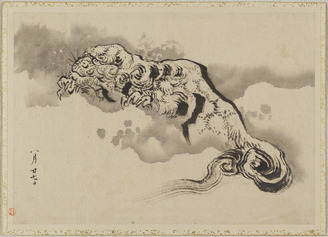
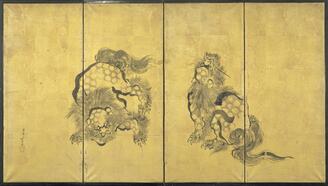
<p>The <i>Daily Sketches for Longevity and Exorcism</i> depict lions in various forms, as well as lion dancers. Katsushika Hokusai created this series of daily sketches at age 84–85, when he resided in Obuse, Shinshu (present-day Nagano Prefecture). They were painted not for a commission, but rather as a wish for his own longevity. Several sheets from this series are known to exist in both domestic and overseas collections. However, the pieces donated to Kyushu National Museum are noted for how remarkably well they have survived as a whole set of 219 sheets, as well as their clear provenance. Originally, they were in the care of Hokusai’s daughter, O-Ei. She later gifted them to Miyamoto Shinsuke, a retainer of the Matsushiro domain in Shinshu, as a replacement for an undelivered hanging scroll that Shinsuke had commissioned of Hokusai. These paintings feature dynamic brushstrokes that fully capture Hokusai’s overflowing creativity on paper.<br /><br /><Translated by Rachel Lam, Edited by Sheila Ryan></p>
落款「先ノ宗理 北斎」。
文政2年(1819)の作品。
寛政3年(1791)の作品。
文化3年(1806)の作品。
<p>羅漢が掲げる鉄鉢からは雲気が上り、龍を暗示する稲妻が光ります。北斎は90歳の長寿を保ち、幅広い画題と画風をよくしました。本図にも熟達したデッサン力がうかがえます。落款から、北斎が「戴斗(たいと)」と号した文化年間(1804~18)後半頃の作品と考えられます。<br /></p>
文政8年(1825)頃の作品。
文政3年(1820)の作品。
北斎最初期の作品
安永8年(1779)8月に、中村座で上演された『敵討仇名かしく』に取材した作品。20歳の北斎が勝川春朗の名前で制作したデビュー作として知られる作品4図のうち1枚。師とした勝川春章の同時期の作風に倣って制作された。
安永8年(1779)作。
黄表紙。勝川春朗画。安永9年(1780)刊。
洒落本。蓬莱山人帰橋(ほうらいさんじんききょう)作。勝川春朗画。天明2年(1782)序。江戸・深川の遊里を舞台に、当時の流行風俗、通言、洒落を巧みに織り込んだ作。作者の帰橋は、上州高崎藩松平侯の家臣で、江戸・桜田の松平邸に住した河野某といわれる。
天明7年(1787)。落款「春朗画」。
寛政元年(1789)。落款「春朗画」。
黄表紙。山東京伝作。春朗画。寛政5年(1793)蔦屋重三郎刊。同日同時刻に生まれた富家と貧家の息子二人の五十年の人生を旅の道中見立てた作。
落款「勝 春朗画」。
落款「春朗画」。
落款「春朗画」。
落款「春朗画」。
宗理時代の作品
浅草庵市人の序がある狂歌絵本『柳の糸』の中の一図。同書は、寛政9年(1797)刊。鳥文斎栄之や北尾重政も挿図を寄せている。司馬江漢の「江の島図」から洋風表現を学んだことが、構図だけでなく山や波の描写からも確認できる。落款は「北斎宗理」。38歳頃の作品。
摺物。「午 春興」。寛政10年(1798)刊。落款は「宗理画」。摺物は版画の一種。絵草紙屋などで販売されるものではなく、仲間同士に配られた。俳諧や狂歌の同好者が連と呼ばれるグループを作り、その身内に摺物を配ったもの。
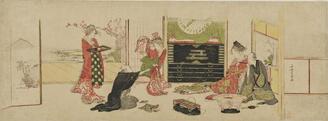
風景画
天保4年(1833)の作品。
江戸時代・19世紀の作品。
<p>This print is based on a Noh play in which an old man who gathers scouring rush for a living is reunited with his long-lost son. The artist Hokusai created this series in his early 70s.<br /></p>
享和2年(1802)の作品。
花鳥画など
団扇絵は、団扇に貼って使うための作品。体に巻きつかせた蛇を断ち切るといわれる雉子が、蛇と死闘を前に間合いを計る緊張感に満ちた一瞬を描く。雉子の体から尾まで伸びた曲線が、団扇の輪郭と呼応している。北斎が好んだ主題だったようで、同様の図が現存する。
<p>Turtles formed an auspicious painting motif and were considered symbols of longevity. The long and narrow format of this print resembles that of a hanging scroll.<br /></p><br /><p>This ukiyo-e woodblock print was created by Katsushika Hokusai.<br /><br />Note how the color is gradated by curved lines that sweep diagonally across the screen. This creates the impression of light shining through oscillating water, thus infusing the picture with a sense of coolness.<br /><br />Three tortoises swim leisurely across the composition, which has an unusual shape, being vertically longer than the average woodblock print. The tortoise at the bottom has long strands of seaweed growing on its back. This is an auspicious motif symbolizing long life. There are four other similarly-sized prints with Hokusai's signature, believed to date from the same period. They all feature auspicious motifs such as carp ascending a waterfall, cranes with pine trees, hawks with cherry blossom trees, and horses with young pines. Perhaps these prints were part of a series produced at the same time and for the same purpose.</p>
<p>西村屋版花鳥図の連作の一図。風をうけて揺らぐ芥子がダイナミックに描かれる。赤と青の洗練された色彩感覚、ジグザグに震えるモダンな描線が、夏の風を感じさせるような爽やかなリズムを奏でている。北斎の為一時代の代表作のひとつ。<br /></p>
洋風版画
北斎の肉筆
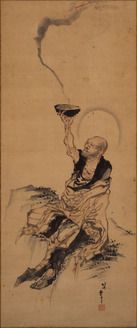
Arhat
<p>羅漢が掲げる鉄鉢からは雲気が上り、龍を暗示する稲妻が光ります。北斎は90歳の長寿を保ち、幅広い画題と画風をよくしました。本図にも熟達したデッサン力がうかがえます。落款から、北斎が「戴斗(たいと)」と号した文化年間(1804~18)後半頃の作品と考えられます。<br /></p>
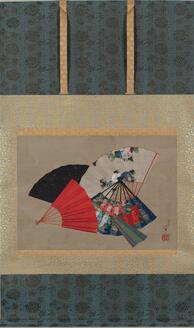
Fans
<p>北斎最晩年、90歳の作品。扇の地紙を、折りによる光の明暗を意識して色調を変えて立体的に描いています。極細密な描法と背景から浮き上がるような不思議な立体表現は北斎晩年の特徴であり、老いても衰えることのなかった作画への探究心がうかがえます。</p>
<i>Daily Sketches for Exorcism and Longevity</i>
<p>The <i>Daily Sketches for Longevity and Exorcism</i> depict lions in various forms, as well as lion dancers. Katsushika Hokusai created this series of daily sketches at age 84–85, when he resided in Obuse, Shinshu (present-day Nagano Prefecture). They were painted not for a commission, but rather as a wish for his own longevity. Several sheets from this series are known to exist in both domestic and overseas collections. However, the pieces donated to Kyushu National Museum are noted for how remarkably well they have survived as a whole set of 219 sheets, as well as their clear provenance. Originally, they were in the care of Hokusai’s daughter, O-Ei. She later gifted them to Miyamoto Shinsuke, a retainer of the Matsushiro domain in Shinshu, as a replacement for an undelivered hanging scroll that Shinsuke had commissioned of Hokusai. These paintings feature dynamic brushstrokes that fully capture Hokusai’s overflowing creativity on paper.<br /><br /><Translated by Rachel Lam, Edited by Sheila Ryan></p>
Videos
Past Exhibitions
| Title | shusai | Place | open | close |
|---|---|---|---|---|
Institutions Holding Related Materials
東京都墨田区に所在。北斎が現在の墨田区本所界隈で生涯を送ったことから、2016年この地に開設されました。
長野県上高井郡小布施町に所在。北斎が80歳を超えた晩年、小布施で描いた作品が展示されています。
The National Diet Library (NDL), founded in 1948, is the library which belongs to the Diet. The NDL assists the activities of the National Diet. The Library collects and conserves materials and information both from Japan and abroad, serving as a foundation of knowledge and culture and providing library services to administrative and judicial entities and Japanese citizens.
As Japan’s representative museum, Tokyo National Museum collects, preserves, displays, and researches the cultural properties of Asia with a focus on Japan, and also provides educational programs.
Kyushu National Museum explores how Japan’s history of cultural exchange with the rest of Asia has impacted the formation of its culture. To that end, we engage in the collection, preservation, exhibition, and research of cultural properties, in addition to providing educational outreach to the local community.
The Tokyo Fuji Art Museum is founded on November 3, 1983, in Hachioji, a thriving university town in the western suburbs of the Japanese capital. Priding itself as “a museum creating bridges around the world” to facilitate the exchange of different cultures, our museum has forged cordial relations with art museums and cultural institutes in 32 countries and territories to date. We do so by bringing the world’s finest works of art to Japan while reciprocating in kind by introducing the finest Japanese treasures to the world through special exhibitions that showcase their beauty and wonder through a unique new set of prisms and perspectives. Our museum possesses some 30,000 pieces of artworks from various periods and cultures including Japanese, Eastern and Western works, ranging from paintings, prints, photography, sculptures, ceramics and lacquer ware to armor, swords and medallions. Especially noteworthy is its outstanding collection of Western oil paintings that spans a five-hundred-year period from the Renaissance, Baroque, Rococo, and Romanticism to Impressionism and contemporary art, as well as its exceptional collection of photographic masterpieces that can give an overview of the history of photography from the birth of the photograph to the present age.
The Art Research Center was established in 1998. Since then, the Center’s mission has been not only to conduct historical and social research and analyses of both tangible and intangible human cultural properties such as visual and performing arts and craftsmanship, but also to record, organize, preserve, and disseminate the research outcomes. To make the vast amount of database of resources on Japanese culture kept at the Art Research Center available to joint researchers in and outside of Japan, while providing the hitherto accumulated digital archiving and database management technologies as the basis for research project activities to promote information archiving and the circulating of joint research on knowledge. Through these undertakings, the Center aims to “become a world class research center” in the field of Digital Humanities.
External Links
In Japan
HPのトップページ上部にある「すみだと北斎」をクリックし、「北斎の生涯」に進む。さらに「ゆかりの地MAP」「北斎について」も掲載されており、多数の浮世絵を閲覧することもできる。
アダチ版画研究所が運営するサイト「北斎今昔」より。
アダチ版画研究所が運営するサイト「北斎今昔」より。
アダチ版画研究所が運営するサイト「北斎今昔」より。
アダチ版画研究所が運営するサイト「北斎今昔」より。
アダチ版画研究所が運営するサイト「北斎今昔」より。
島根県立美術館は葛飾北斎研究の第一人者、永田生慈氏が寄贈した北斎とその弟子に関わる浮世絵コレクション(永田コレクション)約1000点を所蔵。記念展(2019年2月~3月開催)のサイトでは、永田コレクションの作品の一部を見ることができる。
Outside of Japan
欧州の美術館、博物館、図書館等が所有する絵画、書籍等のデジタルコンテンツを統合的に検索できる。北斎の作品や関連資料を多数閲覧できる。画像は、アムステルダム国立美術館所蔵の "Kakivrucht met sprinkhaan"
米国のニューヨークにある美術館。北斎の作品をはじめとする多数のデジタルコンテンツをパブブリックドメインとして提供している。 画像はメトロポリタン美術館所蔵の "Mystical Bird (Karyobinga)"
Other materials in Japanese Search
References
- 編集制作: 座右宝刊行会,集英社
- 大久保純一 著,岩波書店
- 山本陽子 著,明星大学人文学部研究紀要編集委員会 編『明星大学研究紀要-人文学部』第52 号
- 浅野秀剛 監修,平凡社 国立国会図書館 NDL ONLINE
- サンプルページ「葛飾北斎」の項
- 「葛飾北斎」の項
- 「葛飾北斎」の項
- 「葛飾北斎」の項
- 歴史学研究会 編,岩波書店
- 「すみだ北斎美術館」HPのうちの「すみだと北斎」より。