Shinpa — Kawakami Otojiro and the Beginnings of New School Theater
Popular modern dramas emerging in mid-Meiji Period in opposition to old-school kabuki
Shinpa refers to theater that began as political propaganda dramas dubbed soshi-shibai (plays performed by activists) and shosei-shibai (romantic, bohemian-style student theater) that emerged in the mid-Meiji Period and later developed into popular modern dramas. With acting and direction influenced by kabuki and the use of onnagata (male actors playing female roles) and the iconic kabuki joshiki-maku curtain, shinpa fell between kabuki and shingeki, a subsequent form of Japanese theater based on modern realism. The term shinpa (new school) positions kabuki as old theater. First coming into use in the late 1890s, it came to be used as the generic term for a new group of plays in the vein of soshi-shibai and shosei-shibai.
Sudo Sadanori, a leading figure of the Liberal Party, formed the Dai Nihon Soshi Kaizen Drama Association in December 1888. The association staged two plays at the Shinmachi-za theater in Osaka: Korae no Shosei Teiso no Kajin (“Brave Student”) adapted from his novel and Kinno Bidan Ueno no Akebono “(The King’s Tale of Beauty, Akebono of Ueno”), which was based on a political incident. The shinpa school of theater is considered to have begun with these two plays. In February 1891, Kawakami Otojiro, who was known for his oppekepe, mid-Meiji Period rap-like enka, performed the songs “Itagaki-kun Sonan Jiki” (“Itagaki-kun’s Actual Record of Disaster”) and “Keikoku Bidan” (“Inspiring Tale of Statesmanship”) at the Unohiza theater in Sakai. In June of the same year, the Kawakami troupe moved to the Nakamura-za theater in Tokyo, where it enjoyed great success.
As the political color of the original shinpa plays gradually faded, this new school of drama grew into a theatrical movement. Though the shinpa tradition was formed by performing plays based primarily on social themes, the school presented a succession of dramatizations of novels from the end of the Meiji Period to the Taisho Period, including Konjiki Yasha (“The Golden Demon”), Onna Keizu (“A Woman’s Pedigree”), and Onoga Tsumi (“My Own Sin”). Shinpa theater came into its heyday with the passing of three famous kabuki actors, Ichikawa Danjuro IX, Kiku to Onoe Kikugoro V, and Za to Ichikawa Sadanji I.
Related People, Things and Events
Theater company organized in 1917 by Sawada Shojiro with the aim of creating new national theater
Two pioneering theater groups in the modernist shingeki movement
This gallery introduces the items of Database for Exhibition "Engeki-jin Sho-yo Tsubouchi", held by the Tsubouchi Memorial Theatre Museum, Waseda University.
Kabuki, a form of traditional theatre, is still very popular today and continues to evolve. This webpage introduces kabuki-related materials at the Art Research Centre of Ritsumeikan University from various perspectives.
Early Days of Shinpa School of Drama
Although the Sudo Sadanori and Kawakami Otojiro troupes, having yet to perfect their craft, imitated kabuki in many ways, their performances impressed audiences with the novelty of youthful enthusiasm and stark realism. These popular dramatic styles came to be known as soshi-shibai and shosei-shibai. Most of the actors dressed in simple, plain costumes of everyday dark blue kimono with white splash patterns, a heko-obi sash, and a tsutsu-sode haori coat, which audiences appreciated as apropos of student theater.


Kamakami Otojiro and Kamakami Sadayakko
After moving to Tokyo, Kawakami staged Igai (“Surprised”) in January 1894. The play was based on the recently reported Soma Jiken incident, which had outraged the Japanese public. He demonstrated astute production skills, with the ability to seize opportunities such as this and the timely staging of his play Nisshin Senso (“Sino-Japanese War”) in October 1894 immediately after the outbreak of the war. In May 1895, Kawakami finally made it to the Kabukiza Theater stage with Ikaiei Kanraku (“The Fall of Weihai”). Setting out on a tour of the U.S. and Europe in April 1899, his troupe performed in July 1900 at the Expo Universelle held in Paris, France, with Geisha to Bushi (“The Geisha and the Samurai”) and other performances highly praised. His wife, Kawakami Sadayakko, performing for the first time on this tour, became renowned as Madame Sadayakko.
On his return from this overseas tour, he called his new theater Seigeki, in reference to the new type of dialogue-based theater, which required neither dance nor musical instrument accompaniment, that he had learned in the West. At the Seigeki Theater, Kawakami staged Othello, Hamlet, and The Merchant of Venice. He experimented with new production techniques, using Western-style backdrops, costumes, and spotlights and eschewing the hanamachi raised walkway that runs through the audience in kabuki theater.
川上貞奴
<Twelve Portraits> II: Sada Yacco / NICHOLSON, William (1872 - 1949)
「川上演劇 意外」

川上演劇諷俗写真 又々意外
岡本綺堂 ランプの下にて 「川上のオツペケペ節」
日清戦争
川上音二郎戦地見聞日記 戦地視察俳優 川上音二郎
梅堂小国政 皇太子殿下 川上一座の演劇を御覧の図
梅堂小国政 川上音二郎戦地見聞日記
Kawakami troupe tour of Europe and U.S.
川上音二郎欧米漫遊記
落合芳幾 日本演劇 川上と貞奴
川上音二郎の舞台「児島高徳」
芸者と武士(『川上音二郎欧米漫遊記』口絵写真)
楠正成(『川上音二郎欧米漫遊記』)
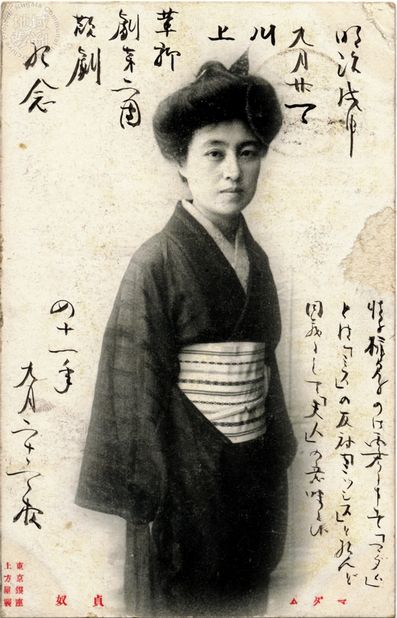
Kawakami Sadayakko
明治42年頃の川上貞奴(『女優論』)
ホール・ケイン原作の翻案劇「ボンドマン」の呉葉役の川上貞奴。明治42年11月の本郷座公演の際のものか。
洋装の川上貞奴
明治30年頃。
マダム 貞奴
1908(明治41年(1908)の絵葉書


Kawakami troupe performances following return to Japan
シェークスピア オセロ 大阪浪花座 明治36年3月20日
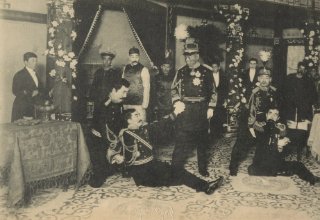
シェークスピア オセロ 本郷座 明治43年1月(『舞台之華』)
シェークスピア ヴェニスの商人 明治36年6月
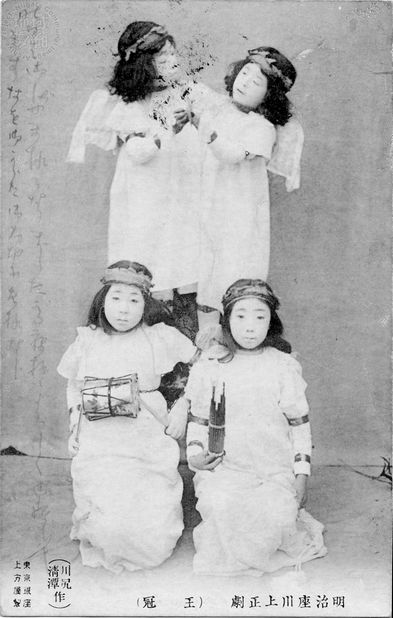
コッペー 王冠(長田秋濤訳) 明治座 明治38年2月
シェークスピア ハムレット 博多教楽社 明治37年12月1日

シェークスピア ハムレット 熊本東雲座 明治38年11月8日
References
- 伊原青々園 著,相模書房
- 秋庭太郎 著,理想社
- 伊原青々園 著,相模書房
- 秋庭太郎 著,鳳出版
- 柳永二郎 著,読売新聞社