Edo's Famous Flower Spots (For Educational or Commercial Use)
Popular flower spots loved by people in Edo and depicted in paintings.
Hanami, which was a pastime of the nobility in ancient times, became popular in the Edo period (1603-1868). Tokugawa Iemitsu, Tokugawa Yoshimune, and others had cherry trees planted in various areas and encouraged people to enjoy cherry blossom viewing as a "springtime pastime," and cherry blossom viewing spots such as Ueno, Sumida-zutsumi, and Gotenyama were created. Although hanami mainly refers to cherry blossoms, there were also many other places famous for their blossoms in Edo, such as plum blossoms and wisteria in Kameido, and irises in Horikiri. This section introduces paintings from the Edo and Meiji periods that depict famous flower viewing spots.
Ueno
In 1625, when the third shogun of the Edo Shogunate, Tokugawa Iemitsu, ordered the construction of Kan-eiji Temple on Toeizan (Mt. Toeizan), the temple was built by priest Tenkai, who brought cherry blossoms from Yoshinoyama in Nara and planted them there. The temple was loved by the common people of Edo, and many cherry blossom-viewing visitors came to the Ueno Kiyomizu Kannon-do Hall, which still remains today. However, since Kan'eiji Temple was the family temple of the Tokugawa family, eating and drinking were prohibited on the temple grounds, no parade music was allowed, and people had to leave the temple by 6:00 p.m. (kuremutsu).
上野東叡山花盛図
東京名所 上野公園之景
Gotenyama
Gotenyama was used by successive shoguns as a resting place for falconry and for tea ceremonies, but it developed into a scenic spot during the reign of Yoshimune Tokugawa, the 8th shogun. Gotenyama became the only cherry blossom viewing spot in Edo overlooking the sea. Unlike Kan-eiji Temple in Ueno, eating and drinking were allowed under the cherry blossoms, and the pictures depict ordinary people sitting on rugs and enjoying their lunch boxes and drinks.
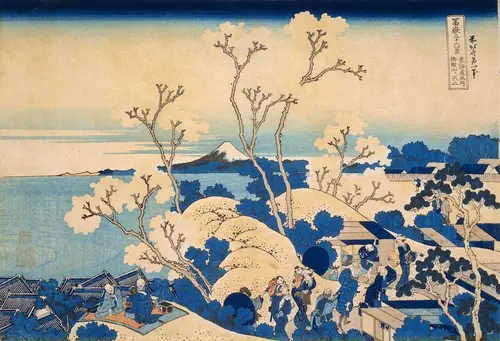
Thirty-six Views of Mount Fuji: Mt. Fuji from Gotenyama Hill in Shinagawa on the Tokaido
Sumidazutsumi
The cherry blossoms along Sumida-zutsumi are said to have originated when the fourth shogun, Tokugawa Ietsuna, transplanted cherry trees from Sakuragawa in Hitachinokuni (Ibaraki Prefecture) to Mokubo-ji Temple in order to provide a recreational area for the common people. In addition, the 8th shogun, Tokugawa Yoshimune, planted 100 more cherry trees, and the area became known as a cherry blossom viewing spot. It is said that this was done to harden the embankment by inviting common people to walk on the soil as flower watchers.
Asakusa
The cherry blossoms of Asakusa were once described by Matsuo Basho in his poem "Hana no Kumo wa Ueno ka Asakusa ka". In 1733, "Kinryuyama Senbonzakura" (one thousand cherry trees), donated by a prostitute from Yoshiwara, was planted and became a popular cherry blossom viewing spot. It is said that a tag in the prostitutes' handwriting was hung from a branch of the cherry tree when it was in full bloom, inviting visitors to come up to the temple.
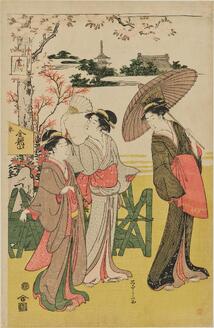
浅草公園遊覧之図
Asukayama
The park was created by the 8th shogun, Tokugawa Yoshimune, under his policy of making the area a parkland. Over 1,000 cherry trees were planted, and later a water teahouse and archery range were established, making it a popular recreation area for the general public. The park became popular because of its proximity to Edo (present-day Tokyo), its excellent view, and the fact that drinking parties and masquerades were permitted.
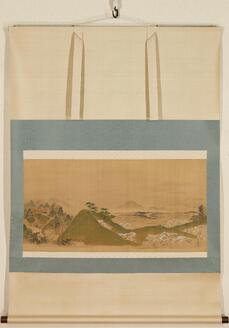
Asuka Hill
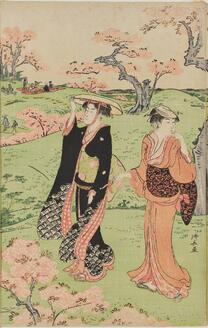
Shin Yoshiwara
Although Shin Yoshihara is known for its cherry blossoms, they are actually only for a limited period of time. Cherry trees with their roots still attached were brought in from the mountains in accordance with the season of the lower floor, planted along Nakanomachi Chuo-dori, and removed when the blossoms fell. At night, the cherry trees could be seen lit up by lanterns, attracting not only the common people of Edo, but also tourists from the countryside, samurai on the daimyo's mission, and many other spectators.
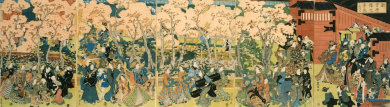
Cherry Blossoms in the Shin-Yoshiwara Courtesan’s District
Umeyashiki
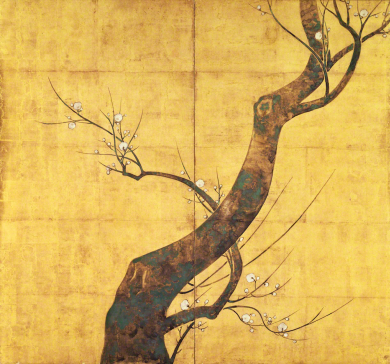
Umeyashiki is the plum garden of Seika-an, the villa of Iseya Hikouemon, a kimono merchant in Kameido. Among them, the famous tree, which is said to have been named Garyubai by Mitsukuni Mito, the second lord of the Mito Domain, because of the way it crawls unevenly across the ground for several tens of meters (about 150 m), is well known and was visited by many onlookers. The Kameido Umeyashiki, painted by Utagawa Hiroshige in his "Meisho Edo hyakkei (One hundred Famous Views of Edo)," is also known to have been copied by Van Gogh.
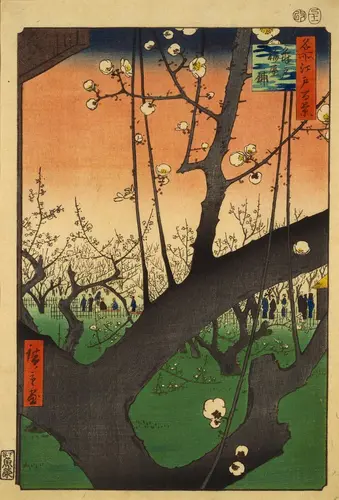
Plum Garden at Kameido, from the Series One Hundred Scenic Spots of Edo
Kameido Tenjin
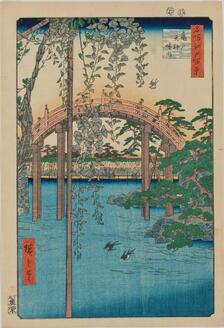
江戸時代初期、亀戸天神の初代宮司が植栽したのがはじまりで、やがて庶民の間での評判となった藤の名所。その見事な姿は「亀戸の五尺藤」「亀戸の藤浪」と称賛されて第5代将軍・徳川綱吉、第8代将軍・徳川吉宗も訪れたという。舟で訪れて日帰りの藤見の楽しむ、人気の行楽地であった。
Horikiri
There are various theories about the origin of the iris garden in Horikiri, but one theory is that the garden was started by Izaemon Odaka of Horikiri Village, who collected irises from various regions and planted them in his own garden. The 12th shogun of the Edo Shogunate, Tokugawa Iekei, Iesada, and their father stopped by the garden when they took a break from falconry, and when the 12th lord of the Owari Domain, Tokugawa Saisho, visited the garden, he gave the garden the praise of "the best iris in Japan" and "Souka", which made the garden famous and popular among the general public.
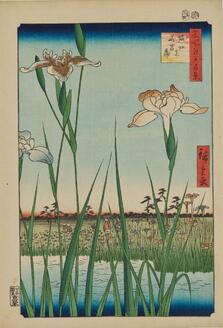
Sweet Flags in Horikiri from the Series One Hundred Famous Places of Edo
Related People, Things and Events
Hanami (Cherry Blossom Viewing)
Hanami refers to the custom of admiring and enjoying flowers, such as cherry blossoms and plum flowers. It was first held among the aristocrats, later spreading to the general public during the Edo era.
Sakura (Cherry Blossom)
A flower of the rose family, long beloved by the Japanese people; the tree grows widely from East Asia across to the Himalayas
Japanese Plum (Ume)
Along with cherry blossoms, Japanese plum flowers have been familiar to Japanese people since ancient times
Sweet flag
A perennial plant of the Araceae family. Called shobu in Japanese, a name that can also refer to hanashobu flowers of the Iridaceae family.