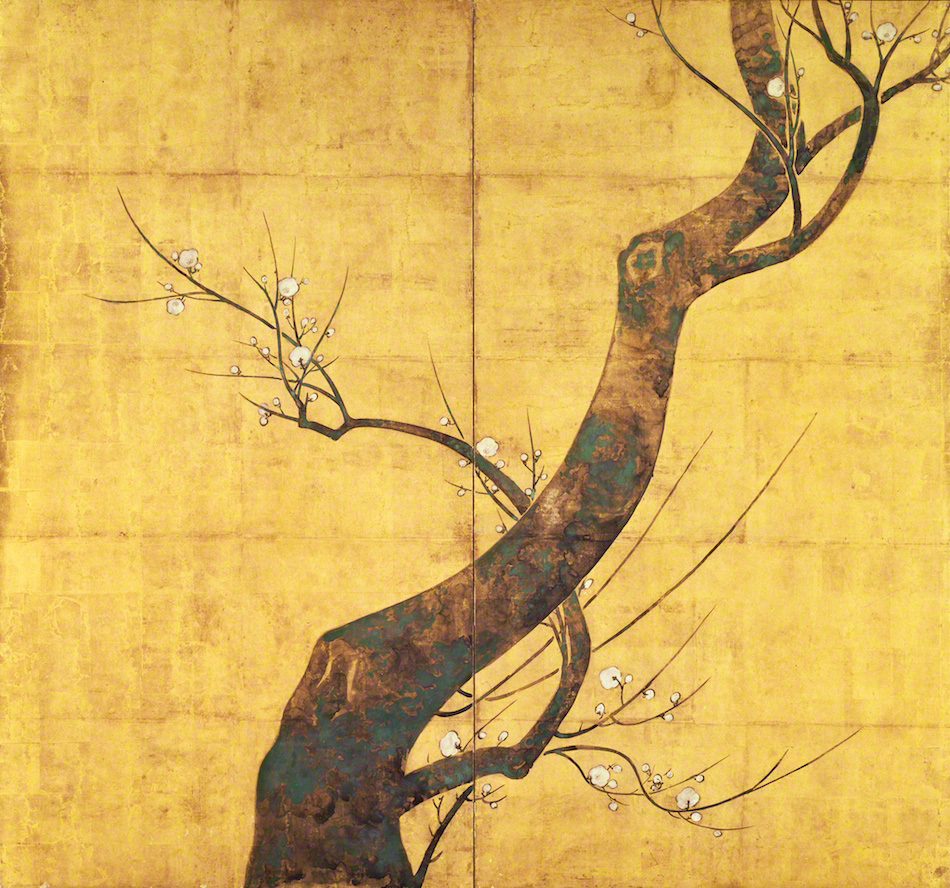
Japanese Plum (Ume)
Along with cherry blossoms, Japanese plum flowers have been familiar to Japanese people since ancient times
The Japanese plum tree (Prunus mume) is a small deciduous tree in the Rosaceae family. It is about 10 meters high, has many branches, and grows oval and alternate leaves. The flowers are white to pink, have five petals, and bloom in early spring prior to the appearance of the leaves. The fruits are spherical and mature around June in the rainy season. From the viewpoint of systematic taxonomy, it is close to the apricot tree among plants of the Prunus genus.
Originally from Sichuan and Hubei provinces in China, it came to Japan as a medicinal tree along with Chinese culture and was cultivated by the Nara period (710-792). Plums appeared in the poetry collection Man'yoshu (Collection of Myriad Leaves), were planted in the front yard of the Shishinden (the throne hall), and were widely loved by people. In the middle of the tenth century, however, Shishinden's plums were replaced by cherry trees, and Japanese love for plum blossoms was transferred to cherry blossoms.
In 901 when Sugawara no Michizane was exiled to Dazaifu, Kyushu, he wrote a poem expressing regret at parting from the plum blossoms in his garden. This poem gave rise to the legend of the flying plum tree, which says that the plum tree was so moved by his poem that it flew to Dazaifu to be near him. After he died, Michizane was deified as Tenjin and enshrined at Tenmangu and Tenjinsha, and to assuage his soul, plum trees were planted in abundance at these Shinto shrines. Plum blossoms have thus become a symbol of Tenmangu and Tenjinsha.
Japanese plum trees were cultivated nationwide. In the Edo period (1603-1867), cultivation spread among the common people, the number of varieties rapidly increased, scenic spots famous for their plum blossoms were established, and the production of dried plums became common. Plum tree gardens were also created. An especially famous garden is Kairakuen, created by Tokugawa Nariaki, lord of the Mito domain (present-day Ibaraki Prefecture).
There are more than 300 cultivars of Japanese plum trees, and they are roughly divided into edible plums (miume) and ornamental flower plums (hanaume). Flower plums are further divided into several series, such as wild plums (yabai) and scarlet plums (hibai). Edible plums are cultivated in various places for fruit production, most plum fruit being produced in Wakayama, Gunma, and Nara prefectures. The fruit is used for pickled plums, candied plums, and plum wine. In addition, immature plums are smoked and dried in the sun to produce ubai (black plums), which is used in traditional Chinese medicine. Immature plums contain amygdalin and are toxic.
Plums have been used in design themes in art since ancient times and are found in Genji monogatari emaki (The Tale of Genji Scroll, 12th century), in which some scenes include themes such as shochikubai (pine trees, bamboo, and plum trees) and ume ni uguisu (bush warbler in a plum tree). In addition, countless family crests include plums, for example, Umebachi (single plum blossom) and Umebishi (plum blossom and rhombus). Two individual trees, the Getchibai (Perceiving the Moon Plum Tree) in Miyazaki Prefecture and the Garyubai (Sleeping Dragon Plum Tree) in Yota, Yamaguchi Prefecture, are designated as natural monuments.
Related People, Things and Events
Books
Related Works
Kameido no Umeyashiki (“The Plum Garden at Kameido Shrine”)
Plum drawings on clothing
Ceramics with a plum pattern
Characters in plays associated with plums: Ume no Yoshibei
Characters in plays associated with plums: Umeomaru
Characters in plays associated with plums: Umegawa
Videos
Past Exhibitions
| Title | shusai | Place | open | close |
|---|---|---|---|---|
Institutions Holding Related Materials
200種約6,000本の梅が咲く。所在地は福岡県太宰府市。
100品種約3,000本の梅が植えられている。所在地は茨城県水戸市。
100品種約4,000本の梅が植えられている。所在地は三重県いなべ市。
会館の2階に梅に関する資料が展示されている。梅干しの実物展示もあり。所在地は和歌山県日高郡みなべ町。
国立科学博物館筑波実験植物園内の植物を検索することができる。研究者ノートなど専門的な解説もあり。
国立科学博物館附属自然教育園内に生息している生物の種名や写真を調べることができる。
植物・花の基本情報、育て方などを「趣味の園芸」講師陣の専門家が執筆。園芸相談Q&Aや特集コーナーがある。「NHKみんなの趣味の園芸」(NHK出版)公式サイト。
梅の品種の説明がされている。梅料理レシピには様々な料理法が載っている。
References
- 小学館