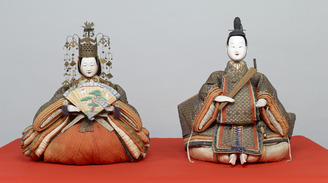
享保雛 / 東京国立博物館
Hina dolls and furnishings
The glamorous feasts of the Imperial court soon spread to samurai warrior families and townspeople. Kinds of suwaribina called kanei-bina or genroku-bina appeared in the collections of wealthy townspeople. With the rise of the Hina Festival, the townspeople's hina dolls evolved into kyoho-bina, lavished with cotton and gold brocade. Their increasing size was often cracked down on by the shogunate, which promoted frugality.
Radiant kyoho-bina
The obina (male hina doll) has straight shoulders and legs, while the mebina (female hina doll) has a plump body. These hina dolls were called "kyoho-bina" because they were popular with townspeople during the Kyoho era (1716-35).
Furnishings of hina dolls
From the middle of the Edo period onwards, not only hina dolls but also furnishings of the most extravagant quality began to be produced. "Mitsuba-aoi-mon maki-e hinadogu" is part of the hina set handed down to the Matsudaira family of the Izumo Matsue clan. The objects are elaborately crafted and a gorgeous assortment decorated with the mitsuba-aoi-mon (crest with three hollyhock leaves) in gold maki-e, as if they were smaller wedding accessories of a feudal lord's family.
These are made of a precious wood called shitan (sandalwood) and decorated with gold and silver maki-e lacquer. Surprisingly, all the metal fittings are made of ivory, and are not only superficial but also function to allow opening and closing the doors. This is a masterpiece of hina accessories, in which the fine handle and the openwork pattern of chrysanthemums show the high level of skill that Edo craftsmen were proud of.