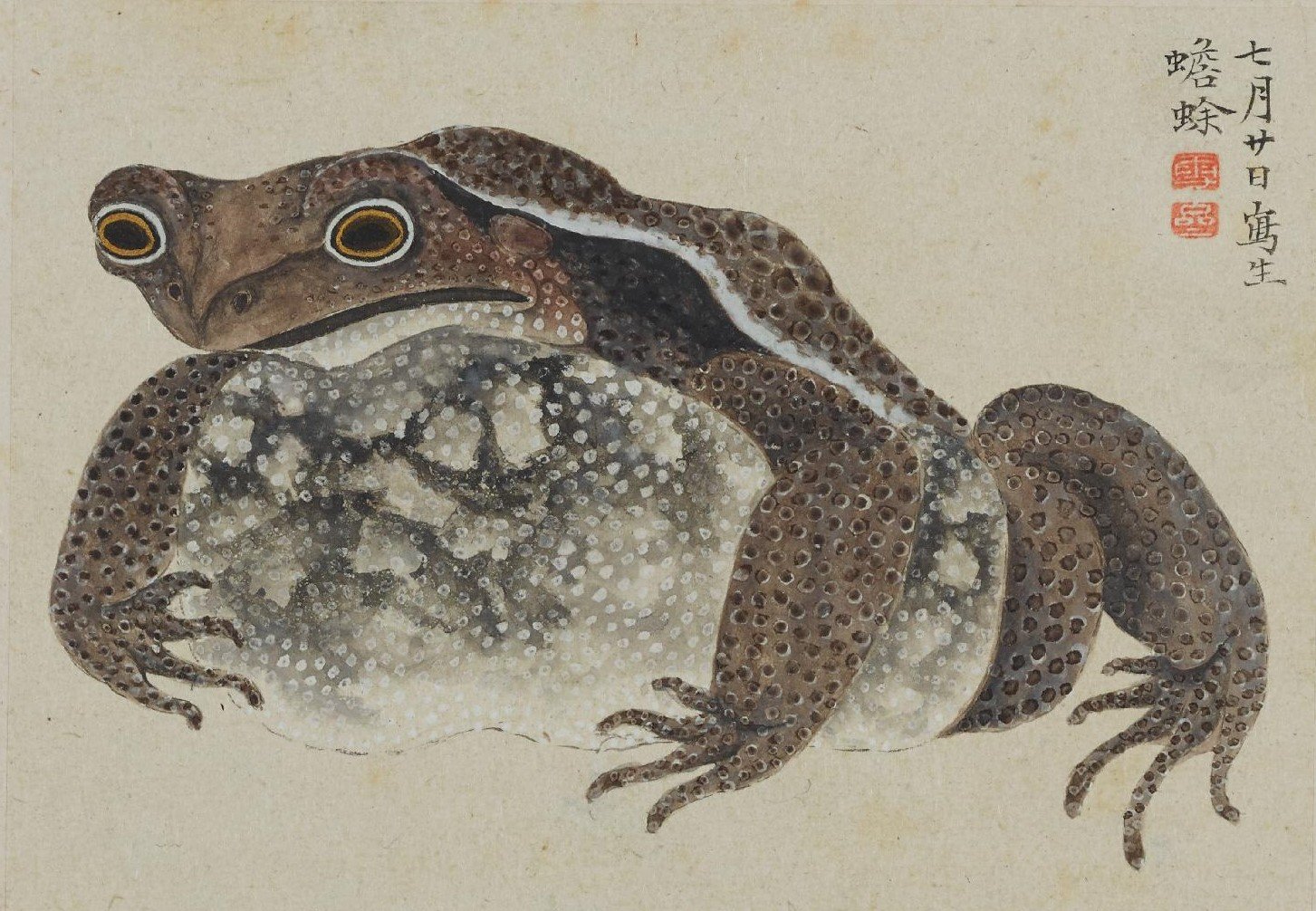
Frog
A type of amphibian that undergoes metamorphosis. In days of old, people were captivated by its beautiful call.
A type of amphibian belonging to the Anura order. Around 3,000 species are distributed throughout virtually the entire world, excluding the Antarctic and Arctic regions. Known for going through metamorphoses in their process of growing, in their immature form, they are called tadpoles (otamajakushi in Japanese); the name frog (kaeru) is first used upon their development into adults. Most males have an organ called a vocal sac, a membrane of soft skin below their throats, which functions to amplify the calls they make when trying to attract mates. In terms of shape, the frog’s body can be roughly divided into a head-and-trunk section and four limbs. Frogs’ hindlimbs are particularly well developed, affording them superior jumping power on land, while webs between their digits give them propulsive power in the water. Some species of frogs that live in trees or along mountain streams also have suction pads on the tips of the digits of their hind feet and forefeet.
The meat of large species such as the American bullfrog and tiger frog, with its flavor that is compared to meat like chicken, its soft texture, and high nutritional value, is widely enjoyed as a food. Due to their familiar vertebrate structure and the ease of obtaining them, they are also used as laboratory animals in the field of biology. In Chinese herbal medicine, senso (toad venom), a secretion from the parotid gland of a species of toad, has been used since ancient times for its cardiotonic effect.
Frogs have also had the common name kawazu in Japan since long in the past. In the preface to the Kokin Wakashu (“Collection of Japanese Poems of Ancient and Modern Times,” 905), Japan’s first imperial anthology of waka poetry compiled by Tsurayuki Kino and others, the frog is noted along with the Japanese bush warbler (uguisu) as a living creature endowed with a beautiful call. Among the various species, the Kajika frog, also known as Buerger’s frog, was particularly captivating to people, and in the Edo period (1603–1868), keeping them in cages to enjoy their calls was in vogue. Depictions of frogs also frequently appear in haiku poetry, as seen in the following examples.
furuike ya / kawazu tobikomu / mizu no oto
ancient pond
a frog plunges in
the sound of water
(Basho Matsuo)
yasegaeru / makeru na Issa / kore ni ari
scrawny little frog,
don’t be beaten! I, Issa,
am right here with you
(Issa Kobayashi)
As frogs spawn near water, they have a sensitive awareness of changes in atmospheric pressure, and it is known that they begin to make their calls before rainfall. In Japan, where the culture of rice cultivation has played a central role, particular interest has been given to the croaking of frogs. Frogs also help maintain paddy fields as they prey on harmful insects, and in some regions, they were even considered divine messengers of kami associated with rice fields.
Related People, Things and Events
Kawanabe Kyosai
A Japanese painter of the late Edo to middle Meiji period known for his highly realistic and unique style
Matsuo Basho
A haiku poet of the early Edo period who established the Basho style and greatly influenced succeeding generations
Issa Kobayashi
A representative haiku poet of the late Edo period, who left behind about 20,000 haiku
Japanese Bush Warbler (uguisu)
A small bird known for its call, rendered "hohokekyo" in Japanese and familiar in poetry and paintings owing to the "bush warbler perched on a plum tree" motif
Ine (The Rice Plant)
It is said that rice farming started around the end of Jomon era in Japan. Since the Yayoi era, it has become the foundation of agricultural culture, and is deeply connected to Japanese customs.

Books
国会図書館関連
続日本紀 巻37-38
「日本書紀」に続く勅撰の歴史書。全40巻からなる。第38巻「延暦三年五月七日」の条に、二万匹のヒキガエルが四天王寺に集まった事件が記されている。「水鏡」にも同じ事件について書かれた箇所がある。
蜻蛉日記 3巻 [2]
藤原道綱母によって平安時代中期に書かれた日記。日本では近世頃に発生したと考えられる、死んだ蛙をオオバコでくるみ地中に埋めて歌いかけるという「蛙の葬式遊び」があるが、その遊びの元となった伝承(死んだ蛙をオオバコの葉でくるむと生き返る)を踏まえた歌が書かれている。
古今和歌集 [1]
平安時代前記に編まれた勅撰和歌集。編者の一人、紀貫之は「仮名序」で「花に鳴く鶯、水にすむ蛙の声を聞けば、生きとし生けるもの、いづれか歌を詠まざりける」と記し、鶯と蛙の声は歌心を誘うものであるとしている。
水鏡詳解
「水鏡」は鎌倉時代に書かれた平安時代の歴史物語。全3巻からなる。本書は明治末期に出されたその解説書。「水鏡」には「続日本紀」と同じく延暦三年五月にヒキガエルの大群が四天王寺に集まった事件が記されている。更に、同事件を平城京から長岡京への遷都の前触れであったと評価している。
水鏡3
鎌倉初期に書かれた平安時代の歴史物語。3巻。中山忠親の著といわれる。桓武天皇の時代(延暦三年五月)にヒキガエルの大群が四天王寺に集まった事件が記されている。
栗氏千虫譜 第7冊
「千虫譜」は、江戸時代後期の医師・本草学者である栗本瑞見による日本で最初の忠類図譜。多数の彩色写生図を収める。本書は明治時代の昆虫学者・曲直瀬愛による解題。
大和本草
江戸時代の本草書。1708年(宝永5)に貝原益軒が著した。先行の著書『本草綱目』から日本に産しないものや薬効的に疑わしいものを除いた772種をとり、他書からの引用や日本特産品・西洋からの渡来品などを加えて1362種の薬物を収載した。
食用蛙の養殖研究
第二次世界大戦前まで、日本では農家の副業として、アメリカ向け輸出用の食用蛙(ウシガエル)の養殖が行われていた。昭和二年に発行された本書は、食用蛙養殖業者向けの実用書である。

Tanka and haiku about frogs
Related Works
Detached Segment of Frolicking Animals
京都・高山寺所蔵の国宝・鳥獣人物戯画から分かれ、掛幅装となった断簡。蛙や狐などの動物が五匹、擬人化されて描かれている。
Toad
江戸時代後期の画家・林十江の作。片足立ちで蝶に飛びかかろうとするヒキガエルを描く。画中の文字「草巷販夫(そうこうはんぷ)」は十江の別号、また「南柯」は栄華のむなしさのたとえ。
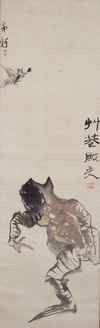
The Daoist Immortals Xiama and Tieguai
室町末期の禅僧画家・雪村の作。右幅に中国の鉄拐仙人、左幅に同じく蝦蟇仙人が描かれている。蝦蟇仙人は3本足の蟾蜍を従えていて、妖術を行うことができたという。蝦蟇仙人は中国での知名度は高くないものの、日本では美術作品や歌舞伎などの題材として多く取り上げられ広く親しまれてきた。
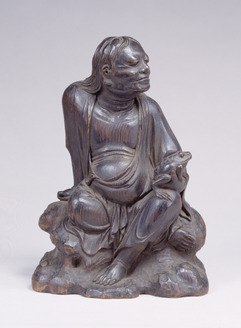
The Taoist Immortal Xiama
幕末の四巨匠と呼ばれた仏師の一人・高橋宝山の作。勢いのある刀技によって、左手にガマガエルを手懐ける仙人の風体をよく捉えている。弟の鳳雲も名匠に数えられる仏師で、孫弟子に高村光雲が出た。
「児雷也」
中国の説話集「諧史」に描かれた怪盗物語を翻案し、江戸時代に読本として人気を博し、後に歌舞伎脚本にも仕立てられた。主人公の児雷也は、蝦蟇の妖術を使う忍者として描かれている。

Past Exhibitions
| Title |
|---|
Institutions and External Links
References
- 世界と日本のカエル大図鑑 : 地球のカエル大集合! : 世界のカエル156種類・日本のカエル全43種類松井正文 監修,関慎太郎 写真・文,PHP研究所スキアシガエル、ヤドクガエルなど世界の蛙、156種類と、ヒキガエル、アマガエル等日本の全部の蛙43種の図鑑。(日本図書館協会)
- 両生類・はちゅう類松井正文, 疋田努, 太田英利 指導・執筆,小学館日本で見られる種類全部と世界の代表的な両生類・爬虫類の合わせて約500種を紹介。鳴き声のCD付。(日本図書館協会)
- くらべてわかるカエル : 識別ポイントで見分ける松橋利光 著,山と溪谷社
- 『日本大百科全書(ニッポニカ)』(japanknowledge) 「カエル」の項目
- 『世界大百科事典』(japanknowledge) 「カエル」の項目
- 『日本国語大辞典』(japanknowledge) 「蛙」の項目
- JapanKnowledge・コトバンク所収コンテンツの最終アクセス日は、いずれも2022/09/16。