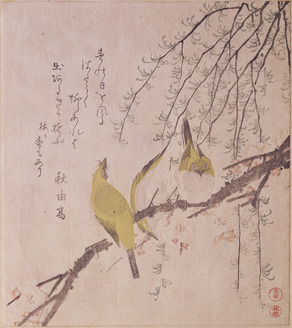
Japanese Bush Warbler (uguisu)
A small bird known for its call, rendered "hohokekyo" in Japanese and familiar in poetry and paintings owing to the "bush warbler perched on a plum tree" motif
The Japanese bush warbler is a small bird in the order Passeriformes, family Cettiidae, and genus Horornis. The Japanese word for bush warbler is uguisu, but it this bird is also known in Japan as harutsuge-dori (literally,. "bird heralding the arrival of spring") because it starts singing in early spring, around the same time that the plum tree blooms. The bush warbler is widely distributed in East Asia and is a common bird throughout Japan. It is a wandering bird that breeds in scrub forests in mountainous areas during the summer, and spends the winter in the plains. comes down to the plains to spend the winter. The male reaches approximately 16cm centimeters in length, and while the female is slightly smaller. It has an olive-brown back and a white chest, with a pale superciliary (above-the-eye) stripe. In Japan, the bush warbler is also known under various other names, such as hanami-dori ("flower-viewing bird"), utayomi-dori ("poetry-reciting bird that recites poetry"), kyoyomi-dori ("sutra-reading bird that reads sutras"), nioi-dori ("fragrant bird"), hitoku-dori (because its call written with the characters of "person comes," this name is said to be derived from the distinctive chirping of the warbler which sounds like "hito -ku," [someone is coming], thought to be a warning of someone approaching), and was believed to be a warning of approaching people) , momochi-dori (believed to mean simply "among the many birds announcing the arrival of springthat sing when spring comes", the bush warbler included), and atago-dori (derived from the name of "Mt. Atago bird").
The bush warbler is mentioned featured in a total of 51 poems in the Man'yoshu ("Collection of Ten Thousand Leaves"), and this which makes it the third -most mentioned bird in the anthology after the lesser cuckoo (hototogisu), which is associated with summer, and the wild goose, which symbolizes autumn. As a bird heralding that heralds the arrival of spring, the bush warbler has become a familiar presence in poems that express the joy of welcoming spring, thus giving rise to resulting in the birth of harutsuge-dori as another name for the bush warbler. On New Year's day in 730, the great military leader and poet Otomo no Tabito held a plum blossom party was held at the his residence of Tabito Otomo, the great military leader and poet., and seven Of the 32 poems about plum blossoms recited written at that party, 7 featured the combination of plum blossoms and a bush warbler. This is One of these poems reads,: "Right when the bush warbler sings, the plum blossoms in the house garden of the house fall after blooming." (Man'yoshu, book 5, poem 841). This motif associating intertwining the images of plum blossoms with the and a bush warbler became settled in later ages, and appeared was featured in numerous traditional Japanese poems and paintings. It also came to be used as an example of two things that match very well.
Breeding of Bush warblers have been bred has been carried out since the middle ages, breeders and sellers of bush warblers and the people who engage in breeding and trading of bush warblers being were called uguisukai-gai. From the beginning of the Edo period (1603-1868), the breeding of bush warblers flourished as people started using their droppings as a for cosmetic purposes and enjoyed their beautiful song. In order To make the birds start chirping earlier, in time for the arrival of the New Year, breeders resorted to exposing birds to candle light while it was still dark and feeding the so-called "yo-gai" or "night breeding," by keeping bush warblers in lighted places and feeding them at night.
As early as premodern times, people rendered the bush warbler's song as ho-hokekyo, which sounds like the name of the Lotus Sutra (Hokekyo) in Japanese. The practice of expressing the chirps of the bush warbler with the onomatopoeia ho-hokekyo, which, when transliterated phonetically with Chinese characters, is a reference to the Lotus Sutra of Buddhism, dates back to pre-modern times. According to Kefukigusa, a guide to haikai poetry compiled in the Edo period, has the haiku, "The song of the bush warbler enchants everybody" ("Uguisu no koe ni ya daremo horegekyo"). (The song of the bush warbler enchants everybody). This was perceived as suggesting This is perceived as a word play with the expression "myoho rengekyo to horeru" ("to be enchanted with the Lotus Sutra"). According to another storytheory, recounted in Kuzen kikigaki (Rennyo's Sayings and Teachings), in his last days, Rennyo Shonin, the head priest of Hongan-ji Temple, said, Kono uguisu ha ho wo kikiyo to naku nari, which can be interpreted as "This bush warbler is telling us to listen to the sutra."," a word play that associates the chirping of the bush warbler (ho-hokikiyo) with the expression "ho wo kikiyo" ("listen to the Sutra") (source: Kuzen Kikigaki, a collection of Rennyo sayings and teachings).
Related People, Things and Events
Books
Uguisu (Japanese bush warbler) in poems and other works
『万葉集』は奈良末期に成立したとされる日本最古の和歌集。鶯は51首が詠まれ、夏のほととぎす、秋の雁に次いで3番目に多い。春の訪れを告げる鳥として、迎春の喜びを詠む歌が定着し、「春告げ鳥」の異名を生んだ。
平安時代初期に成立した最初の勅撰和歌集。歌数は1100首。『古今和歌集』は季節を体系化し、日本人の「季節感」を醸成したといわれるが、「梅に鶯」はそのような日本的美意識の型のひとつといえる。
『源氏物語』第23帖「初音」巻。初音とは、鶯がその年初めて鳴く声のこと。明石の御方が娘の明石の姫君に送った歌「年月を松にひかれて経る人に今日鴬の初音聞かせよ」が巻名の由来。掲出の頁はその歌のくだり。
平安中期の随筆『枕草子』では「鶯は、文などにもめでたきものに作り、声よりはじめて、さまかたちも、さばかりあてにうつくしきほどよりは、九重のうちに鳴かぬぞいとわろき」(「鳥は」)と描かれる。
鎌倉初期に成立した8番目の勅撰和歌集。『古今和歌集』と同様、春歌上に鶯を詠んだ歌が見られる。
後奈良天皇(一四九六~一五五七)が「初鶯」の題で詠んだ「山さむみ」と「けふに明て」の二首の歌のうち、最初の「山さむみ」に点をつけられている。点者はこちらの歌をよしとしたわけであるが、ただ、そこにも「うくひすも」を「うくひすの」にするなど、三カ所にわたって添削が施されている。点者の厳しい指導の程がうかがわれる。
 後奈良天皇は戦乱で窮乏生活を強いられるなか、諸芸の研鑽に励み伝統的な公家文化を後世に伝えた天皇として知られる。また、疫病に悩む黎民のために自ら「般若心経」を書写するなど、真摯な祈りを捧げ続けたことでも有名。
江戸前期の俳諧論書。松江重頼著。7巻5冊、正保2年(1645)刊。鶯の鳴き声が「法華経」という聞きなしにつながったと考えられ、「鶯の声にや誰もほれげ経」(毛吹草・五・鶯)の例は、「妙法蓮華経」に「惚れ」を掛けたもの。鶯には「経読み鳥」という異名もある。
江戸前期の俳人・松尾芭蕉(1644−1694)の俳句にも「鶯」を詠んだ歌が多数ある。「鶯や柳のうしろ藪のまへ」「鶯や餅に糞(ふん)する縁の先」など。
明治時代、俳句革新運動を興した俳人・正岡子規(1867~1902)の句集。「鶯や朝寝を起す人もなし」「鶯の覚束なくも初音哉」「鶯や籔の隅には去年の雪」など。
Related Works
Paintings of uguisu in plum trees
Designs that feature uguisu in plum trees
Other pairings
Uguisu(Japanese Bush Warbler) specimens and photographs
Institutions Holding Related Materials
The National Diet Library (NDL), founded in 1948, is the library which belongs to the Diet. The NDL assists the activities of the National Diet. The Library collects and conserves materials and information both from Japan and abroad, serving as a foundation of knowledge and culture and providing library services to administrative and judicial entities and Japanese citizens.
As Japan’s representative museum, Tokyo National Museum collects, preserves, displays, and researches the cultural properties of Asia with a focus on Japan, and also provides educational programs.
Kyoto National Museum collects, preserves, displays, researches and provides educational programs focusing on cultural properties from Heian- through to Edo- period Japan, when the capital was located there.
The Tokyo Fuji Art Museum is founded on November 3, 1983, in Hachioji, a thriving university town in the western suburbs of the Japanese capital. Priding itself as “a museum creating bridges around the world” to facilitate the exchange of different cultures, our museum has forged cordial relations with art museums and cultural institutes in 32 countries and territories to date. We do so by bringing the world’s finest works of art to Japan while reciprocating in kind by introducing the finest Japanese treasures to the world through special exhibitions that showcase their beauty and wonder through a unique new set of prisms and perspectives. Our museum possesses some 30,000 pieces of artworks from various periods and cultures including Japanese, Eastern and Western works, ranging from paintings, prints, photography, sculptures, ceramics and lacquer ware to armor, swords and medallions. Especially noteworthy is its outstanding collection of Western oil paintings that spans a five-hundred-year period from the Renaissance, Baroque, Rococo, and Romanticism to Impressionism and contemporary art, as well as its exceptional collection of photographic masterpieces that can give an overview of the history of photography from the birth of the photograph to the present age.
東京都豊島区目白にある緑地。園内では様々な鳥が見られ、ウグイスも飛来する。
所在地は東京都台東区。1882(明治15)年に農商務省所管の博物館付属施設として開園した、日本で最初の動物園。鶯を見ることができる。
External Links
SUNTORYが運営する鳥の百科事典。フリーワードや特徴、鳴き声で検索できる。イラストや写真も豊富。
全国の博物館・美術館等から提供された作品や国宝・重要文化財などを掲載。「梅に鶯」で検索すると、梅と鶯をモチーフに描かれた、さまざまな絵画や木版画等を閲覧できる。
日本野鳥の会が運営するサイト。野鳥に関する様々な情報を知ることができる。膨大な数の投稿写真は、検索しやすいように分類されている。
References
- 鈴木宏子 著,NHK出版
- 集英社
- 細川博昭,株式会社秀和システム
- 小学館
- 鳥居正博 編著,聖文社
- 佐佐木幸綱 [ほか]編,大修館書店