Japan Search Action Plan 2021-2025
Table of Contents
- I. Introduction
- II. Mission
- III. Three Values: The Important Role of Digital Archives
- IV. What does it mean to "Make Digital Archives Blend into Everyday Life"?
- V. Four Actions: Pillars of Activities with Japan Search
- ◆Support◆ Japan Search supports the activities surrounding digital archives from various angles.
- ◆Provide◆Japan Search will not only provide information on digital archives themselves, but also information on their construction and utilization.
- ◆Expand◆Japan Search will enhance the digital space by promoting digital archiving and expanding collaboration, thereby expanding the possibilities for the use of content in society.
- ◆Challenge◆ Japan Search will constantly incorporate innovative technologies to create new uses of digital archives and promote DX in society.
- 連携機関向けアンケート結果(R4年度~)
【PDF】 Japan Search Action Plan 2021-2025 (1.7MB)
I. Introduction
On the occasion of the first anniversary of the official release of Japan Search on August 25, 2021, in September of the same year, the Digital Archive Japan Promotion Committee and the Working-Level Review Committee (Secretariat: Intellectual Property Strategy Promotion Headquarters at the Prime Minister's Office) formulated the "Japan Search Strategic Policy 2021-2025" (Strategic Policy)[1], which outlines the direction of Japan Search's activities for the next five years.
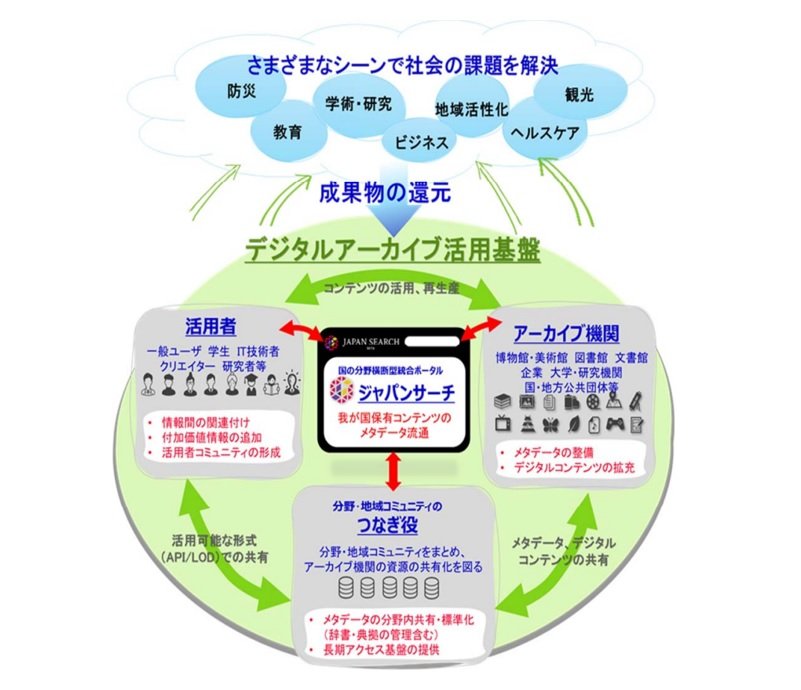
This document, "Japan Search Action Plan 2021-2025" (Action Plan), indicates specific actions to be taken in the five years to 2025 to realize the goals set forth in the Strategic Policy. Under the strategic policy, all participants aim to promote actions that promote digital transformation (DX) of society through digital archiving. As shown in Figure 1, Japan Search serves as a foundation for the utilization of digital archives, with various archival institutions expanding their digital contents, "linkers" in the field and regional communities supporting them and promoting collaboration between archival institutions and Japan Search. The users will use the digital archives for various purposes, aiming to build a cycle of returning the results to society.
The Action Plan is implemented not only by the Japan Search operators (Working-level Review Committee), but also by the partner institutions that provide data to Japan Search ( aggregators and archiving institutions), the users and communities that utilize Japan Search, and the facilitators who support the users and promote their use of the archives.
In order to check the progress of the Action Plan, the Working-Level Review Committee will conduct a questionnaire survey of partner institutions and users every year after 2022 to check the degree of achievement of the goals set forth in the Strategic Policy, and will announce the priorities for the following year.
[1] Japan Search Strategic Policy 2021-2025 https://jpsearch.go.jp/about/strategy2021-2025
[2] The Digital Archive Japan Promotion Committee and the Working-level Review Committee "Three-Year Summary Report," 2020.8.
II. Mission
The strategic policy sets forth the following mission under the catchphrase "Making Digital Archives Blend into Everyday Life".
Through new information technology and archival collaboration, we will enhance the discoverability of Japan's cultural and academic contents and provide infrastructure that facilitates their use, thereby realizing a rich and creative society in which digital archives are integrated into everyday life.
III. Three Values: The Important Role of Digital Archives
The Strategic Policy identifies three roles that digital archives should play: "inheritance and reconstruction of records and memories," "common knowledge base to support communities," and "formation of new social networks". While these cannot be achieved by Japan Search alone, they can offer a guidance for the realization of the creative society of the future that we should aim for. Below are the specifics for each of these items.
◇Inheritance and Reconstruction of Records and Memories◇
Digital archives to date have widely collected and organized past works and materials recorded on various media, and by re-recording them on digital media, have made them accessible as digital information. In the future, it is expected that copies of all records and memories will be created in digital space, facilitating their inheritance, reconstruction, and analysis.
By promoting not only inheritance but also reconstruction, we will be able to easily relate materials that have had unclear relationships due to differences in material types and holding institutions, thereby leading to the discovery of new knowledge. It is also possible to organize information across fields, from entry-level to professional level.
Furthermore, it is important to record ongoing events and information experiences from multiple perspectives to pass them on to the future. In the future, information experiences that should be recorded will themselves change into mixed reality forms that combine digital information and real space, or become expressive activities using mixed media. New methodologies for recording these will need to be developed.
◇Common Knowledge Base to Support the Community◇
Today, due to filter bubbles such as SNS, it is difficult to assume a common understanding of facts even among close friends, but a common knowledge base that has been long developed and refined is the value of a community and is essential to its sustainability.
When people learn, think, and discuss within a certain community (culture), the existence of a body of knowledge that serves as a premise and the provision of a knowledge base that supports it are essential. Digital archives are considered to be the knowledge base that supports such a body of knowledge.
One's discoveries and thoughts obtained through learning and discussion can be expressed by adding new links to the knowledge base, analyzing the contents of the knowledge base, and adding new tags to the knowledge base. It can be understood as kind of editorial operations or curations for digital archives. In other words, providing flexible curation tools for anyone to use in the digital archives means providing new communication tools to convey discoveries and ideas.
By utilizing the rich body of knowledge and knowledge base inherited by the communities and the new communication tools that anyone can use, it is possible to both playing through learning and learning through playing. Through such activities, the communities will be vibrantly inherited, and their shared values will be passed on to the next generation.
◇Formation of New Social Networks◇
The interconnection of digital archives in Japan and abroad will create an extensive knowledge base that covers a wider range of fields and regions. New ideas and values will be created through the connections among people in different fields and regions and the exchange of contents between communities.
In particular, unexpected connections between data in digital archives developed in different fields of expertise will provide opportunities for dialogue between communities of experts in distant fields and generate discussions that will lead to the creation of new integrated knowledge. In other words, it can be expected that the connections between digital archives will create new social networks among the expert communities.
IV. What does it mean to "Make Digital Archives Blend into Everyday Life"?
What exactly is the world in which the catchphrase " Making Digital Archives Blend into Everyday Life" as stated in the strategic policy has been realized? Based on what we have been considering with partner institutions [3], we envision a future in which the following are realized.
- Digital archives have become an infrastructure for information and communication.
- Various platforms are mutually connected to each other's data and have become social infrastructure.
- Business use of digital archives has spread throughout society and is yielding results.
- Many people use digital archives without being aware of the term " Digital Archives".
- When people want to know something, they are accustomed to obtaining information from reliable sites/institutions.
- More and more people enjoy "seeing, knowing, and researching" using Digital Archives, and they are using them in their daily lives and learning.
- Digital archives are used in special events (festivals, events, ceremonies, etc.).
[3] A meeting was held on December 15, 2021 to exchange opinions with partner institutions regarding the "Japan Search Strategic Policy 2021-2025. For an overview, please refer to the 4th Japan Search Working Group Document 1-2.
V. Four Actions: Pillars of Activities with Japan Search
The Strategic Policy sets four goals under each of the four actions "Support," "Communicate," "Expand," and "Challenge" (16 goals in total). Based on the role of Digital Archives presented in Chapter III, this chapter breaks down the 16 goals of the Strategic Policy, clarifies the players*, and indicates specific actions to be taken by 2025 toward the realization of a world where " Make Digital Archives Blend into Everyday Life," as confirmed in Chapter IV.
The following symbols indicate players (entities involved in initiatives).
●: Japan Search operators (Working-level Investigative Committee)
▲: Archiving institutions/connecting institutions (partner institutions)
■: Users and facilitators (people and organizations that promote the use of the archives)
Each of the objectives is arranged from the following four perspectives.
- Objective: To show the relationship with the "Three Values: Important Roles of Digital Archives"
- Ideal: Showing the ideal form that we are ultimately aiming for
- Current status: What is being done and what is not being done at the present time? Identify issues to be addressed.
- Actions: Indicate specific actions to be taken.
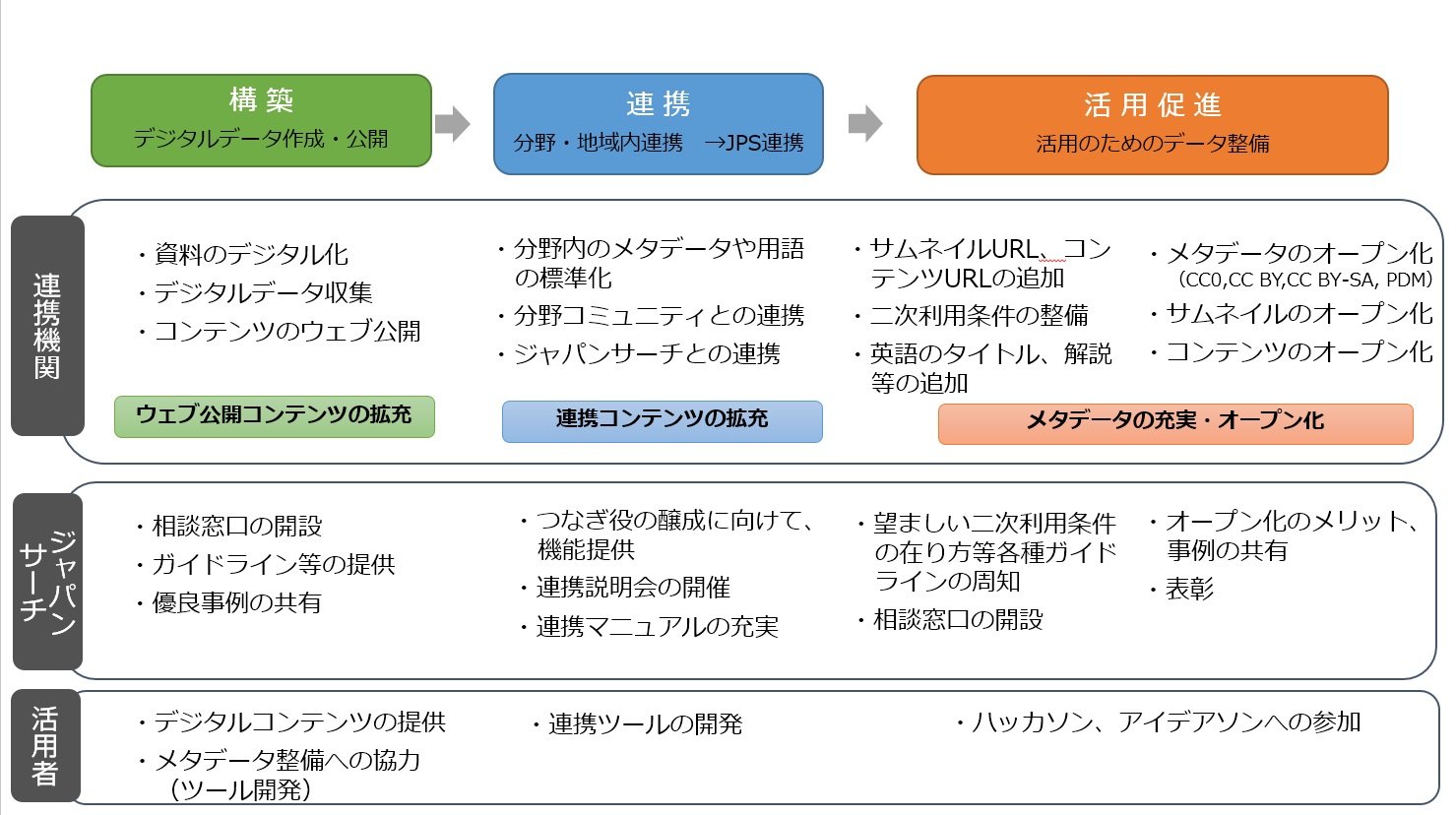
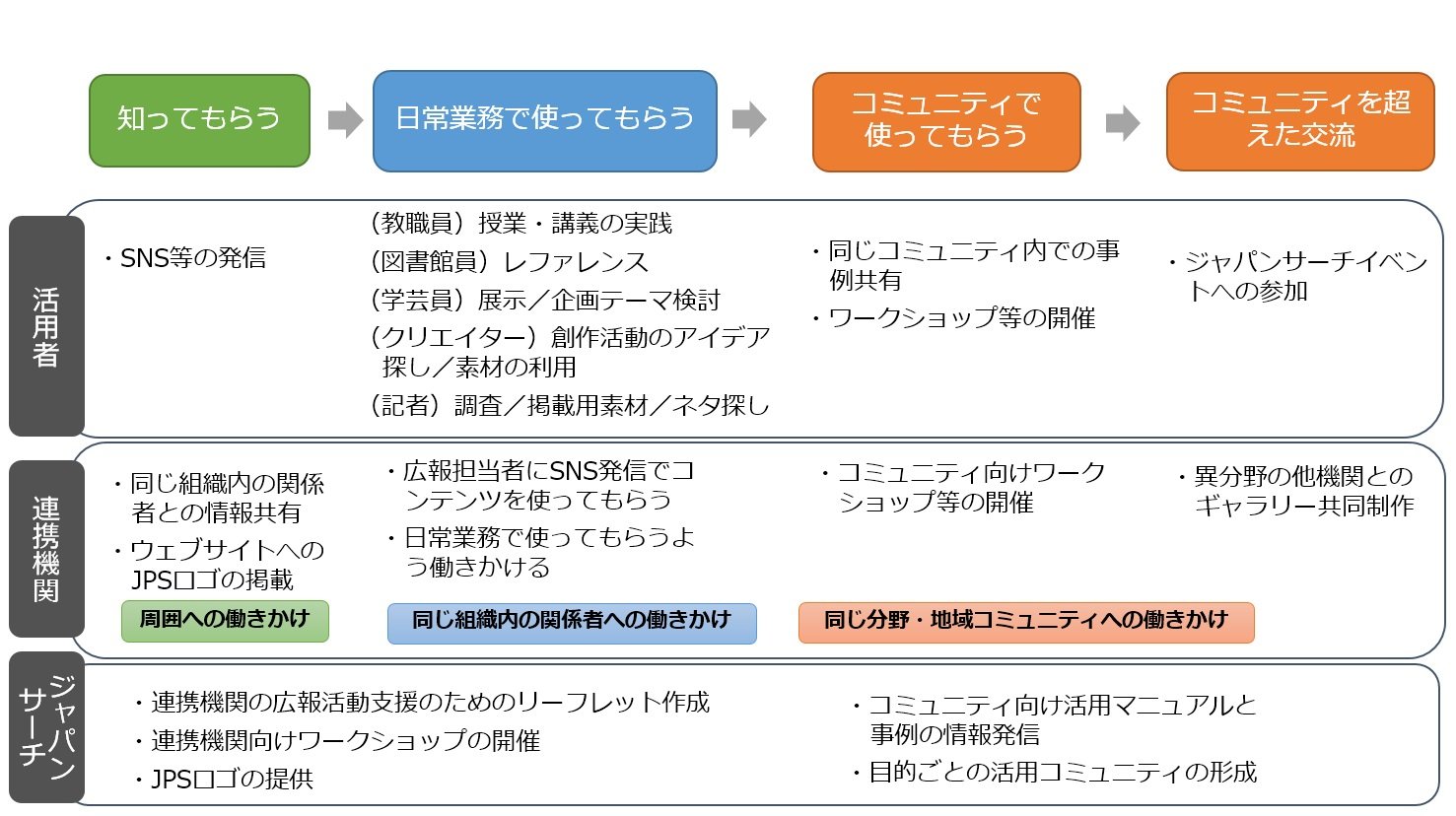
Not only Japan Search operators and partner institutions, but also institutions that are planning to build digital archives, institutions that are planning to collaborate with Japan Search, and users of Japan Search can participate in the measures indicated in the Action Plan. Users can also play a role in facilitating the utilization of Japan Search. Japan Search will support those who participate in the Action Plan by encouraging them to take action where they can, after ascertaining where they currently belong and which phase they are in as shown in Figures 2 and 3. We are also inviting people to join us in taking action together.
Through this action plan, Japan Search aims to solve social issues and create a movement for social change.
The term " Digital Archives" here refers to the entire system for collecting, preserving, and providing various digital information resources, and " Digital Contents" refers to materials, works, etc. in analog media that have been digitized or materials, works, etc. in bone-digital format, and " Contents" refers to the general term for both digital and analog materials, works, etc.
◆Support◆ Japan Search supports the activities surrounding digital archives from various angles.
1. Enable experiences with digital contents in everyday learning and play
Objective: Realization of a "common knowledge base that supports the community"
To provide an environment where people can play as they learn and learn as they play so that they can experience using digital contents without being aware in their daily lives.
Ideal: Research and study using digital contents is implemented in schools nation-wide through the use of Japan Search. In academic and research fields, Japan Search is being used to create and discover new knowledge. In leisure activities, Japan Search can be used to research familiar items and for fun and hobbies.
Current status: Japan Search has functions such as "My Note" and "My Gallery", which allow users to express their discoveries using digital contents, and some schools have begun to use these functions. In addition, studies of teaching materials and class preparation are being undertaken through the use of Japan Search. In the future, it will be needed to support various activities by promoting the use of Japan Search in learning and expanding its use to other areas.
Measures : [Related Targets: 2, 6, 10]
(1) In order to promote the use of Japan Search in school classes, culture schools, and other places of learning, we will propose concrete methods of utilization and support the setup of venues for the exchange of information. ●▲■
(2) Enrich the functions of Japan Search to enable users to easily experience the fun and appeal of digital contents. ●
(3)In order to create experiences for the playground, we will facilitate the use of Japan Search for SNS materials, programming, game materials, search and retrieval games, and creating new board games. ●▲■
(4)Through outreach programs, hackathons, idea-thons, etc., we will propose how to use Japan Search to improve information literacy while playing/learning. ●▲■
(5)We will collaborate with the digital archives in events such as storytelling events and cultural festivals, which to date have focused on physical activities. ▲■
(6)We will promote academic and research use of data provided by Japan Search via API. ●▲■
2. Support various curation activities of digital contents
Objective: Realization of a "common knowledge base to support the community
Through curating contents (collecting, selecting, and editing contents with specific themes), anyone can connect multiple pieces of cross-disciplinary information, express their findings and ideas, thereby providing a common knowledge base to create connections between people and content from different fields and regions, leading to new communication.
Ideal: The "Curation" function of Japan Search is used on a daily basis. People from different fields and regions use the "Curation" function to communicate with each other. Various contents curation activities are being implemented at archival institutions, such as the integration of physical and virtual exhibits.
Current status: "My Gallery", a curation function of Japan Search, can be used by anyone without account registration, and the galleries can be shared online (for 24 hours only). In addition, the "Workspace" function for collaborating institutions allows multiple people to collaborate on their own galleries at any time using only a URL and password. Furthermore, a thematic search function is available for collaborating institutions to enable special searches on specific topics. However, these functions are not well known, and there is room for further promotion of their use.
Measures: [Related Targets: 1, 6, 8, 10]
(1)Support curation activities by hosting workshops on the curation function of Japan Search.●▲■
(2)Further improve the "My Gallery" function to make curation more intuitive.●
(3)Practice curation activities such as holding contests using the "My Gallery" function.●▲■
(4)Implement new approaches using Japan Search in curatorial activities at museums, art galleries, archives, libraries, etc., such as integrating physical and virtual exhibits, or reusing physical exhibits in virtual exhibits.▲■
(5)We will facilitate the use of Japan Search's collaborative contents as material in public relations, thereby promoting media coverage of Japan Search as material for the press agencies and other media to publish.●▲■
(6) Support for efforts to develop various curation possibilities using digital contents.●
3. Connect contents from institutions in a wide range of fields and regions, as well as connecting people
Objective: Realization of "Formation of a New Social Network"
To connect not only digital archive contents but also people involved in digital archives nationwide across disciplines, so that people can support each other across disciplinary and regional boundaries and solve problems faced by archival institutions.
Ideal: Through Japan Search, digital archive contents are connected cross-disciplinary fields. Digital archiving stakeholders in different fields and regions are connected through Japan Search to bring together knowledge and solve problems faced by archival institutions.
Current Status: In addition to holding events such as Japan Search collaboration briefings and industry-academia-government forums, there have been meetings for archival institutions to share their knowledge, including an exchange of opinions on the formulation of strategic policies. On the other hand, the archival institutions have not yet established a forum for regular exchanges of knowledge among themselves.
Measures: [Related Targets: 5, 7, 15]
(1) Connect digital archives in a wide range of fields and regions, aggregate their contents, and provide them in an easy-to-use format.●
(2) Increase opportunities for stakeholders and partner institutions to share issues and knowledge across fields, such as holding forums and workshops for partner institutions.●
(3) Participate in Japan Search events and other events with stakeholders both within organizations and in the community to share knowledge and experience.▲■
(4) Publish practical and useful information such as cases of establishment of archives and cooperation by collaborating organizations.▲■
(5) Open a counseling service for the establishment and collaboration of digital archives by setting up question forms, holding counseling sessions at events.●
(6) Connect digital archives with Japan Search using Japan Search's API or web parts function.▲■
4. Long term support for digital archives of various sizes created in society
Objective: Realization of "inheritance and reconstruction of records and memories"
Ensuring long-term access to digital archives and their materials in various sizes created in society so that records and memories of our own history can be passed on to the future.
Ideal: Archival institutions have established their systems in accordance with the "Guidelines for Long-Term Preservation for Digital Archives" [1], and are taking measures for appropriate preservation, management, and use of digital data. The importance of digital archive activities and long-term preservation efforts are fairly valued, and digital archives are well rooted in our society.
Current status: The Working-level Review Committee formulated the "Guidelines for Long-term Preservation for Digital Archives" and has developed the requirements for the long-term preservation of digital data. In addition, the "Digital Archive Assessment Tool"[2] has been published to ensure that digital archiving efforts are fairly valued by stakeholders. On the other hand, it is difficult to say that awareness of the long-term use guarantee in digital archives has risen. However, it can be said that there is sufficient backup for metadata by coordinating with Japan Search.
Measures: [Related Targets: 9]
(1) Raise awareness of the necessity of long-term preservation measures for digital data and the importance of such measures in order to promote the establishment and availability of digital archives that guarantee long-term access.●▲■
(2) Briefing sessions will be held and documentation will be developed to promote the "Guidelines for Long-Term Preservation for Digital Archives" and the "Digital Archive Assessment Tool".●
(3) Share widely concrete solutions and best practices for long-term preservation, or case studies of failures.●▲■
(4) Open a contact point for counseling on long-term preservation.●
(5) Investigate methods of data succession for archives to be closed.●▲
[1] The Digital Archive Japan Promotion Committee and the Working-level Review Committee, "Long-term Preservation Guidelines for Digital Archives," 2020.8. https://www.cas.go.jp/jp/seisakukaigi/titeki2/digitalarchive_suisiniinkai/pdf/guideline2020.pdf
[2] The Digital Archive Japan Promotion Committee and the Working-level Review Committee, "Digital Archive Assessment Tool," 2018.4. (Revised version 2020.8.) https://www.cas.go.jp/jp/seisakukaigi/titeki2/digitalarchive_suisiniinkai/files/assessment_tool_kaitei.xlsx
◆Provide◆Japan Search will not only provide information on digital archives themselves, but also information on their construction and utilization.
5. consolidate and organize diverse digital archives and convey them to the present and the future
Objective: Realization of "inheritance and reconstruction of records and memories"
Encourage new value to be added to information, and reconstruct records and memories to be inherited to the future, by widely aggregating past records and memories and various ongoing records, organizing them in cross-field connection, and distributing them in a format for easy utilization.
Ideal: Metadata of Japan's major and attractive digital archives are connected to Japan Search in a standardized format, and such metadata is organized and distributed in an easy-to-utilize format.
Current status: Japan Search coordinates metadata while easing the workload of archival institutions as much as possible, normalizes the aggregated metadata (Japanese calendar to Western calendar, old place names to modern place names), and converts it into the "Japan Search Utilization Schema," a cross-disciplinary standard format that is easier for users to use. It is expected that the efforts will continue to develop aggregated metadata. In addition, for effective utilization of metadata, it is necessary to promote standardization of terminology, etc. in each field and regional community.
Measures: [Related Targets: 3,7]
(1) Promote the awareness of the significance and necessity of collaboration among digital archives in order to facilitate cooperation with archival institutions in a wide range of fields and regions.●▲■
(2) In order to lower the cost of collaboration with Japan Search, we will share information on requirements for collaboration and make efforts to disseminate recommended methods of collaboration.●▲■
(3) Organize the aggregated metadata and provide it in an easy-to-use format with value-added information, such as by adding further information, making it multilingual, and converting it to Linked Open Data (LOD).●▲■
(4) Promote standardization of metadata and terminology within the field and community.▲
6. Convey the use of digital archives to various communities
Objective: Realization of a "common knowledge base to support communities"
Promoting the use of digital archives as a common knowledge base within the community by widely disseminating information on how to use digital archives to various communities.
Ideal: Digital archives are used on a daily basis in various communities. Practical examples of digital archive use will accumulate in the community, and the methods of use will be shared.
Current status: Workshops are held and YouTube videos and other information on how to use Japan Search are available. The utilization of digital archives is steadily expanding in education, academia/research, libraries, museums, art galleries, and archives, but it has yet to be applied in broad communities such as business, regional revitalization, tourism, health care, disaster prevention, and lifelong learning.
Measures: [Related Targets: 1, 2, 10]
(1) Provide user-friendly information on how to use the Japan Search functions, such as "My Note" (bookmark function), "My Gallery", "Workspace", and "Projects"[1].●
(2) Through events and SNS, introduce Japan Search's collaborating contents and provide examples of various uses of the digital archive. In addition, we will promote public relations cooperation between Japan Search and partner institutions.●▲■
(3) To facilitate smooth utilization within organizations and communities, we will provide necessary information by preparing leaflets, creating API utilization tools and programming materials, and holding practical workshops.●▲■
(4) Share information on Japan Search's efforts with public relations, education, and exhibition planning staff within organizations and communities.▲
(5) Introduce Japan Search at trainings within organizations and communities.▲■
(6) We will hold events targeting stakeholders in schools and other learning places such as lifelong education, social education, and culture schools, etc., using the digital archives including Japan Search.●▲■
(7) Co-host idea-thons and hackathons using data from various digital archives.●▲■
(8) Introduce the use of Japan Search's collaborating contents to media such as press and creators in various fields.●▲■
(9) Provide local governments with easy-to-understand explanations of the significance of digital archives and examples of their use.●
[1] This function offers the same functions as those of collaborating institutions, such as database registration and gallery creation, and can be used as a temporary joint project for multiple institutions to participate in.
7. Share information for archival institutions to build and collaborate on digital archives
Objective: Realization of "inheritance and reconstruction of records and memories"
By communicating with archival institutions the significance of establishing and connecting digital archives and ensuring access to information necessary for the establishment and connection, archival institutions should acquire all records and memories, including things in real space and materials in analog media, on digital space and pass them on to the future.
Ideal: Archival institutions properly understand the basic concepts and procedures for establishing and sharing digital archives as well as physical collection development. Archival institutions should be able to collaborate on their collections regardless of the medium, analog or digital.
Current Status: Despite holding briefing sessions on cooperation, it would be difficult to say that the necessary information is sufficiently reaching the institutions that wish to establish digital archives and cooperate with each other. In addition, it is necessary to share the significance and merits of the development of digital archives and collaboration among archival institutions to society broadly.
Measures: [Related Targets: 3, 5, 9]
(1) We will revise and share widely the "Guidelines for Establishment, Sharing, and Utilization of Digital Archives" [1] and other guidelines and "Digital Archive Assessment Tools" for the promotion of digital archives as necessary.●▲
(2) We will provide information necessary for collaboration with Japan Search in an easy-to-understand manner. In addition, we will deliver the voices of users that will promote collaboration.●
(3) We will increase opportunities for archival institutions to share knowledge on the establishment of digital archives and collaboration by holding briefing sessions, offering training programs, and dispatching lecturers.●▲
(4) Share efforts related with digital archives by using current networks within the organizations and the communities.▲■
(5) Open a counseling service for the establishment and collaboration of digital archives by setting up question forms, holding counseling sessions at events.(Repeat)●
(6) Connect digital archives with Japan Search using Japan Search's API or web parts function.(Repeat)▲■
[1] Liaison Committee of Relevant Ministries and Agencies and Working-Level Committee on Collaboration of Digital Archives, "Guidelines for Establishment, Sharing, and Utilization of Digital Archives," 2017.4. Available at: https://www.cas.go.jp/jp/seisakukaigi/titeki2/digitalarchive_suisiniinkai/pdf/guideline2020.pdf
8. Promote the appeal of digital contents in galleries
Objective: Realization of a "common knowledge base to support communities"
To realize the integration of learning and play utilizing a rich knowledge system by broadly promoting the appeal of digital contents such as connecting and delivering digital contents from different fields and presenting new ideas and contexts.
Ideal: Increase in the number of galleries open to the public. Archival institutions will provide information about their collections in the galleries. Archival institutions will present new and attractive exhibitions that integrate the physical and digital worlds. Through the galleries, users will be able to explore Japan Search, access the websites of the holding museums, and eventually visit the physical holding museums.
Current Status: "Gallery" already plays a role in some respects as pages where digital contents can be easily enjoyed. On the other hand, it is not yet fully recognized that "Gallery" enables partner institutions to widely promote their own collections and to create new ideas and values by connecting and editing contents in different fields.
Measures: [Related Targets: 2]
(1) Create a "Galleries" on Japan Search that introduces collaborated digital contents with explanations for each theme, and promote the attractiveness of the contents.●▲
(2) Create "Galleries" across the organizations.●▲
(3) Workshops and other events will be held to promote the appeal of creating "Galleries".●▲■
(4) Create new and attractive exhibitions that integrate digital and physical space.▲■
(5) Develop necessary functions and information to support the creation of "Galleries" by the collaborating organizations.●
(6) Inform collaborating institutions how to deliver digital contents using "My Gallery" and "Workspace Project".●
◆Expand◆Japan Search will enhance the digital space by promoting digital archiving and expanding collaboration, thereby expanding the possibilities for the use of content in society.
9. Promote digitization of various materials and enhance the knowledge base of digital space
Objective: Realization of "inheritance and reconstruction of records and memories"
Encourage the inheritance and reconstruction of records and memories for the future by developing a knowledge base in digital space by creating digital copies of all records and memories, including objects in real space and materials in analog media.
Ideal: All materials held by museums, art museums, libraries, and archives nationwide, and regional materials held by local governments have been digitized. Communities that actively utilize their local digital archives have been fostered. The establishment and utilization of regional archives are promoted nationwide, making regional materials available to anyone, anywhere.
Current Status: Although digitization of contents is progressing in some fields such as books and official documents, the total amount of digital contents available on the Internet is still small compared to Europe and the United States. Many archival institutions face challenges in digitizing materials and developing metadata, such as lack of budget, manpower, and skills.
Measures: [Related Targets: 4, 7, 11]
(1) Increase the number of digital contents registered in Japan Search. Expand the contents in a wide range of eras and fields.
(2) Share useful information for the improvement of digital contents with archival institutions, such as technical information on digitization (including specifications for image processing), how to maintain collections, how to develop metadata, and so on. In addition, we will disseminate information related to the above.●▲
(3) Create and publish tools that allow users to easily experience the establishment of a digital archive.●■
(4) Digitize the materials in accordance with the "Guidelines for Establishment, Sharing, and Utilization of Digital Archives".▲
(5) Create manuals to publish digital contents created or collected by archival institutions.●
(6) Open a counseling service for the establishment and collaboration of digital archives by setting up question forms, holding counseling sessions at events.(Repeat)●
10. Discover people who can make use of digital archives and increase the number of fans
Objective: Realization of a "common knowledge base that supports the community" and "Formation of a New Social Network"
To promote the creation of new ideas and values by rooting digital archives in society as a common knowledge base that can be used on a daily basis, by developing human resources to propose and distribute various ways of using digital archives, and by increasing the number of fans who use digital archives.
Ideal: There are people throughout the country who propose and distribute various ways of using digital archives. There is a broad range of fans nationwide who use digital archives on a daily basis and support the efforts of digital archives. There will be a large number of mutual circulations of access between Japan Search and the collaborating digital archives.
Current Status: Museums, art galleries, libraries, and other institutions are making use of images of materials in their collections for special exhibitions, etc. and are also making progress in their use in the educational field. On the other hand, the number of citizens who use digital archives on a daily basis is still small. Reasons for the lack of penetration of digital archives among the public may include lack of recognition of the benefits and convenience of digital archives, difficulty in understanding how to use digital archives, and strict conditions for secondary use.
Measures: [Related Targets: 1, 2, 6]
(1) Through events and SNS, introduce Japan Search's collaborative contents and provide examples of various uses of the digital archive. In addition, public relations cooperation between Japan Search and partner institutions will be promoted.●▲■
(2) Provide an entry point for access to Japan Search from the digital archive websites of partner institutions by placing the Japan Search logo on their websites, etc. ▲■
(3) Hold workshops to promote the use of digital archives.●▲
(4) Create " facilitators" (people and organizations that promote the use of the digital archives) and support their activities.●▲■
(5) Propose various ways to utilize the Japan Search archives and discover human resources to communicate with the public.●▲■
(6) Enhance the Japan Search user manual, help pages, etc.●
11. Expand digital archives collaboration with Japanese attractions, especially those with regional characteristics
Objective: Realization of "inheritance and reconstruction of records and memories" and "Formation of a New Social Network"
Inherit attractive records and memories from various regions of Japan into the future by expanding collaboration with unique regional digital archives.
Ideal: All major digital archives in all 47 prefectures are connected to each other. There are "aggregators" of regional archives throughout the country.
Current Status: As of February 2022, Japan Search has collaborated with eight local governments as its partner (aggregator) institutions, and approximately 560,000 items of regional contents have been registered via local libraries, archives, museums, art galleries, and other partner institutions. However, the number of collaborating regional archives is still limited, and there is a polarization in terms of fields and regions. It has also been pointed out that Japan Search's regional contents include only a small number of post-modern items.
Measures: [Related Targets: 9]
(1) Promote collaboration with unique regional digital archives in each of the 47 prefectures.●▲
(2) Increase the number of unique regional digital contents.▲
(3) Specify Japan Search's collaboration policy and establish a collection policy.●
(4) We will support the fostering of institutions to serve as aggregators for regional archives by introducing good practices in regional archive collaborations, offering information necessary for cross-field collaborations, and providing a trial function ("Project") of Japan Search's collaboration.●
(5) Support archival institutions connecting via the aggregating partners to ensure smooth collaboration with Japan Search.●
(6) Investigate collaboration with overseas digital archives that hold Japan-originated contents.●▲
12. Increase user-friendly contents that are easy to find and have well-developed terms of use
Objective: Realization of "inheritance and reconstruction of records and memories" and a "common knowledge base that supports the community"
Enhance discoverability and provide a common knowledge base that everyone can use on a daily basis by enriching contents metadata and displaying conditions for secondary use in an easy-to-understand way, thereby promoting the inheritance and reconstruction of records and memories.
Ideal: A fair number of Japan Search collaborated data have image URLs, descriptions, and appropriate secondary use conditions, etc. set in the metadata. All of the digital archives in Japan have rights descriptions in accordance with "Desirable Secondary Use Condition Indication in Digital Archives" [1].
Current status: Japan Search displays images through URLs registered in metadata, and has mechanisms in place to make it easy for users to find and use contents by setting and displaying digital contents, thumbnails/previews, and metadata secondary use conditions, respectively, in a user-friendly way. On the other hand, some images without image URLs, descriptions, or other information are not available. Users, therefore, still find it difficult to find and use the contents.
Measures: [Related target: 13]
(1) Enrich metadata contents such as content image URLs, thumbnail image URLs, descriptions, secondary use conditions, etc.●▲
(2) Improve metadata in English (titles, descriptions, etc.).●▲
(3) Promote awareness of "Desirable Secondary Use Condition Indication for Digital Archives". We will set appropriate secondary use conditions so that digital contents provided on Japan Search will be clearly labeled with appropriate secondary use conditions.●▲
(4) Hold meetings to share and discuss the knowledge of partner institutions and experts on the conditions for secondary use of digital contents.●▲
[1] The Digital Archive Japan Promotion Committee and the Working-level Review Committee, "Desirable Secondary Use Condition Indication in Digital Archives," 2019.4. Available from: https://www.cas.go.jp/jp/seisakukaigi/titeki2/digitalarchive_suisiniinkai/jitumusya/2018/nijiriyou2019.pdf
◆Challenge◆ Japan Search will constantly incorporate innovative technologies to create new uses of digital archives and promote DX in society.
13. Maximize freely available and open digital contents
Objective: Realization of "inheritance and reconstruction of records and memories" and a "common knowledge base that supports the community"
Increasing the amount of digital contents with open terms of use so that we can maximize the use of the common knowledge base that supports communities. Also, making it easier for contents created in the digital space to be inherited in the future.
Ideal: A fair amount of Japan Search's collaborated contents will be open (freely available for secondary use CC0, CC BY, CC BY-SA and PDM) digital contents, and images with a certain level of quality will be published on the web.
Current status: As of the end of FY2021, there are approximately 1.3 million collaborated contents for which open licenses or copyright protection periods have already passed, but this is only 5% of the total number of contents. It is necessary to promote understanding of openness among archival institutions and offer incentives. Archival institutions that are able to publish even a small portion of open contents can improve their recognition and brand power, and reduce human costs by avoiding procedures for permission requests.
Measures: [Related Targets: 12,16]
(1) Investigate the possibility of making digital content open (CC0, CC BY, CC BY-SA, and PDM) collaborated with Japan Search, and work to make these contents open as much as possible.▲
(2) Provide information on the necessity and importance of contents openness in an easy-to-understand way, share examples of excellent efforts, and foster an environment that encourages archival institutions to work on openness.●
(3) Provide a mechanism to give incentives to institutions that work on openness ●
(e.g., awarding prizes, holding competitions using open works, such as Europeana's GIF IT UP)
(4) We will make the "open data evangelists" of the Digital Agency aware of Japan Search and support activities to promote digital archives to be open.●
(5) We will support activities to enhance the information literacy of users by, for example, always noting the source of the digital contents when using open data such as CC0 and PDM so that archival institutions can open their digital contents with confidence.●▲■
14. Demonstrate new possibilities for digital archives with advanced technology
Objective: Realization of "inheritance and reconstruction of records and memories" and a "common knowledge base that supports the community"
Create digital space to provide a foundation for archiving copies of historical and current records and memories to be inherited into the future, and to enable archived digital contents to be easily utilized to create new communication tools appropriate to the times.
Ideal: Japan Search is regarded as a stable infrastructure with a sophisticated UI, including offering utilization functions, and as a technologically advanced system with state-of-the-art technology. It is being followed as an excellent example of digital archiving from all over the world.
Current status: As for the search performance, automatic generation of Roman characters for searching at metadata registration, automatic English translation of keywords for searching are implemented, as well as image search developed using AI. Also, image processing is based on the global standard IIIF. In addition, various functions ("My Gallery", "Workspace", etc.) are provided to promote the utilization of contents.
Measures: [Related Targets: 16]
(1) To enable users to quickly find the contents they are looking for, we will improve search performance and the accuracy of image searching. In addition, we will display related contents to encourage users to make new discoveries.●
(2) We will implement SEO measures so that Japan Search pages will be listed at the top of search engines widely used in the world.●
(3) We will continue research and development of advanced information technology, and develop new service models and useful tools (automatic maintenance of metadata, support for converting handwritten metadata to text, etc.) to promote the establishment, collaboration, and utilization of digital archives.●▲■
(4) To develop AI-based services and create new services and innovations, we will assemble and publish datasets using digital archives.●▲■
(5) Support the creation of new applications using the Japan Search API by enhancing "Information for Developers" and providing tools that facilitate utilization of the API.●
(6) We will organize the aggregated metadata and provide Wikidata with value-added RDF data, including the additional information, multi-language, and LOD. We also offer datasets for machine learning that are useful for researchers, engineers, etc.●▲
15. Build new community networks across fields and regions
Objective: Realization of "Formation of a New Social Network"
Establish a knowledge base covering a wide range of fields and regions to form new social networks, and promote contents exchange among communities and the creation of new ideas and values.
Ideal: New connections will be established between communities that have not interacted with each other before. For example, joint research and fusion among multiple academic fields will be facilitated, and new research areas will be founded. New business areas will be developed through collaboration across industry, government, and academia by using digital archives.
Current Status: In the practice of digital archives, there are already examples of new collaborative research, such as history x seismology. In the future, in order to promote multi-disciplinary approaches and develop new business areas, it is necessary to create various exchanges among communities that have never seen before, for example, exchanges between archival institutions as data providers and users, and exchanges with overseas countries.
Measures: [Related Targets: 3]
(1) Hold events to promote exchanges between collaborating institutions and users, and among different fields and regional communities. (Example: Japan Search Fest)●▲■
(2) Support the creation of utilization communities for different purposes, such as use for educational purposes, academic/research use, and tourism use, and provide opportunities for information exchange among people in various positions, such as educational personnel, government officials, universities, and companies.●▲■
(3) Promote collaboration with overseas digital archives using the Japan Search API by enhancing the English-language publication of "Information for Developers" and providing tools that facilitate the use of the API.●■
(4) In addition to "GIF IT UP", expand cooperative projects with Europeana, DPLA, etc. regarding curation of collaborated contents in order to promote exchanges with overseas institutions.●▲■
16. Promote the digital transformation of society through the circulation of knowledge production and utilization
Objective: Realization of "inheritance and reconstruction of records and memories" and a "common knowledge base that supports the community" and "Formation of a New Social Network"
Guarantee the circulation of knowledge in society as a common knowledge base that supports communities by encouraging the inheritance and reconstruction of records and memories. In particular, in the circulation of knowledge, archival institutions and users should add value-added information to contents and create new value, thereby promoting social transformation through digital archives.
Ideal: Digital archives are used in everyday life, and social transformation through digital archives is progressing in a wide range of fields. In archival institutions, too, (1) digitization of archival materials in the collections of archival institutions (including the collection of bone-digital materials) and collaboration with Japan Search, (2) Development of new technologies and services using digital contents, which will improve daily operations more efficiently and provide richer services than ever before, thereby promoting DX of archival institutions.
Current Situation: DX of society is a major challenge, as evidenced by the recent response to COVID-19, where digital technology is not fully used at the forefront of education and public services. The routine use of digital archives is one of the challenges to solve this issue. It is necessary to share the direction of DX that archival institutions and users should aim for, and promote necessary efforts so that everyone can benefit from the digital society.
Measures: [Related Targets: 13,14]
(1) As a leader of DX in society, Japan Search will offer technical information and digital tools to support DX of archival institutions.●
(2) We add new information to the data provided by archival institutions to promote the creation of new value of archival institutions and the discovery of their identities.●▲■
(3) Share best practices where services and daily operations have been innovated through the use of digital archives.●▲■
(4) In addition to holding workshops, we will implement initiatives to disseminate the Japan Search Action Plan to society, including the development of a preferred model from the establishment of a digital archive to its utilization.●▲■
(5) Award archival institutions and users who are actively engaged in initiatives to make digital archives a part of everyday life (promotion of digitization, more openness, offering new services using new digital technologies, etc.).●▲■
April 6, 2022
The Digital Archive Japan Promotion Committee and the Working-level Review Committee Decision
[Hereafter, the Committee's constituent organizations, members, et al.]
Dr. Akihiko Takano, Professor Emeritus, National Institute of Informatics (Chair)
The Cabinet Office, Intellectual Property Strategy Headquarters (Secretariat)
The Cabinet Office, the Minister's Secretariat Archives and Documents Division
The Digital Agency
Ministry of Internal Affairs and Communications, Information & Communications Technology Bureau
Ministry of Economy, Trade and Industry, Commerce and Information Policy Bureau
Japan Tourism Agency
National Museum of Nature and Science
The Independent Administrative Institution National Museum of Art
National Institutes for Cultural Heritage
National Institutes for the Humanities
Joint Support-Center for Data Science Research
Broadcast Programming Center of Japan
Rights & Archives Management Center, NHK
Dr. Naoto Ikegai, Associate Professor, Graduate School of Law, Hitotsubashi University
Dr. Sugimoto Shigeo, Professor Emeritus, University of Tsukuba
Mr. Hiroki Yamazaki, Representative Director, Intellectual Resource Initiative
Dr. Hidenori Watanave, Proffessor, Graduate School of Interdisciplinary Information Studies, the University of Tokyo
Dr. Ikki Ohmukai, Associate Professor, Graduate School of Humanities and Sociology / Faculty of Letters, the University of Tokyo
[Other institutions and collaborators who contributed to the preparation of this report]
Aomori Prefectural Government, Department of Environment and Public Affairs
The Japanese Council of Art Museums
Nanjo City Board of Education, Okinawa
Kansai University Open Research Center for Asian Studies (KU-ORCAS)
Research Resource Archive, Kyoto University
Library of Education, National Institute for Educational Policy Research
University of Tokyo Library System
Nature and Science Museum, Tokyo University of Agriculture and Technology
Niigata University, Regional Image Archive Reserch Center
Fukui Prefectural Archives / Fukui Prefectural Library
Art Research Center, Ritsumeikan University.
University of the Ryukyus Library
The Tsubouchi Memorial Theatre Museum, Waseda University
Mr. Masao Oi, Graduate School of Interdisciplinary Information Studies, The University of Tokyo
【PDF】 Japan Search Action Plan 2021-2025 (1.7MB)