飛鳥時代の仏教の広がりについて
飛鳥時代の仏教に関連する芸術作品、記述をまとめ仏教がどう広がっていったかを知る。
館長からの挨拶
西暦538年に百済から伝来された仏教。
その仏教が最初日本でどのように広まっていったかを、展示されている作品から読み解きます。
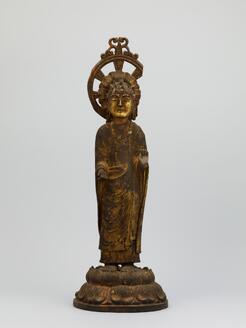
This wooden statue was made in the 7th century during the late Asuka period, not long after Buddhist statues first arrived on Japan's shores. It was originally passed down at Horyuji Temple in Nara.Only a few Buddhist statues still remain from that time. Those made of wood are particularly valuable. This statue is made from the aromatic wood of the camphor tree in accordance with teachings from India, which stated Buddhist statues should be made from fragrant wood.The child-like face contains a hint of sadness. From another angle, though, this enigmatic statue also appears to be an old man.Let's look at the statue from the side. The body is bent like an arrowhead, with the chest pulled in and the stomach pushed out. This is a characteristic pose of Buddhist statues from this era. The top of the head was once adorned with a large number of spiral curls but most have been lost with the passing of time.The left hand is held up with the palm facing out in a gesture that signals there is no need to be afraid. The right hand is held lower and is extended toward the viewer. This symbolizes the granting of wishes. This buddha has a child-like face and a gently curved S-shaped posture, both stylistic features of the Asuka period (593–710). While most buddhas from this period are gilt bronze, this one is carved from camphor wood. This unusual choice likely relates to the worship of camphor trees, which were thought to house sacred spirits.
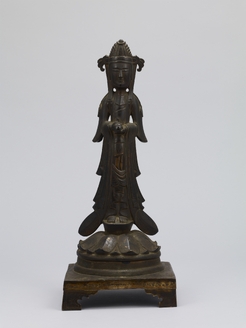
This Bodhisattva stands atop a lotus blossom, holding up a wish-fulfilling jewel in both hands. The figure's robes spread outward to both sides, while the lack of depth in the depiction of the body suggests that it was meant to be observed from the front. Another distinctive feature of this sculpture is that it fits within the shape of an isosceles triangle when viewed from the front. These elements draw on the style of Tori, a Buddhist sculptor active at the beginning of the seventh century, in the early Asuka period.However, the hems of the robes flow slightly backwards, and the figure has a gentle, kind face. Both of these features reflect a stylistic development that builds upon the work of Tori. Moreover, this sculpture reflects a period of stylistic transition in the latter half of the Asuka period, when Buddhist sculptures began to take on more natural-looking physiques. The inscription engraved on the front of the pedestal reveals that this work was created in the year 652.
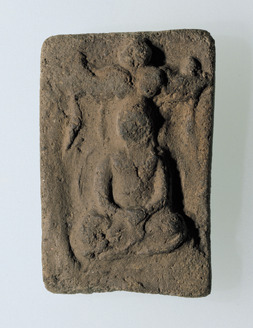
A Buddhist deity is depicted seated alone in the lotus position under a tree. Tiles with images of Buddhist figures were probably used to decorate the inner space of important temple buildings to create solemnity.
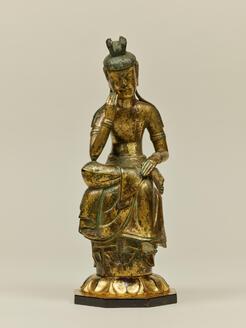
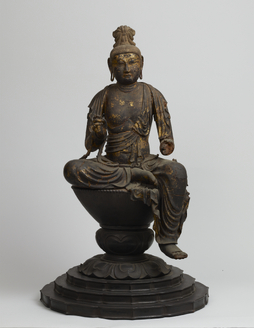
This Buddhist figure sits with one leg crossed, resting his right elbow on his knee and his chin in his hand. His slightly rounded back, tilted head, and the way the fingers of his right hand just barely touch his cheek lend the statue an air of naturalness.His armlets and the way his hair is gathered into a bun on top of his head tell us that he is a bodhisattva. In Japan, statues posed contemplatively with one leg crossed and one leg pendant, like this one, often depict the bodhisattva Miroku, who was worshipped in Japan as a bodhisattva who would save humanity.This gilded bronze statue was excavated from a sutra mound at Mt. Nachi, a famous sacred mountain in Wakayama Prefecture. A sutra mound is a place where cylinders containing sutras, mirrors, Buddhist statues, or other similar artifacts are buried in the earth. In the late Heian period (794–1192), it was widely believed that Buddhist teachings would decline 2,000 years after the death of the buddha Shaka. Many people of the time believed that the bodhisattva Miroku would appear in 5,670,000,000 years to save humanity. People made sutra mounds to preserve Buddhist teachings until that time. You could say that this statue was put in a time capsule meant for people 5,670,000,000 years in the future.This Buddhist deity sits in contemplation with one leg resting on his knee. In Japan, images with this posture were often worshipped as the bodhisattva Miroku. People thought he would return to this world to save all living beings 5,670,000,000 years after the death of Buddha Śākyamuni.
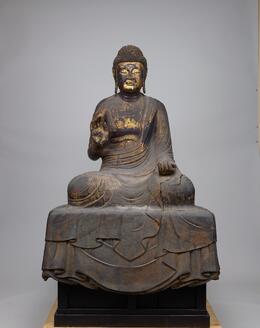
The suface of this sculpture was modeled by applying a putty-like mixture of lacquer and wood pulp onto a wooden core. This technique became popular in the Nara period (710–794).The Buddhist pantheon includes a variety of Buddhist deities with different names, appearances, and roles. “Buddha” means “one who has reached truth.” It originally referred only to the Buddha Shaka, the founder of Buddhism. As Buddhism developed after Shaka’s death, however, its followers came to believe that other Buddhas also exist.This is a statue of the Buddha Yakushi. The “yaku” in Yakushi means “medicine.” As his name suggests, he is believed to have the power to cure any disease. All buddhas share the same basic appearance, which can be seen in this statue. Its characteristics include a hair style with many small, round curls, three wrinkles at the base of the throat, and simple clothing consisting of only a plain cloth wrap.Note how the statue is modeled. It has an oval face with clean-cut features, and the folds of its robe are lightly and simply carved.The rough shape of this statue was carved from a single block of wood. Paste was then shaped over its surface. Based on recent research, the paste that forms the statues surface is thought to be a mixture including the inner bark of the elm tree, sticky substances, and wood dust. This process brings out both the thick solidity of the wooden model and the softness of the paste. On the other hand, it also requires a great deal of time, labor, and wealth. This technique was employed primarily during the Nara period (710–794). Buddhist statues from later periods feature thinner layers of paste on their surfaces and are classified as wooden.
ご覧いただきありがとうございました。
飛鳥時代の仏教について興味を持っていただけたら幸いです。
現物を飾る限定展を開催します。
今回で興味を持っていただけた方はぜひ足を運んでいただきたいです。