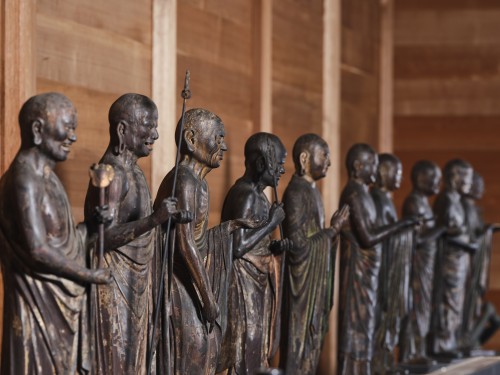
Unkei and Kaikei
Two sculptors of Buddhist statues active early in the Kamakura period who exerted tremendous influence on later Japanese sculptors
Unkei
d. 1223
Unkei was a Buddhist statue sculptor of the late Heian and early Kamakura periods. His father, Kokei, was a highly reputable master sculptor of the Kei School, which followed the tradition of Buddhist sculpting started by Jocho (d. 1057). Around the time of these two sculptors, aristocrats, when they commissioned Buddhist statues, tended to rely on sculptors of the In or En schools, thus giving these two schools considerable draw in society. The Kei School, attached to the Kofuku Temple in Nara, was active mostly in Nara and its vicinity, and was not very influential. In the time of Unkei, however, the Kei School found favor with the samurai class, and it received many orders not only from samurai households but also from the Kamakura shogunate and landed gentry. The rebuilding of Kofuku and Todai temples after Taira no Shigehira burned them down in the Siege of Nara (1180) brought about this change in fortune. Unkei's realistic, powerful style stood in marked contrast to the formalized, trifling statues commissioned by aristocrats at the end of the Heian period and conformed to the general cultural trend of the time, namely, a strong repudiation of Heian court culture. But his work was not simply a repudiation of statues of the former age. He also studied sculptures since the Tenpyo era (729-749) in the Nara area and synthesized them into his own work. Therein lies the basis of the strength of his works. His outstanding works include the statue of Dainichi Nyorai (Mahavairocana) at Enjo Temple in Nara; the statues of Miroku (Maitreya), Mujaku (Asanga), and Seshin (Vasubandhu) in Hokuen Hall at Kofuku Temple in Nara; and a statue of Kongorikishi (Vajrapani), made with his father's apprentice Kaikei, at Todai Temple in Nara. After Unkei passed away in 1223, his sons—Tankei, Kosho, and Koben—as well as Kaikei, continued to be active. As a result of their activity, the first half of the Kamakura period became, in the sphere of sculpture, the age of the Kei School, centered on Unkei, and in succeeding ages the Unkei style exerted tremendous influence on Japanese sculpture.
Kaikei
Dates unknown
Kaikei was a Buddhist statue sculptor of the late Heian (794-1180) and early Kamakura (1180-1333) periods. It is thought that he was an apprentice to Unkei's father, Kokei. He signed his works "Tanba koji" (lecturer of Tanba Province) or "Echigo hokkyo" (master of the Dharma bridge of Echigo Province), two Buddhist ranks. In addition, he also styled himself as "An Amida Butsu" (one who loves the Amitabha Buddha), on account of his belief in True Pure Land Buddhism and his bond with the Todai Temple priest Chogen, who had converted him to Buddhism. When he worked with Unkei, Kaikei followed Unkei's vigorous style, but he also had his own style. Critics have called his style "graceful" for its wise and gentle visages, flowing robes, and color schemes with gold paint or gold foil. While accepting the flowing style of Fujiwara sculpture in the late Heian period, he also adopted the physical realism characteristic of the Kamakura period. About 30 extant sculptures can be identified as having been made by Kaikei. His most outstanding works are Miroku, the Bodhisattva of the Future, in the Boston Museum of Fine Arts; Kongorikishi (Vajrapani), made with Unkei, at the large southern gate in Todai Temple in Nara; Standing Statue of Amida Nyorai (Amitabha Tathagata) in Shunjo Hall also at Todai Temple; the Amitabha Triad, the principle object of worship, at Jodo Temple, built by Chogen, in Hyogo Prefecture; Rushana Butsu (Vairocana, only the head is original) at Shindaibutsu Temple, founded by Chogen, in Iga, Mie Prefecture; Monju (Manjushri Bodhisattva) with Five Venerable Forms, made during the Kennin era (1201-1204), in Monju-in in Nara. In the latter half of his life, Kaikei made many Amida Nyorai statues, showing his fervent belief in True Pure Land Buddhism. After Kaikei came Gyokai, Eikai, and Chokai, who continued to make Buddhist statues in the An'ami style, the style for which Kaikei is known. They thus furthered his influence on later ages.
Related People, Things and Events
Books
Unkei and Kaikei in art history
Related Works
Judai Deshi Zo (“Ten Great Disciples”) at Daihoon-ji Temple (work of Kaikei)
Works of Kei school
Videos
Past Exhibitions
| Title | shusai | Place | open | close |
|---|---|---|---|---|
Institutions Holding Related Materials
The National Diet Library (NDL), founded in 1948, is the library which belongs to the Diet. The NDL assists the activities of the National Diet. The Library collects and conserves materials and information both from Japan and abroad, serving as a foundation of knowledge and culture and providing library services to administrative and judicial entities and Japanese citizens.
As Japan’s representative museum, Tokyo National Museum collects, preserves, displays, and researches the cultural properties of Asia with a focus on Japan, and also provides educational programs.
Nara National Museum collects, preserves, displays, researches and provides educational programs about cultural properties with a focus on Buddhist art.
早稲田大学図書館は、1882年、東京専門学校の図書館設置以来、長い歴史を持つ国内私立大学の中でも最大規模の図書館です。
奈良県奈良市の華厳宗の大本山。運慶、快慶の代表作、阿形像と吽形像の金剛力士像が立つ。
所在地は静岡県伊豆の国市。阿弥陀如来坐像を始め、30代中頃の運慶が手がけた5体の作品がある。
奈良県奈良市の真言宗の寺院。運慶による国宝「大日如来像」は多宝塔の本尊。
奈良県奈良市の法相宗の寺院。運慶作品として仏頭、無著世親立像、弥勒如来坐像がある。
三重県伊賀市の真言宗の寺院。快慶作の盧舎那仏(頭部のみが当初のもの)がある。
奈良県桜井市にある華厳宗の寺院。快慶作の国宝「木造騎獅文殊菩薩及脇侍像」(文殊五尊像)がある。
京都市上京区にある真言宗の寺院。快慶作の十大弟子像のほか、慶派の仏像を安置する。
External Links
奈良県観光局観光プロモーション課が作成するWEBページ。写真とともに、運慶、快慶の解説がある。
東京国立博物館のブログ記事。「運慶・快慶周辺とその後の彫刻」─仏像の髪型―という題で、解説が行われている。