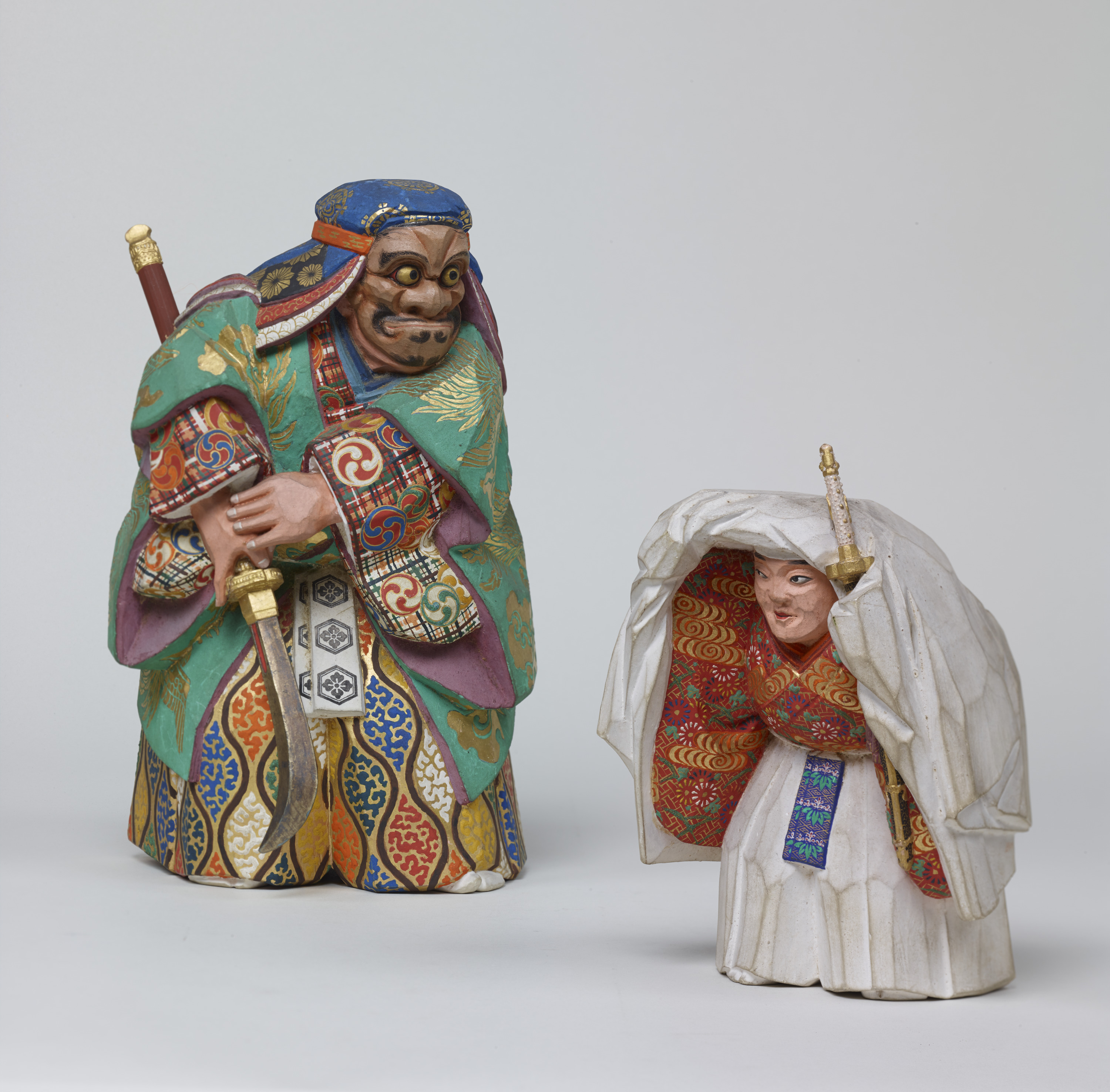
Benkei
The brave Buddhist warrior-monk who later became Minamoto no Yoshitsune's retainer
Benkei, also called Musashibo (the bonze from Musashi Province), is most famous as Minamoto no Yoshitsune's retainer and is also known as a brave Buddhist warrior-monk. It is not known when he was born. From the oral tradition that he died defending his lord Yoshitsune in the Battle of Koromogawa in Mutsu Province, we can infer that he died in 1189. He is thought to have been an actual historical figure, but actual historical facts are scarce.
In the entry for the 3rd to 6th in the eleventh month in 1185 in Azuma kagami (Mirror of the East; a History of the Kamakura Shogunate), among Yoshitsune's followers is one named "the monk Benkei" and "Musashibo Benkei." In the epics Heike monogatari (Tale of the Heike) and Genpei josui ki (The Rise and Fall of the Minamoto and Taira Clans), one can also find his name.
According to Gikei ki (The Chronicle of Yoshitsune), Benkei was born as a son of a shrine steward of Kumano in Kii Province. Known as a "young devil," he entered the monastic discipline of the West Pagoda of Enryaku-ji Temple on Mount Hiei, but was expelled for his frequent bouts of mischief. Later he undertook a pilgrimage to the sacred mountains of Shikoku and entered the monastery on Mount Shosha in Harima Province (Engyo-ji Temple in Himeji, Hyogo Prefecture), but here too he caused an uproar. He then headed to Kyoto and resolved to challenge swordsmen and take their swords and in this way accumulate 1,000 swords.
According to the Legend of Benkei on the Bridge, Benkei then encountered the young Yoshitsune (then known by his childhood name Ushiwaka) on the Gojo Bridge, sought his sword, but failed to obtain it. Having been defeated by the young Yoshitsune, he then became Yoshitsune's retainer.
In the Legend of Benkei on the Boat, after the defeat of the Taira clan in the Genpei War, Yoshitsune, pursued by Minamoto no Yoritomo, fled to the western part of Japan. While Yoshitsune and Benkei were fleeing by boat, the vengeful ghost of Taira no Tomomori appeared to them, but Benkei dispatched it.
Then there is the Ataka Legend. In this legend, while Yoshitsune and Benkei were fleeing to the north, Benkei came to Yoshitsune's aid with a clever stratagem at Ataka Pass (Komatsu, Ishikawa Prefecture).
Finally, in the Dying on His Feet Legend, Benkei, in the Battle of Koromo River, suffered a swarm of arrows and died on his feet.
These legends have served as the subject matter for Noh songs such as Funa Benkei (Benkei on the Boat), Hashi Benkei (Benkei on the Bridge), and Ataka, as well as for kabuki plays like Kanjincho (The Subscription List) and Benkei joshi (Benkei the Emissary). In all of these materials, Benkei is treated as a true hero.
In folklore, Benkei is said to carry seven weapons. What these weapons are varies according to the source. Gikei ki, for example, lists his weapons as a longsword, a sword, a broadaxe, a sickle, a rake, and a staff made from a yew tree.
Related People, Things and Events
Books
Related Works
根付・人形など
Benkei featured in noh plays
Benkei as performed by Ichikawa Danjuro
Videos
Historical audio records (SP records) of Benkei
Past Exhibitions
| Title | shusai | Place | open | close |
|---|---|---|---|---|
| 逓信総合博物館(ていぱーく) | 2005/2/4 | 2005/2/20 | ||
| 国立公文書館 | 2011/4/2 | 2011/4/21 | ||
| 林原美術館 | 2005/6/12 | 2005/7/17 |
External Links
嘉祥3年(850)、比叡山延暦寺の高僧慈覚大師円仁の開山。その後、12世紀のはじめに奥州藤原氏初代清衡公によって大規模な堂塔の造営が行われた。
北海道寿都町(すっつちょう)のHPより。奥州平泉を逃れた源義経・弁慶一行は、蝦夷ヶ島(北海道)に渡り、この地に滞在したと伝えられています。
平成23年度 春の特別展「国立公文書館創立40周年記念貴重資料展Ⅰ 歴史と物語」より。展示された資料は寛文10年(1670)刊で、紅葉山文庫旧蔵のもの。
和歌山県田辺市の田辺観光協会が運営するサイト。トップ画面の「ジャンルから探す」の中の「モデルコース」をクリックし、「武蔵坊弁慶ゆかりのコース」を選択すると、田辺市内の弁慶に関わる名所・旧跡を知ることができる。
島根県立古代出雲歴史博物館の指定管理者の一員でもある「ミュージアムいちばた」が運営するサイト「いずもる」より。島根県松江市内の伝説地を、動画とともに紹介している。
公文教育研究会が運営するサイト。トップページの左上に「弁慶」と入力し、浮世絵を検索する。
江戸東京博物館HPより。平成9年(2005)の展覧会「安政の江戸大地震150年」の紹介ページがあり、そのうちとして「弁慶なまづ道具」の画像が見られる。
References
- 上横手雅敬 編著,文英堂
- サンプルページ「弁慶」の項
- 「弁慶」の項
- 「弁慶」の項
- 「弁慶」の項
- 歴史学研究会 編,岩波書店
- 『義経記』が載っている。
- サンプルページ「義経記」の項