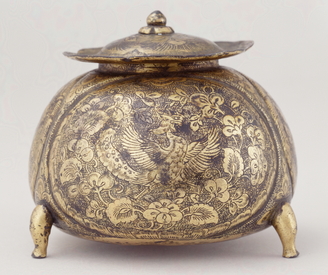
Kinko (Metalwork)
From swords and decorative items to cast Buddhist images; a major branch of Japanese craftwork
A branch of artistic craftwork produced with metal as the main material, as well as techniques used to make such crafts. Includes processes such as casting (chuzo), in which metal is shaped by melting it and pouring it into molds, forging (tanzo), in which metal is shaped by hammering it out, and chasing (chokin), which involves carving or engraving with chisels.
The craft originated in areas where ancient civilizations had developed around 4,000 BC, and its development focused on the use of metals that were relatively easy to source and process: gold, silver, and copper. Gold in particular was long valued as the most precious material due to its processability and the way it continually maintains its gleam.
Metalworking techniques were transmitted to Japan from China and Korea in the Yayoi period around 300 BC, and by around 100 BC small items such as swords and decorative objects were being made. With the introduction Metalworking techniques were transmitted to Japan from China and Korea in the Yayoi period around 300 BC, and by around 100 BC small items such as swords and decorative objects were being made. With the introduction of Buddhism to Japan in the Asuka period (592–710), the technologies rapidly developed further for use in temple construction, Buddhist image production, and so on. Representative examples of work from this period include Buddhist images made with lost-wax casting (ro-gata chuzo) and gilded, such as Asuka-dera Temple’s Joroku-butsu Great Buddha (606) and Horyu-ji Temple’s Shaka Sanzon-zo Shakyamuni Triad (623). In the Nara period (710–794), a massive cast Buddhist image, the Rushana-butsu Zazo Seated Vairocana-Buddha (754), the principal object of worship (honzon) at Todai-ji Temple was produced as well, with a seated height of 15 meters and a weight of 250 tons. Also, in 708 during Empress Genmei’s reign, the first Japanese coins, called Wado-kaichin, were produced, facilitated by offerings of copper from Musashi Province made to her.
After the Kamakura period (1185–1333) when samurai warriors gained power in place of nobility, metalwork processes for producing weapons, armor, helmets, and so on were developed. Many outstanding examples of sword fittings, such as guards (tsuba), hilts (menuki), and knives attached to sheaths (kozuka) are worth inspecting. One such example is the Sanjuppiki Ryu-zu Midokoro-mono After the Kamakura period (1185–1333) when samurai warriors gained power in place of nobility, metalwork processes for producing weapons, armor, helmets, and so on were developed. Many outstanding examples of sword fittings, such as guards (tsuba), hilts (menuki), and knives attached to sheaths (kozuka) are worth inspecting. One such example is the Sanjuppiki Ryu-zu Midokoro-mono (“Three Sword Fittings with Image of Thirty Dragons”) made by Yujo Goto, a metal chaser of the Muromachi period (1336–1573). Fittings for swords were made by forging processes involving the striking of iron tens of thousands of times by technically proficient artisans.
Technical advancements in metalwork came to be made in Japan, not only in craftsmanship but in terms of industrial product creation, as well. Improvements made over the course of the Edo period (1603–1868) to the furnaces and foot-operated bellows used in iron refinement enabled the production of better-quality iron and steel. This allowed farming tools such as suki (spades or plows) and kuwa (hoes), which until then had been made of bronze, to be replaced with iron-crafted forms, increasing the efficiency of crop production. This, in turn, led to increased population growth and urban development.
Related People, Things and Events
Books
Related Works
Chuzo (casting)
Tanzo (forging)
Chokin (chasing)
Videos
Past Exhibitions
| Title | shusai | Place | open | close |
|---|---|---|---|---|
Institutions Holding Related Materials
The National Diet Library (NDL), founded in 1948, is the library which belongs to the Diet. The NDL assists the activities of the National Diet. The Library collects and conserves materials and information both from Japan and abroad, serving as a foundation of knowledge and culture and providing library services to administrative and judicial entities and Japanese citizens.
As Japan’s representative museum, Tokyo National Museum collects, preserves, displays, and researches the cultural properties of Asia with a focus on Japan, and also provides educational programs.
Kyoto National Museum collects, preserves, displays, researches and provides educational programs focusing on cultural properties from Heian- through to Edo- period Japan, when the capital was located there.
Nara National Museum collects, preserves, displays, researches and provides educational programs about cultural properties with a focus on Buddhist art.
茶人中村栄俊氏が収集した美術品を中心とした所蔵品を持つ。年4~6回の展覧会あり。
External Links
国立文化財機構の4つの国立博物館 (東京国立博物館、京都国立博物館、 奈良国立博物館、九州国立博物館)と研究所(奈良文化財研究所)が 所蔵する国宝・重要文化財の高精細画像を見られる。
日本の伝統工芸作品を紹介するサイト。金工の技法や産地、種類などを解説している。
岩手県の南部鉄器や福井県の越前打刃物など、全国各地の金工品を見ることができる。それぞれの特徴、作業風景、作り方など各地の金工品の魅力を伝えている。
References
- 香取正彦 [ほか]共著,理工学社
- 永田和宏 著,講談社