Man'yoshu(Collection of a Myriad Leaves)
Japan's oldest collection of poetry, compiled in the Nara period
The Man'yoshu, Japan's oldest collection of poetry, is thought to have been made toward the end of the Nara period (7th-8th centuries). It consists of 20 volumes and about 4,500 Japanese poems (waka). It is believed to have been compiled by Otomo no Yakamochi, a statesman of the Nara period and an outstanding poet of the Man'yoshu collection.
Contributors came from all over Japan and represented all classes of society, from the imperial family and aristocrats to commoners. It is thought the poems were composed from the fifth century to 759, but because poems composed prior to Emperor Jomei's reign (629-641) were passed down by recitation, even their approximate date of composition is unknown.
The Man'yoshu can be divided into four periods, according to changes in poetic style. In terms of major poets, the first period, up to 672, includes Arima no Miko and Nukata no Okimi. The second period, up to 710, includes Kakinomoto no Hitomaro. The third period, up to 733, includes Yamanoue no Okura, Yamabe no Akahito, Otomo no Tabito, and Takahashi Mushimaro. The fourth period, from 734 to 759, includes Otomo no Yakamochi and Otomo no Sakanoue no Iratsume. While the Man'yoshu does include the poetry of famous poets of high social standing, it also includes that of commoners, such as local folksongs and a poem recited by a sakimori (warrior) garrisoned at a strategic post in Kitakyushu.
Since in the Nara period, Japan had not yet developed its own phonetic alphabet, kana, the poems of the Man'yoshu were all written in Chinese characters used to represent their phonetic values without regard to their meanings. Characters used in this fashion are called man'yogana. The Man'yoshu is the origin of the Japanese tradition of waka Japanese poetry. Together with the Kojiki (Records of Ancient Matters) and the Nihon shoki (Chronicles of Japan), it serves as a valuable source of information about ancient Japan.
Related People, Things and Events
Books
Related Works
Old manuscripts of Manyoshu (“Collection of Ten Thousand Leaves”)
The poets of Manyoshu
Noh plays related to Manyoshu
高砂
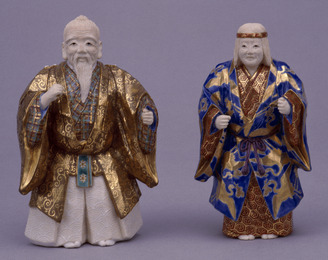
世阿弥作の謡曲「高砂」では、『古今和歌集』仮名序で「高砂と住吉の松を相生(夫婦)の松」とされていることについて、高砂の松を『万葉集』の時代、相生の松を『古今和歌集』の時代として、今も昔も変わらない和歌の繁栄の例えとして説明する。
「高砂」
二帖一組の肉筆画帖。左には格式ある老人の衣裳を着た翁(前シテ)、中央には姥(ツレ)、右には阿蘇友成(ワキ)とその従者(ワキツレ)が描かれている。
〔謡本〕 高砂
古活字版で刊行された観世流謡本の揃いである。「嵯峨本謡本」、「光悦謡本」、「角倉本」等と通称されるもののひとつで、我が国が世界に誇る美しい装丁と印刷の本である。料紙に色替りの染紙が使用されていることから「色替り本」(「第二種本」)と呼ばれる揃い本である。刊行は、「上製本」(「第三種本」)より後で、慶長末年頃といわれている。表章氏の説では、「色替り本」の揃いは、色替り本94冊、色替り料紙ではない「追加本」8冊、「補充本」8冊、合計110番110冊とされている。この資料は全101冊。内訳は色替り本87冊、追加本4冊、補充本5冊、上製本5冊。「くれは」「猩々」「高砂」「盛久」「ひかき」の計5冊は本来は色替り本だが、後代に「上製本」から補われたものと思われる。
〔謡本〕 高砂
各冊巻末に元和6年(1620)卯月(4月)の観世左近大夫暮閑の奥書があることから、「元和卯月本」と通称される観世流の謡本。年月の明記された版行謡本としては最も古いもので、観世大夫公認の謡本として権威を持った。元来は100冊揃い。装訂は綴葉装(列帖装)で両面印刷。各冊の表紙には曲に因んだ絵が金銀泥で描かれ、本文は近衛流の書体で、美術的にも珍重される。実際に刊行されたのは元和9年(1623)頃と考えられている。伝本により、表紙の図柄や描法、料紙、題簽の色などに違いがあり、制作時期などに関係すると思われる。
「能楽図絵」 「船橋」
能「船橋」は古作の能を世阿弥が改作。『万葉集』の和歌にもとづく中世の伝承をモチーフにしている。山伏の一行(ワキ・ワキツレ)が上野国佐野に着くと、橋の建立の供養をしている男女(シテ・ツレ)が現れる。男は、昔ここで女と逢瀬をし、橋板を外されて川に落ち死んでしまった男の『万葉集』の故事を語り、実は自分たちがその男女だと明かして消える。夜、山伏が弔っていると、男女の霊(後シテ・ツレ)が再び現れる。
「能楽百番」 「草紙洗小町」
内裏での歌合わせの前日、歌人・大伴黒主(ワキ)は相手の小野小町(前シテ)の家に忍び込み、小町の和歌を盗み聴く。黒主はその歌を古歌と偽るため、『万葉集』の草子に書き入れた。翌日、歌会で小町(後シテ)が歌が読むと、黒主はその歌が古歌の盗作だと言い出し、証拠として『万葉集』の草子を出す。小町が草紙を見ると、その歌の箇所だけ文字の書き方が異なり、黒主の策略に気づく。小町が草子を水で洗うとやはり例の歌だけが消えていた。黒主は恥辱のあまり自害を図るが、小町がこれを引き留め、帝も黒主を許す。皆が小町に舞いを舞うように勧めると、小町は舞を舞った。
観世流謡曲本 32 草紙洗小町
「草紙洗小町」の大正時代の観世流の謡曲本。

Videos
Past Exhibitions
| Title | shusai | Place | open | close |
|---|---|---|---|---|
Institutions Holding Related Materials
The National Diet Library (NDL), founded in 1948, is the library which belongs to the Diet. The NDL assists the activities of the National Diet. The Library collects and conserves materials and information both from Japan and abroad, serving as a foundation of knowledge and culture and providing library services to administrative and judicial entities and Japanese citizens.
Kyoto National Museum collects, preserves, displays, researches and provides educational programs focusing on cultural properties from Heian- through to Edo- period Japan, when the capital was located there.
As Japan’s representative museum, Tokyo National Museum collects, preserves, displays, and researches the cultural properties of Asia with a focus on Japan, and also provides educational programs.
『万葉集』の世界を多角的に体感できるミュージアム。地下1階展示室は、映像や人形、アニメーションなどで『万葉集』の世界を紹介する体験型の展示空間。1階展示室では、『万葉集』の歌をモチーフにした日本画を鑑賞できる。
年間を通して越中万葉や『万葉集』をテーマとした展示や講座を開催。『万葉集』と上代文学に関する図書・研究論文約85,000冊や、貴重な『万葉集』の断簡・注釈書・古写本などを収集・保存・展示。敷地内には『万葉集』ゆかりの花木を植栽した「四季の庭」もある。
大伴家持をはじめとした国府町ゆかりの歌人や、因幡地方の歴史・文化を紹介するミュージアム。中庭には、『万葉集』で詠まれた約50種の草花が植えられている。万葉衣装の貸し出しもある。
春日大社内にある、『万葉集』に因んだ植物約300種を植栽する植物園。約3ヘクタール(9,000坪)の園内には、万葉歌の陶板とともに『万葉集』の植物を標本展示する「萬葉園」などがある。
武蔵国分寺境内にある、『万葉集』に詠まれている植物約160種が集められた植物園。
『万葉集』の歌の情景をたどり、万葉の世界観を“歩き味わう”7つのウォークルートを紹介。
『万葉集』の恋の歌をテーマにした7つのウォークルートを紹介。
External Links
『古事記』『日本書紀』『万葉集』を楽しみ、味わう奈良県公式サイト。
『萬葉集』と関連各分野の研究を行う萬葉学会が発行する学会誌(発行から3年経過)を閲覧可能。
『万葉集』研究者・上野誠氏(奈良大学文学部国文学科教授)が運営。『万葉集』にまつわるエッセイを掲載。
『万葉集』に詠まれている植物をイラストともに解説。
関西大学図書館廣瀨文庫所蔵の万葉集(冷泉本系(非仙覚本))をデジタル化し公開。
References
- 佐竹昭広, 木下正俊, 小島憲之 共著,塙書房
- 多田一臣 編,三省堂
- 大久間喜一郎 [ほか]編,雄山閣出版
- 秋山虔, 三好行雄 編著,文英堂