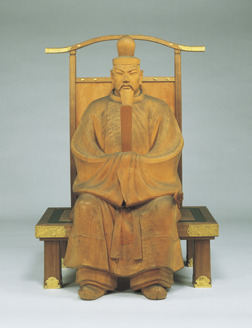
Sugawara no Michizane
A tragic scholar, politician, and deified spirit of the middle Heian period
Sugawara no Michizane (845-903) was a scholar and politician of the middle Heian period. He was the son of Sugawara no Koreyoshi and was raised in a family noted for producing scholars generation after generation. At the age of 11 he wrote his first Chinese poems, surprising his father. In 877 he became a doctor of literature (a doctor specialized in Chinese literature and Chinese official histories), and in 886 he became governor of Sanuki Province.
While he was governor of Sanuki, the Ako Incident occurred as a result of a conflict between Emperor Uda and his chief advisor, Fujiwara no Mototsune. During this incident, Michizane sent a letter of censure to Mototsune, thereby gaining the trust of Emperor Uda. After Mototsune's death, Michizane was selected to be head chamberlain, and in 899, when Mototsune's son Fujiwara Tokihira became minister of the left, Michizane was appointed as minister of the right, an exceptionally high level of office for a scholar. However, the Fujiwara family strongly disapproved of his advancement, and in 901 he was found guilty of slandering Tokihira and demoted to commander (effectively the head) of the outpost government Dazaifu in Kyushu, where he died two years later.
He is noted for advocating the abolition of embassies to China in 894. He wrote Ruiju kokushi (Japanese History, Organized by Topic) and had a hand in the compilation of Nihon sandai jitsuroku (Veritable Records of the Reigns of Emperors Seiwa, Yozei, and Koko). He also left two collections of Chinese poetry: Kanke bunso (Chinese Poetry by Sugawara no Michizane) and Kanke koshu (Later Anthology of Sugawara Michizane), the latter being a collection of his poetry written after his demotion.
After his death, a series of strange events, said to be the workings of Michizane's vengeance, led authorities to pardon him posthumously for his offense, restore him to his former rank and title, and, in 993, to grant him senior first rank and the title grand minister of state. In the private sector, a small shrine (which later became Kitano Tenmangu) was built for him in Kitano, Kyoto, and he was deified as the Shinto god Tenman Tenjin.
In later ages he became venerated throughout Japan as the god of learning. It is also believed that Michizane's spirit became an avenging demon and needed to be placated. This led to a wider adoption of the folk-religious belief in avenging demons. Kitano Tenjin engi (Legends of the Kitano Tenjin Shrine), a work of the early Kamakura period (1180-1333), gathered legends about Michizane's spirit raging about as the thunder god.
Related People, Things and Events
Books
Related Works
Sugawara no Michizane depicted in Kitano Tenjin Engi Emaki (“Illustrated Scroll of the Origin of Kitano Tenjin”)
Totou Tenjin “Tenjin Crossing to China” A painting based on the legend that Sugawara no Michizane (Tenjin or Heavenly Being) traveled to China and practiced Zen meditation. In the painting he is dressed as a Chinese scholar, wearing a crown, and grasping a branch of flowering plum.
Sugawara no Michizane in ukiyo-e paintings
Videos
地図で探す
Past Exhibitions
| Title | shusai | Place | open | close |
|---|---|---|---|---|
External Links
福岡県太宰府市宰府に鎮座する神社で、菅原道真を祀っています。前身は大宰府に左遷され、この地で亡くなった道真の墓地に建立された神殿とされています。
京都市上京区馬喰町に鎮座する神社で、祭神は菅原道真。天慶5年(942)に多治比文子(たじひのあやこ)が神託によって自宅の辺りに道真を祀り、天暦元年(947)に現在地に移転したといわれています。
東京都文京区湯島に鎮座する神社で、祭神は天之手力雄命(あめのたぢからをのみこと)と菅原道真。
太宰府天満宮HPより。幼少期から晩年期までの生涯が、画像入りで紹介されている。
北野天満宮HPより。ほかに「ご由緒」や「天神さんの七不思議」なども紹介されている。
湯島天神HPより。縁起および「天神信仰」「道真公の御事歴」「天神さまと梅」「天神さまと牛」についての解説が載る。
日本芸術文化振興会が運営するサイト「文化デジタルライブラリー」の演目解説より。竹田出雲らの合作による人形浄瑠璃で、延享3年(1746)初演。近松門左衛門作「天神記」の影響を受け,菅原道真の配流,天満天神縁起を主筋とする。詳細については、トップ画面の「Enter」をクリックして閲覧する。
富山県富山市の「人形の愛児堂」HPより。菅原道真の生い立ちが、わかりやすく紹介されている。
References
- 坂本太郎 著,吉川弘文館
- 大岡信 著,岩波書店
- 村山修一 編,雄山閣出版
- 「菅原道真」の項
- 「菅原道真」の項
- 「菅原道真」の項
- 「菅原道真」の項
- 歴史学研究会 編,岩波書店
- サンプルページ「菅家文草」の項
- サンプルページ「天神祭」の項
- サンプルページ「菅原伝授手習鑑」の項