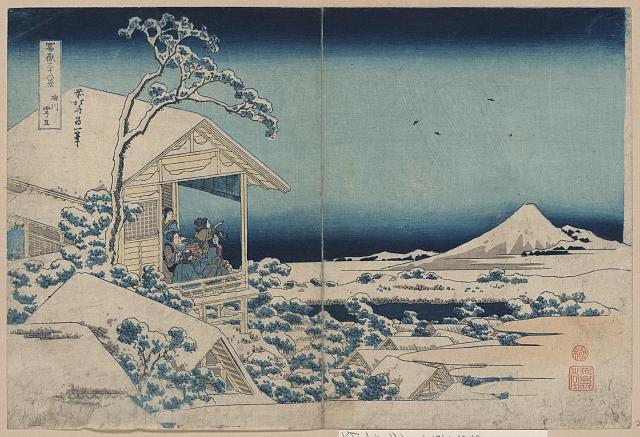
Yukimi (Snow-Viewing)
Yukimi, or snow-viewing, is one of a customs related to snow. The first record of snow-viewing is thought to be the yukimi feast in the year 872, mentioned in Nihon Sandai Jitsuroku (The True History of Three Reigns of Japan).
Among regions with temperate climates, Japan is known for its heavy snowfall and its many customs are related to snow. While some Japanese regions suffer from the heavy winter precipitation, other cities on the Pacific coast that see relatively little snowfall refer to snow fondly as Mutsunohana and have a long-standing custom of yukimi (snow-viewing). The term Mutsunohana or Rikka, meaning ‘six flowers’, alludes to the hexagonal shape of snow crystals.
The first record of snow-viewing is thought to be the yukimi feast in the year 872, mentioned in Nihon Sandai Jitsuroku (The True History of Three Reigns of Japan). Other instances can be seen in anecdotes from Sei Shonagon’s Makura no Soshi (The Pillow Book), written in the 11th century, where Empress Teishi mentions to Sei Shonagon that she would “like to see the ‘Koroho Snow’”, a reference to Bai Juyi’s Hakushi Monjyu, to persuade her to raise the bamboo blind so they could view the snow in the garden.
Snow-viewing became a common pastime among upper-class families; it is said that in the 11th century, the retired Emperor Shirakawa held an imperial outing for snow-viewing. There is also record of the retired Emperor Gosaga taking a boat out for yukimi in 1251.
Later during the Edo era, the custom spread to the common people. Places such as Atagoyama, Chomeiji Temple, Ushi no Gozen Oji Gongen Shrine, Jokoji Temple in Nippori, Mimeguri Inari Shrine, Asakusa’s Matsuchiyama , Ichigaya Hachimangu Shrine, and Kaneiji Temple in Ueno became popular snow-viewing spots for the people of Edo.
Related People, Things and Events
Books
Related Works
Videos
External Links
国立国会図書館の電子展示会「錦絵でたのしむ江戸の名所」では、江戸時代の名所の賑わいや景観、季節の娯楽などを垣間見ることができる。「雪」の項では雪にまつわる錦絵がまとめてある。