Sanseki (the Three Calligraphers)
Sanseki refers to three superb calligraphers of the middle Heian period—Ono no Michikaze, Fujiwara Sukemasa, and Mujiwara Yukinari—or their calligraphy
Sanseki (literally, the Three Traces of the Brush) refers to the three outstanding calligraphers of the middle Heian period—Ono no Michikaze (or Tofu, 894-967), Fujiwara no Sukemasa (944-998), and Fujiwara no Yukinari (972-1027)—or their work. They are also referred to as the Sansei (Three Sages) or Sanken (Three Wise Men). This manner of referring to these three calligraphers is similar to the use of Sanpitsu (the Three Brushes) to refer to Kukai, Emperor Saga, and Tachibana no Hayanari, three calligraphers of the early Heian period. Seki 蹟 is combined with another, identifying character to individually identify these three calligraphers. Thus, Ono no Michikaze is known as Yaseki from the character 野 in his surname, Fujiwara no Sukemasa is known as Saseki from the character 佐 in his given name, and Fujiwara no Yukinari is known as Gonseki from the character 権 in his court title. There are a couple of reasons for why these particular calligraphers were grouped together as Sanseki. One is that these three calligraphers were already grouped together in Saiyosho (a treatise on Japanese-style calligraphy), by Fujiwara no Norinaga of the late Heian period. Another is that in Kaiki, a memoir about Konoe Iehiro (calligrapher, regent, and grand minister of state at the beginning of the eighteenth century), by Yamashina Doan, his personal physician, Yamashina recalls the episode in which Emperor Go-Ichijo visited the home of Fujiwara no Michinaga and Michinaga presented him with the calligraphy of these three calligraphers. The term Sanseki is said to have first appeared in Wa Kan meisu (Japanese and Chinese Numerical Terms Used to Refer to Individuals, 1695), compiled by Kaibara Ekken. Prior to the Sanseki, calligraphy in Japan followed the Tang dynasty style imported from China in the early Heian period. The historical significance of these three calligraphers is that they perfected a Japanese style of calligraphy. This is a trend widely seen in the establishment of a national culture.
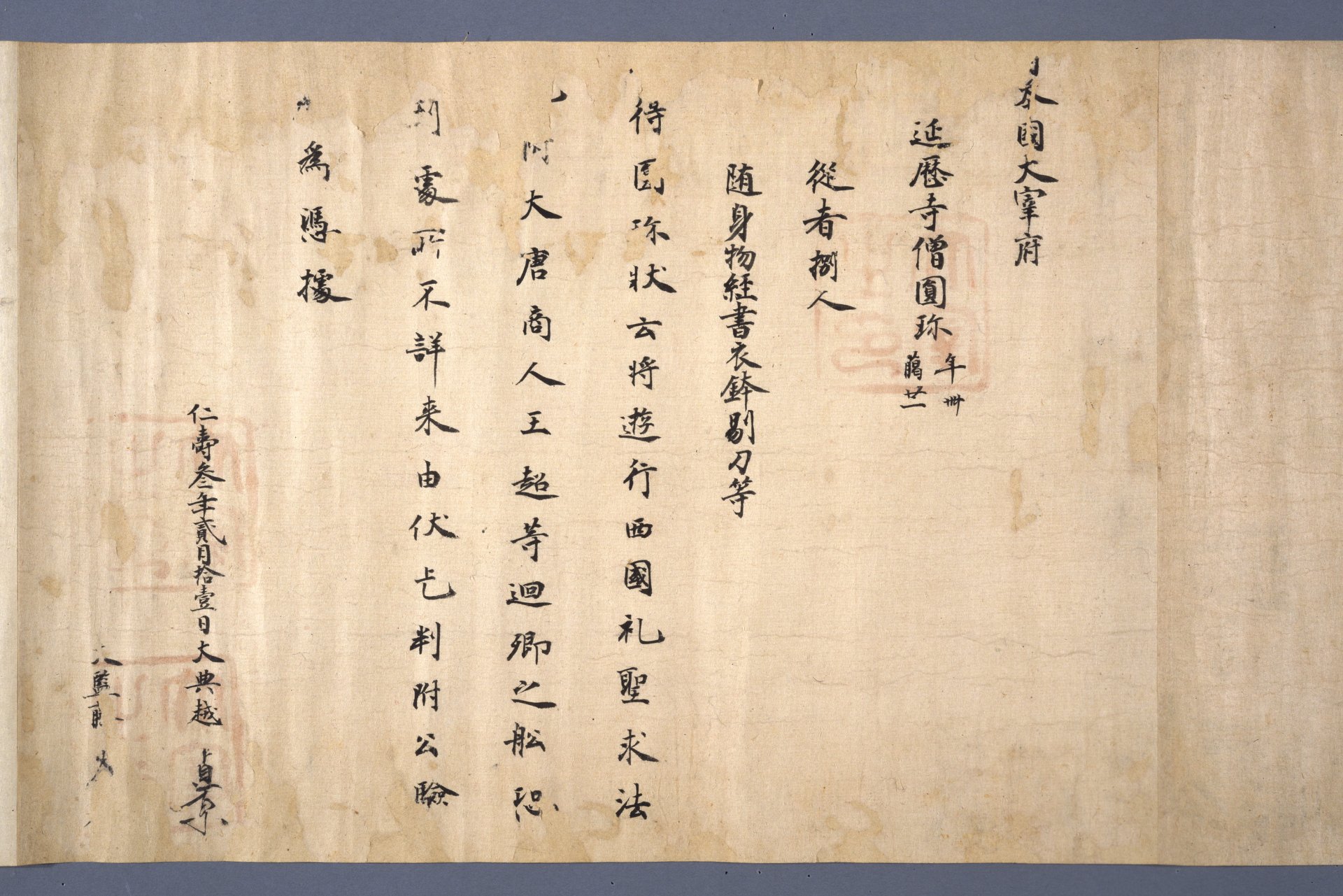
Calligraphy in Ono no Michikaze's hand includes Enchin shigo chokusho (Imperial Decree Bestowing a Posthumous Name on Enchin) and Byobu dodai (Draft of Calligraphy for a Screen). Fujiwara Sukemasa's calligraphy appears in Shi kaishi (Chinese-Style Poem on Kaishi Paper), Onmei jo (The Emperor's Gracious Command), and Ri Raku jo (Leaving the Capital). And Fujiwara Yukinari's hand can be seen in Haku-shi shi kan (Bai Juyi's Poems) and Honnoji-gire (Remnant of the Honno Temple Scroll).
Related People, Things and Events
Books
Related Works
Michikaze Ono, or Tofu Ono
Sukemasa Fujiwara
Yukinari Fujiwara
Past Exhibitions
| Title | shusai | Place | open | close |
|---|---|---|---|---|
Institutions Holding Related Materials
The National Diet Library (NDL), founded in 1948, is the library which belongs to the Diet. The NDL assists the activities of the National Diet. The Library collects and conserves materials and information both from Japan and abroad, serving as a foundation of knowledge and culture and providing library services to administrative and judicial entities and Japanese citizens.
As Japan’s representative museum, Tokyo National Museum collects, preserves, displays, and researches the cultural properties of Asia with a focus on Japan, and also provides educational programs.
The Tokyo Fuji Art Museum is founded on November 3, 1983, in Hachioji, a thriving university town in the western suburbs of the Japanese capital. Priding itself as “a museum creating bridges around the world” to facilitate the exchange of different cultures, our museum has forged cordial relations with art museums and cultural institutes in 32 countries and territories to date. We do so by bringing the world’s finest works of art to Japan while reciprocating in kind by introducing the finest Japanese treasures to the world through special exhibitions that showcase their beauty and wonder through a unique new set of prisms and perspectives. Our museum possesses some 30,000 pieces of artworks from various periods and cultures including Japanese, Eastern and Western works, ranging from paintings, prints, photography, sculptures, ceramics and lacquer ware to armor, swords and medallions. Especially noteworthy is its outstanding collection of Western oil paintings that spans a five-hundred-year period from the Renaissance, Baroque, Rococo, and Romanticism to Impressionism and contemporary art, as well as its exceptional collection of photographic masterpieces that can give an overview of the history of photography from the birth of the photograph to the present age.
所在地は東京都世田谷区。東急グループの礎を築いた五島慶太のコレクションを中心とした美術館。館の所蔵品は、年6~7回開催される展覧会で分野別に展示される。「関戸本古今集切 伝藤原行成筆」を収蔵。
所在地は愛知県春日井市。全国的にも数少ない書専門の美術館。書道史の研究施設として、書道文化の一層の向上発展に貢献することを目的として設立された。
所在地は香川県高松市。藤原佐理筆「詩懐紙」を収蔵。
所在地は東京都港区。茶道具を中心に、書画、陶磁、漆芸、能装束など、日本、中国、朝鮮の古美術品を展示公開している私立美術館。藤原佐理筆「離洛帖」を所蔵。2019年3月18日より長期休館中。
External Links
京都市歴史資料館の情報提供システム「フィールド・ミュージアム京都」内のページ。三筆、三蹟が解説されている。
アイエムのインターネットミュージアム。東京国立博物館の小野道風の「和様の書」について、YouTubeで閲覧できる。
東京国立博物館のブログ記事。藤原行成の書についての解説が、画像とともに閲覧できる。
References
- 小松茂美 責任編集,中央公論社