Culture of the Edo period (2) ― Genroku Culture
Culture that developed in the Kamigata region in the early Edo period, in which the townsfolk played a vital role
This culture developed primarily in the Kamigata region around Kyoto and Osaka in the early Edo period during the Genroku era (1688–1704). With the establishment of the shogunate system, Edo developed into a major city of around 1 million people, and the populations of Kyoto and Osaka grew to about 300,000 each, as well. A new civil society in which townsfolk were the key players came to form alongside the warrior society, and a new educated, cultured class emerged in the citizenry. The underpinnings of scholarship in the era were provided by the development of terakoya private temple schools that taught self-discipline, Hakuseki Arai’s authoring of Tokushi Yoron (“A Reading of History”), which drew on historical aspects to argue for the legitimacy of the Tokugawa shogunate, and Takakazu Seki’s achievement in developing Wasan (Japanese mathematics), and other developments.
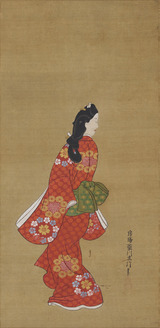
Meanwhile, the Kamigata region was a bastion of dynastic culture, and in the Genroku era, the aristocratic culture of elegance took on an even higher level of refinement, with Korin Ogata’s fine art achievements and the gorgeous beauty of Yuzensai Miyazaki’s yuzen-zome (resist-dyeing) textile craftwork. While such forms of aristocratic culture still remained out of reach for the townsfolk, familiarity with picture books printed with monochrome black sumi ink and ukiyo-e woodblock prints at least afforded them glimpses.
In the field of chonin bungaku (“literature of the townsfolk”), works published by authors such as Saikaku Ihara and Basho Matsuo attracted popularity, as well. Sonezaki Shinju (“The Love Suicides at Sonezaki”), a joruri play written by Monzaemon Chikamatsu, based on an actual double-suicide incident that had taken place in Osaka’s Sonezaki district, was first performed in 1703. On the other hand, with the innovation of the exaggerated aragoto technique in Edo kabuki by Danjuro Ichikawa I, and other developments, this was an era that can also be considered to have injected the history of theater with a spirit of lively creativity.
Table of Contents
Literature and art
Scholarship
Fine art
Architecture and gardens
References
- 詳説日本史図録編集委員会 編,山川出版社
- 児玉幸多 著,中央公論新社
- 辻惟雄 監修,美術出版社