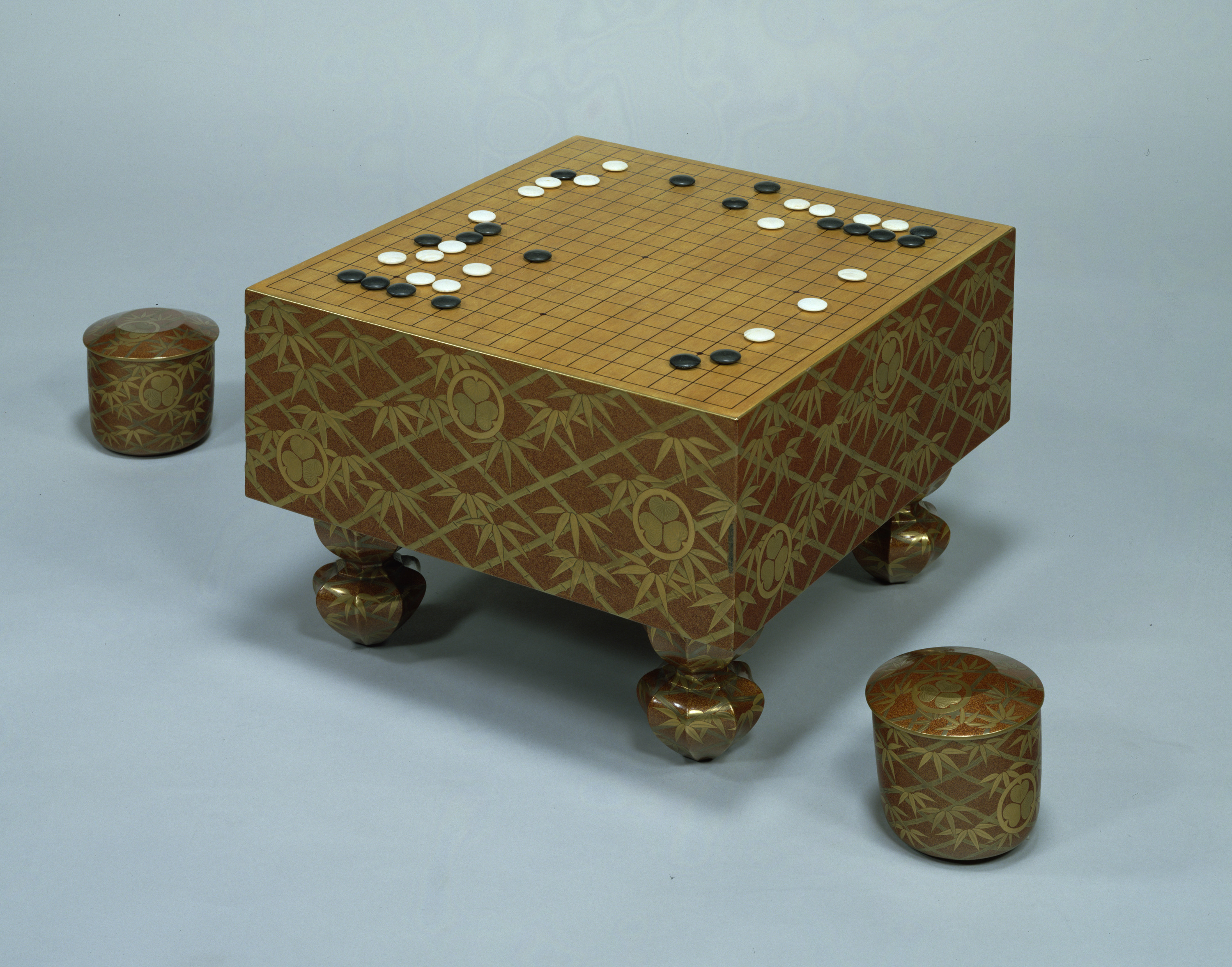
Go (Igo)
A two-player game rooted in Japanese culture since ancient times
Go is a two-person board game. The game is played on a Go board, which has 361 intersections, formed from 19 vertical and 19 horizontal lines. To begin the game, each player chooses a color of Go stones (either black or white). Each player then takes turns placing his Go stone at any intersection on the board, one stone per turn. The winner is the person whose stones have surrounded more intersections.
Go originated in ancient China and is said to have originally been a way to tell fortunes. It is unknown when this means of telling fortunes developed into the game it is today, but Go is believed to date back at least 2,000 years. It has been in Japan since ancient times. It was already popular in the Nara period (710-792), it is thought, because a Go board has been preserved in the Shosoin, a repository for treasures that date from that period. During the Heian period, Go was popular as an aristocratic game, it being mentioned in Murasaki Shikibu's Tale of Genji and Sei Shonagon's Pillow Book. In the Kamakura (1185-1333) and Muromachi (1336-1573) periods, it became widely liked by monks and warriors. During the Azuchi-Momoyama period, Hon'inbo Sansa, the first master of Go, was born. Sansa entertained three rulers—Oda Nobunaga, Toyotomi Hideyoshi, and Tokugawa Ieyasu—with his Go skills. In the Edo shogunate (1603-1867), he took up a position in the Go Office, which was established under the office having jurisdiction over temples and shrines. After that, four families—Hon'inbo, Inoue, Yasui, and Hayashi—were supported by the shogunate and produced the most outstanding Go players. In the Meiji era (1868-1912), Go lost the protection it enjoyed under the Edo shogunate, and its popularity declined. However, its popularity later returned owing to the efforts of Hon'inbo Shuho, who established the Go association Hoensha, and Hon'inbo Shuei, who established the Association for Encouraging Go. The creation of a Go section in newspapers also helped Go to gain wide support.
Related People, Things and Events
Books
Board game records, etc.
Related Works
Videos
Institutions Holding Related Materials
東京本院は東京都千代田区に所在。囲碁殿堂資料館が置かれるほか、売店で囲碁用品や囲碁に関する書籍を販売する。
広島県尾道市にある記念館。本因坊秀策の功績や囲碁の歴史を紹介している。
山梨県北杜市にある美術館。浮世絵・陶磁器・書籍など囲碁に関したさまざまな資料を収集。
The National Diet Library (NDL), founded in 1948, is the library which belongs to the Diet. The NDL assists the activities of the National Diet. The Library collects and conserves materials and information both from Japan and abroad, serving as a foundation of knowledge and culture and providing library services to administrative and judicial entities and Japanese citizens.
As Japan’s representative museum, Tokyo National Museum collects, preserves, displays, and researches the cultural properties of Asia with a focus on Japan, and also provides educational programs.
Kyoto National Museum collects, preserves, displays, researches and provides educational programs focusing on cultural properties from Heian- through to Edo- period Japan, when the capital was located there.
Aichi Prefectural Museum of Art was founded as the successor of the Aichi Prefectural Art Gallery, which originally opened in Sakae, the center of Nagoya City, Aichi Prefecture, in 1955. The museum opened in 1992 as part of the Aichi Arts Center, an urban cultural complex, and has established a wide-range collection of approximately 8,000 items, centered on works of art of the twentieth century. The Museum has also organized numerous exhibition of a wide-range of themes. The Museum has actively worked to develop and communicate new aspects of art and culture to the public, based on its core mission to serve as the primary art museum of the Chubu region.
External Links
「囲碁」の歴史、棋戦の予定と結果、棋士の一覧など、囲碁に関するあらゆる情報が掲載されている。
国立国会図書館のミニ電子展示。さまざまな資料とともに、囲碁の歴史を紹介。
References
- 日立デジタル平凡社,平凡社
- 稲本万里子 著,森話社