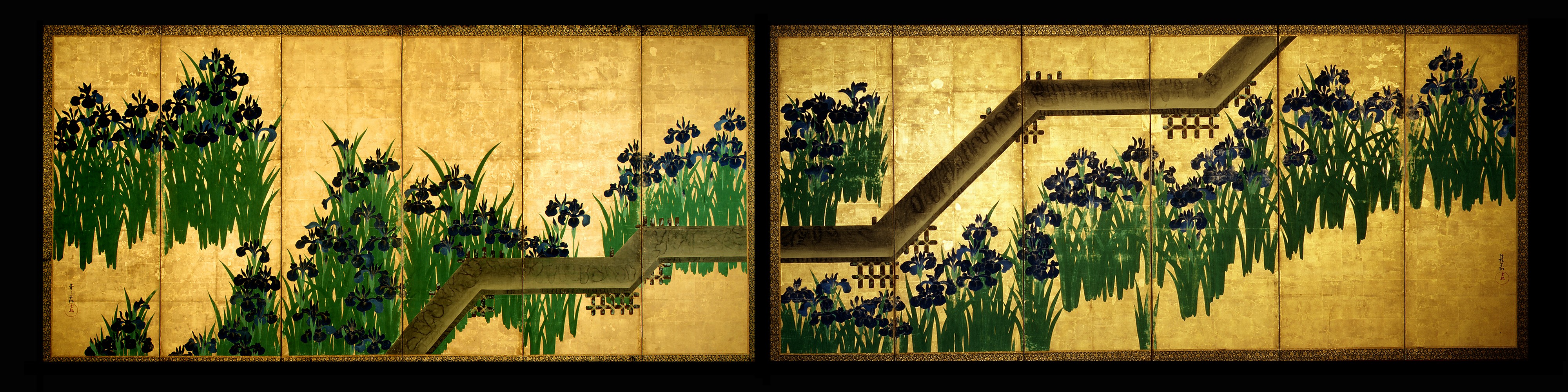
Ogata Korin
A leader in Kyoto culture during the Genroku era who perfected the Rin-pa School of painting 1658-1716
Ogata Korin was a painter and craftsman of the early and middle Edo period. His given name was Koretomi, and his childhood name was Ichinojo. He usually signed his works Korin, but he also used the names Doshu, Jakumyo, and Chokoken, among others. He was the second son of Ogata Soken, who ran Kariganeya, a dry goods shop in Kyoto. His younger brother Ogata Kenzan made a name for himself as a potter.
When Korin was 30 his father died. He received a considerable inheritance but he frittered the money away on pleasures and entered a period of poverty. He began life as a painter at about 40.
Although his father initiated him into the art of painting, he learned the style of the Kano School from Yamamoto Soken. While being enamored of the styles of Tawaraya Sotatsu and Honami Koetsu, he also developed his own style. This style, the style of the Rin School ("Rin" being an abbreviation of "Korin"), involves rich decoration and a vivid sense of form.
Korin formed close friendships with and accepted support from the Ginza government official Nakamura Kuranosuke and several wealthy merchants. After he went to Edo, he received patronage from the lumber merchant family Fuyuki and the daimyo (feudal lord) families Tsugaru and Sakai, all the while continuing to paint.
In 1701 he was invested with the clerical rank hokkyo (master of the dharma bridge, a rank in the Buddhist priesthood). Thereafter many of his paintings bear the seal "Hokkyo Korin”. He devoted himself heart and soul to painting until his death in 1716 at age 59.
Among his most notable works are several paintings on screens and a number of craft items. The screens include Irises Screen, Red and White Plum Screen (both national treasures), and Wind God and Thunder God Screen (an important cultural property). The craft items include Writing Box with Eight Bridges (a national treasure) and Square Dish: Design of Poet Watching Wild Geese (an important cultural property). The writing box takes its theme from Tales of Ise, and the square dish, made by his brother Kenzan, bears Korin's design.
関連するギャラリー
Books
Critical biographies, etc., regarding Ogata Korin
Related Works
過去の展覧会を調べる
| Title | shusai | Place | open | close |
|---|---|---|---|---|
Institutions Holding Related Materials
国宝「紅白図屏風」のほか、敷地内には光琳の二条新町屋敷を復元した、光琳屋敷がある。
国宝「燕子花図」などを所蔵。尾形乾山の作品も多数収蔵している。
The National Diet Library (NDL), founded in 1948, is the library which belongs to the Diet. The NDL assists the activities of the National Diet. The Library collects and conserves materials and information both from Japan and abroad, serving as a foundation of knowledge and culture and providing library services to administrative and judicial entities and Japanese citizens.
As Japan’s representative museum, Tokyo National Museum collects, preserves, displays, and researches the cultural properties of Asia with a focus on Japan, and also provides educational programs.
Kyoto National Museum collects, preserves, displays, researches and provides educational programs focusing on cultural properties from Heian- through to Edo- period Japan, when the capital was located there.
External Links
国宝「紅白梅図屏風」などの光琳作品をコレクション検索で探すことができる。
コレクションは国宝7件、重要文化財87件、重要美術品94件を数える。光琳作品は、国宝「燕子花図」を収蔵する。
References
- 日立デジタル平凡社,平凡社
- 仲町啓子 著,東京美術
- 安村敏信 著,東京美術