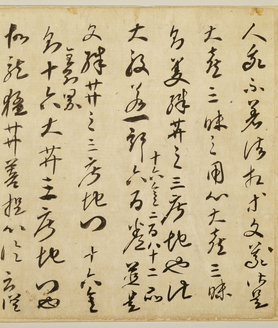
Sanpitsu (the Three Calligraphers)
Three superb calligraphers of the early Heian period: Kukai, Emperor Saga, and Tachibana no Hayanari
The Sanpitsu (literally, the Three Brushes) were three outstanding calligraphers of the early Heian period: Kukai (774-835), Emperor Saga (786-842), and Tachibana no Hayanari (d. 842). At least that is the meaning of the term if used without any qualifier. The term was first used to refer to these three early Heian calligraphers in Wa Kan meisu (Japanese and Chinese Numerical Terms Used to Refer to Individuals, 1695), compiled by Kaibara Ekken. But there developed a custom of in every age taking the three most accomplished calligraphers of the age and calling them the Three Brushes of that age. For instance, Kan'ei Sanpitsu refers to the three noted calligraphers of the Kan'ei era (1624-1644): Konoe Nobutada (also known by his Buddhist name Sanmyaku-in), Hon'ami Koetsu, and Shokado Shojo. Obaku no Sanpitsu refers to three noted Obaku Zen calligraphers: Ingen, Mokuan, and Sokuhi (posthumously named Nyoichi). And Bakumatsu no Sanpitsu refers to the three noted calligraphers toward the end of the Edo period (1603-1867): Maki Ryoko, Ichikawa Beian, and Nukina Kaioku (also known as Suo).
Of the three noted calligraphers of the early Heian period, Kukai and Hayanari went to China and studied Chinese culture and calligraphy. When they returned home to Japan, they brought with them many copybooks (orihon books consisting of rubbings of model calligraphy taken from stone and wood tablets preserving the calligraphy of masters of the past) and presented them to Emperor Saga. Chinese calligraphy, and the calligraphy of Wang Xizhi (303-361) in particular, became a basic model for the calligraphy of these three men. And their calligraphy in turn laid the foundation for Japanese calligraphy from then on.
Kukai's own calligraphy includes 38 lines of Kongo hannya kyo kaidai zankan (Remnant of a Preface to the Diamond Sutra) and Fushin jo (Three Letters to Saicho). A document in Emperor Saga's own hand is Kojo kaicho (A Certificate of Kojo's Reception of Buddhist Commandments). There are no documents known to be in Tachibana no Hayanari's hand, but Ito naishinno ganmon(A Prayer for Princess Ito) is said to be such.
Related People, Things and Events
Books
Related Works
Depictions of the Sanpitsu (three greatest calligraphers)
Past Exhibitions
| Title | shusai | Place | open | close |
|---|---|---|---|---|
Institutions Holding Related Materials
The National Diet Library (NDL), founded in 1948, is the library which belongs to the Diet. The NDL assists the activities of the National Diet. The Library collects and conserves materials and information both from Japan and abroad, serving as a foundation of knowledge and culture and providing library services to administrative and judicial entities and Japanese citizens.
As Japan’s representative museum, Tokyo National Museum collects, preserves, displays, and researches the cultural properties of Asia with a focus on Japan, and also provides educational programs.
Kyoto National Museum collects, preserves, displays, researches and provides educational programs focusing on cultural properties from Heian- through to Edo- period Japan, when the capital was located there.
Nara National Museum collects, preserves, displays, researches and provides educational programs about cultural properties with a focus on Buddhist art.
空海の書や著作などを多数収蔵している。所在地は和歌山県伊都郡高野町。
境内にある国宝殿には、光定戒牒(嵯峨天皇筆)を収蔵している。所在地は滋賀県大津市。
静岡県浜松市にある、橘逸勢を祀る神社。毎年秋には「筆供養」を行っている。
External Links
京都市歴史資料館情報提供システム。三筆、三蹟の歴史と詳細について解説されている。
幕末の書家・巻菱湖と江戸時代後期の人物の書を中心に、日本の書をテーマに沿って展示した美術館。ホームページ上で、空海、嵯峨天皇、橘逸勢の三筆のほか、寛永の三筆、幕末の三筆なども紹介している。