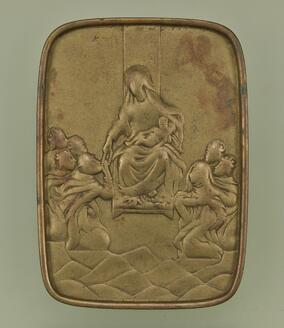
Crypto-Christians (senpuku Kirishitan)
Christians who remained faithful for the 230 years since Christianity was prohibited in the early Edo period
Crypto-Christians (senpuku Kirishitan) were believers who continued to keep their faith while superficially pretending to be Buddhists under the Christian persecution that began after the Shimabara Rebellion. Many lived in the northern region of Kyushu, and they practiced peculiar forms of worship and rituals, parts of which were added in from native religions. These religious organizations, supported by such roles as conductor of ceremonies, baptizers, and ceremonial assistants, were called different names in different regions, names such as chokata, mizukata, kikiyaku, oyajiyaku, and yakuchu. The central house of worship would enshrine a nandogami (closet god), and those in charge of baptizing practiced asceticism. During ceremonies, offerings would be given, invocations believed to have long been orally passed down would be sung, and members would partake of holy communion (naorai). When French priest and Catholic missionary Bernard-Thadée Petitjean arrived in Japan in 1865, he found some of these Christians at the Oura Church in Nagasaki, and most of them joined the Catholic Church. Even after the ban on Christianity was lifted in 1873, some followers chose not to join a church but continued to follow the faith they had as crypto-Christians, a faith with connections to Buddhism and Shinto. Such people were found in places like Ikitsuki Island, Hirado Island, and Goto Islands, and they are sometimes referred to as hidden Christians (kakure Kirishitan) for the sake of distinction. In 2018, relevant sites including Oura Cathedral, the Hara Castle remains, and areas such as Hirado, Amakusa, and Goto were given World Heritage (cultural heritage) status as “Hidden Christian Sites in the Nagasaki Region.”
Related People, Things and Events
Books
Related Works
Cultural Properties of Japan
Videos
Past Exhibitions
| Title | shusai | Place | open | close |
|---|---|---|---|---|
Institutions Holding Related Materials
1964年に復元された島原城を中心とした資料館。天守閣には、島原の乱や潜伏キリシタンの関係史料などが紹介されている。
長崎市 日本キリシタン史に関する資料の収集、保存・展示、調査研究を行い、キリスト教に関する豊かな文化の創造に資することを目的に開設。
1987年大阪府茨木市千提寺地区にオープン。この地区はかつてキリシタン大名高山右近の領地であり、「隠れキリシタンの里」として有名。
長崎県文化振興・世界遺産課によるサイト。世界遺産「長崎と天草地方の潜伏キリシタン関連遺産」の価値を国内外のたくさんの人々に知ってもらい、理解してもらい、共感してもらうことを目的とする。「歴史から知る」「地図から知る」「価値から知る」「構成資産から知る」などにより構成される。
References
- サンプルページ「潜伏キリシタン」の項
- サンプルページ「キリシタン」の項
- 「隠れキリシタン」の項
- 「隠れキリシタン」の項
- 小学館全4巻。
- 対外関係史総合年表編集委員会 編,吉川弘文館