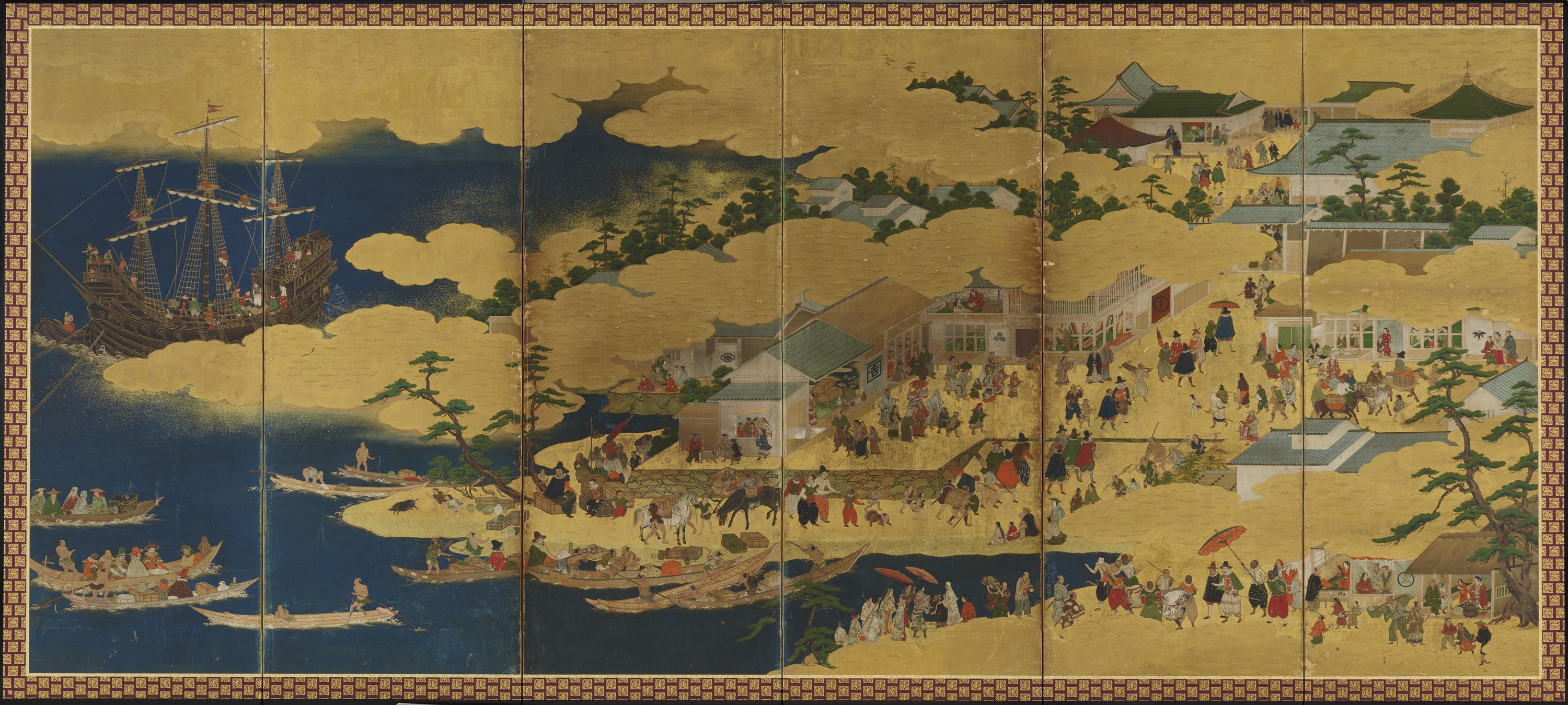
Trade with European Countries (nanban boeki)
Nanban boeki (literally, “trade with southern foreigners”) refers to trade between Japan and Portugal, Spain, and other European countries from the mid-16th century through the 17th centuries. This trade brought the culture associated with the Age of Discovery to Japan
Commercial trade was carried out from the mid-16th century through the 17th century between Japan and the trading vessels of the Portuguese and Spanish. The stranding of a Portuguese vessel on the island Tanegashima in 1543 set off travel of Portuguese commercial vessels from places such as Ningbo (China) and Malacca (Malaysia) to Kagoshima, Yamakawa, Bonotsu, Funai, and Hirado in Kyushu. In 1557 Portuguese traders established a sea route based in Macau that linked Goa (India), Malacca, and Japan. Subsequently, Portuguese merchants received the right to trade in Guangdong (China) and gained a foothold from which to expand trade with Japan. In 1571 an area near the port of Nagasaki was granted to the Society of Jesus as premises for a church, after which large sailing ships from Portugal came to the port every year, bringing Chinese raw silk, silk fabric, cotton yarn, gold, lead, tin, ceramics, musk, licorice, and sugar. Silver accounted for most of the goods exported from Japan, and was used to meet China’s demand for silver. In the 17th century, Chinese junks resumed trade with Japan, and more and more Japanese went overseas to pursue officially approved trade. Protestant countries such as the Netherlands and England entered the Japanese market as well. However, the Tokugawa Shogunate did not welcome the arrival of European ships, because they brought Christian missionaries, and increasingly limited access. Eventually, foreign trade was severely restricted under a national policy of seclusion, and, after the Shimabara Rebellion, Portuguese ships were banned altogether in 1639. This heralded the end of nanban boeki.
Related People, Things and Events
Books
Related Works
南蛮屏風
工芸品にみる南蛮文化
国宝・重要文化財を探す
Videos
Past Exhibitions
| Title | shusai | Place | open | close |
|---|---|---|---|---|
Institutions Holding Related Materials
As Japan’s representative museum, Tokyo National Museum collects, preserves, displays, and researches the cultural properties of Asia with a focus on Japan, and also provides educational programs.
Kyoto National Museum collects, preserves, displays, researches and provides educational programs focusing on cultural properties from Heian- through to Edo- period Japan, when the capital was located there.
Kyushu National Museum explores how Japan’s history of cultural exchange with the rest of Asia has impacted the formation of its culture. To that end, we engage in the collection, preservation, exhibition, and research of cultural properties, in addition to providing educational outreach to the local community.
南蛮美術、近世の東西文化交流、長崎系絵画(黄檗・南蘋風・洋風画)などのコレクションがある。
海外交流史に関する8万点余の資料、古文書、美術工芸品などを収蔵する。
南蛮美術中心の美術館。安土桃山時代から江戸時代の初めまで、南欧ラテン系(おもにポルトガル、スペイン)の人々との交流によって、その影響を受けた数々の作品が生まれた。本館では美術品や工芸品をはじめ、陶器や漆器、古文書などの品々を所有。館内では1階にキリスト教関連の作品、2階には南蛮美術品を展示する。1968年(昭和43年)大阪中津に開館。
所在地は、大分県大分市勢家町4丁目844-1。かつて神宮寺公園の付近一帯は浅瀬の波に洗われる美しい海浜で、天文年間(1532~1555)、ポルトガルや明との貿易を行った大友宗麟は、この浜辺を交易場として利用していた。それにちなんだ「南蛮貿易場址」の碑があり、その側に太刀を杖にした大友宗麟像が建てられている。
大分日本ポルトガル協会によるサイト。