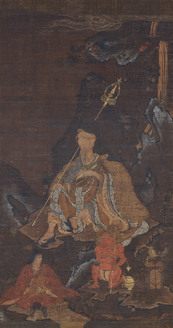
Shugendo
A religious faith purportedly founded by En no Gyoja in the Nara period that syncretically developed from mountain worship and esoteric Buddhism
Shugendo is a practice-oriented religion that syncretically formed from ancient Japanese mountain worship and esoteric Buddhist (Vajrayana) methods of incantation and asceticism. Its practitioners are known as shugenja or yamabushi. It is purported to have been founded by En no Gyoja (also known as En no Ozunu) of the Nara period (710–794). In the mid-Heian period, among exoteric Buddhist practitioners there was a rise in ascetics who strove to strengthen their spiritual prowess through training involving circumambulations of mountain peaks. In time, Honzan branch of Shugendo (affiliated with Tendai Buddhism) made Shogo-in Temple the headquarters of its activities, and the Tozan branch of Shugendo (affiliated with Shingon Buddhism) made Sanbo-in in Daigo Temple its headquarters, taking as training grounds the mountains of Omine, Kumano, Yoshino, and Kinbu. Shugendo became independent of esoteric Buddhism in the late Kamakura period and established training sites on mountains throughout Japan. Principal holy mountains include Mount Iwaki in Tsugaru, the Three Mountains of Dewa, Mount Futara in Nikko, Mount Tsukuba, Mount Mitsumine in Chichibu, Mount Fuji, Mount Ontake, Mount Tate, Mount Haku, Mount Daisen in Hoki, Mount Ishizuchi in Shikoku, and Mount Hiko in Kyushu. In medieval times, oshi (resident practitioners who lodged pilgrims) and yamabushi based at the various regions’ holy mountains, serving as pilgrimage guides, led Shogunal retainers and local gentry in entry-to-the-peak training sessions. It is said that some yamabushi, who were customarily allowed free passage, served warlords as spies. In the early modern era (16th–19th centuries), yamabushi became increasingly integrated in village life, and such practices of theirs as ritual incantations increasingly penetrated into the lives of commoners. Shugendo’s influence on coming-of-age rites, festivals, and the arts has also been significant. Because this religion had also established mentor and patron relationships, they also administered religious confraternities and acted as guides for ascents to worship on holy mountains. Until the modern era, almost all holy mountains forbade women to enter. The practice of Shugendo was forbidden by the Meiji government, but it was revived following World War II.
Related People, Things and Events
Books
Related Works
役行者
古像・入峰道具
修験関連の写真
Videos
地図で見る
Institutions Holding Related Materials
岐阜県郡上市白鳥町長滝にある。
富山県立山町の芦峅寺にある。立山の自然と人間の関わりについて、人文・自然の両分野から学術的・総合的に調査研究し、その成果を紹介。
山形県鶴岡市羽黒町手向にある。大正4年(1915)に出羽三山神社の宝物館として設立され、昭和27年(1952)出羽三山歴史博物館となる。
福岡県田川郡添田町英彦山にある。「彦山三所権現御正体」をはじめ、英彦山にまつわる文化財を展示。
平成27年(2015)に龍谷ミュージアムと京都文化博物館が同時開催。
主な活動は、毎年霊山の社寺等で開催する学術大会と機関誌『山岳修験』(年2回)の発刊、山岳修験に関する優れた研究者の業績に対する日本山岳修験学会賞の授与、機関誌に掲載された若手研究者による優れた論文に対する奨励賞の授与など。
信州大学附属図書館が所蔵する山岳関係資料コレクション「小谷コレクション」の中の和古書・古地図等を電子化し、公開しているサービス。