
Japanese Woodblock Prints and Paintings Depicting Japanese Specters (For Educational or Commercial Use)
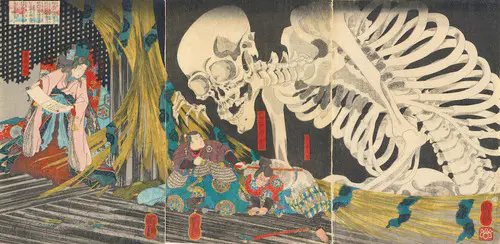
山東京伝の読本『善知安方忠義伝』に取材した本図は、国芳の代表作の1点。相馬の古内裏は、相馬小次郎こと平将門が下総国に建てた屋敷で、将門の乱の際に荒れ果ててしまっていた廃屋。妖術を授かった将門の遺児滝夜叉姫と良門は、父の遺志を継いでこの廃屋に仲間を募り、やがて妖怪が出没するようになる。それを知った源頼信の家臣、大宅太郎光国は妖怪を退治してその陰謀を阻止する。原作では複数の骸骨が現れるが、国芳はこれを巨大な一体の骸骨に置き換えることによって、迫力ある画面構成を生み出すことに成功している。
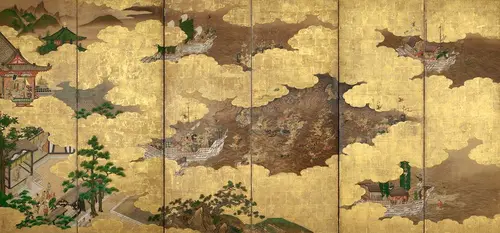
「大職冠」は藤原鎌足と竜王の宝珠争奪戦を描いた幸若舞の人気の演題。中国から日本に運ばれる宝珠が竜王に奪われ、鎌足の依頼を受けた海女がそれを取り戻す筋書。冠位十三階の最高位である大職冠を得た唯一の人物であることから、大職冠は鎌足の異名となった。本屏風はこの物語を巧みに構成した優品であることから、現在まで詳細が不明の画家「法橋(山本)元休」を知る重要作品と位置づけられる貴重な屏風である。

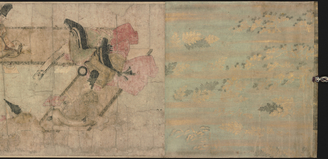
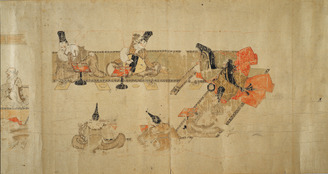
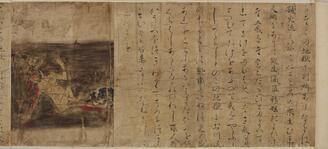
<p>Hungry ghosts are the spirits of people who once lived lives filled with greed and evil deeds. Now they suffer from insatiable hunger and thirst in one of the realms of suffering. This illustrated scroll has its roots in the teachings of the Pure Land faith, which was popular at the end of the Heian Period. It depicts in minute detail the unearthly forms of the hungry ghosts. The scroll is based on the Shobo nenjo-kyo, or the Meditation on the Correct Teaching Sutra. It was originally passed down with a text explaining the pictures, but this was subsequently lost and there are now various opinions as to what each scene represents. Let's take a look at these scenes.<br /><br />In one, men and women are shown enjoying music. Small hungry ghosts are attached to their shoulders and chests. This is thought to depict people with no respect for the Buddha's teachings. The ghosts are probably feeding on their corrupt souls. The next scene shows a birth. A hungry ghost is holding its arms out to feed on the newborn. This spirit, crawling out from the pits of hell, was once someone who tricked sick people in a previous life. A further scene shows hungry ghosts feasting on human excrement. These are the spirits of people who had previously contaminated food meant for monks.<br /><br />Each scene portrays the awful existence of the hungry ghosts. Perhaps these depictions caused viewers to reflect on their own lifestyles and behavior. What feelings do they rouse in you?<br /><br />It is thought this work was once part of the Six Paths of Transmigration, a set of paintings originally kept in the treasure house of Kyoto's Rengeo'in Temple. Commonly known as Sanjusangendo, this house was built by the cloistered emperor Goshirakawa.</p>

<p>This narrative handscroll deals with the theme of salvation from the perpetual state of hunger and thirst suffered in the realm of the hungry ghost <I>(gaki), </I> which is among the six realms of rebirth <I> (rokudo). </I> The scroll shows how offering water to the ancestral grave is a form of repose to the hungry ghosts. Also depicted are scenes of how Maudgalyayana (Mokuren), one of the Buddha's ten great disciples, saved his mother from this realm by starting the <I>ullambana (obon) </I> ceremony of making oblations to the dead as well as scenes of how to hold memorial services for the deceased.</p>
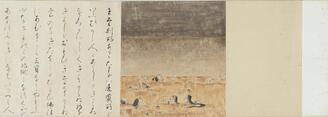
<p>The nature of one’s sins determines which of the Buddhist hells one falls into. Here we see a section of the Buddhist hell—a river of boiling excrement—reserved for monks who have indulged in drinking alcohol and eating meat, violoations of the precepts. The poor monks who have fallen into this horrific river cower in fear, tears of fire flowing from their eyes.</p>

<p>{i=>[jigoku, emaki], content=>[There are Six Realms (Rokudō) into which one can be reborn at death, and those who have committed serious offenses fall into the realm of the Buddhist hells (, ). This painting is part of a masterwork illustrated handscroll (, ) that depicts some of the various sub-hells comprising the most dreadful of the Six Realms. Seven sub-hells are shown, including the Hell of the Flaming Rooster.]}</p><br /><p>It is conceivable that the Scroll of Hells, as well as the Scroll of Hungry Ghosts, was based on the idea of metempsychosis or the cycles of life in the Six Realms. That idea was popular at the end of the Heian period. The Six Realms consist of hell, hunger, beasthood, Ashura (Asura or evilness), human beings, and heaven. All the creatures were supposed to live in those six realms in turns. The scroll introduced in this article is a segment from the complete scroll and was once kept in Daishō-in temple in Tokyo; afterwards it was kept by the Hara family in Yokohama. This scroll covers seven infernal scenes which were taken from sixteen tortures in eight infernos based on the description in the Kise-kyō sutra (ch'i-shih-yin-pên-ching). The first chapter describes the inferno of excrement, the second chapter the inferno of measures, the third chapter the inferno of iron mill, the fourth chapter the inferno of a rooster, the fifth chapter the inferno of hot sand from black clouds, the sixth chapter the inferno of bloody pus and the seventh chapter describes some unidentified inferno. The scenes are represented by dynamically drawn lines and bold compositions. The contrast of black, which symbolizes the darkness of hell, and vermilion, which symbolizes the flames of guilt, gives a strong impression and it makes the scroll ghastly and at the same time beautiful.</p>
<p>Viewers may wish to avert their eyes from these grisly scenes of people collapsed in bloody heaps or grimacing in pain amid fierce flames.<br /><br />Buddhism teaches that we are reincarnated in one of six worlds after death, depending on how we behaved when alive. The worst of these is the realm of hell. The paintings here are based on descriptions of hell in the Shobonenjo-kyo, a sutra containing the teachings of the Buddha.<br /><br />These four scenes depict the four levels of hell and the sufferings that await people who have committed various crimes related to alcohol. The first two levels focus on people writhing in agony, while the third and fourth levels feature a bird‘s eye view of people undergoing various kinds of torture. The compositional structure shifts with each scene to present a clear picture of the different torments that await each respective sinner. All the scenes are rendered in simple black and red tones, a device that accentuates the horrors and truly makes this a guide to hell.<br /><br />These kinds of hell paintings were made to warn people of the punishments that awaited if they misbehaved. They also sated the curiosity of people who wanted to know what the hell of the Buddhist scriptures looked like.<br /></p>
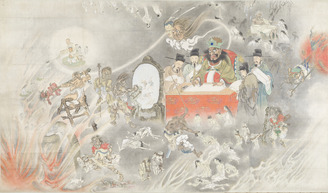
<p>奪衣婆(だつえば)に衣服を剥(は)がされた亡者(右上)が閻魔大王の前で審判を下され(中央)、さまざまな責め苦を受けながら地蔵に救われる光景(左上)が描かれている。暁斎は、はじめ浮世絵を学び、狩野派の画風をも習得して、とくに風刺画や戯画に個性を発揮している。<br /></p>
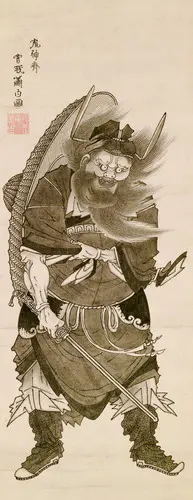
剣を持つ鍾馗を、変化に富んだ墨色を駆使してユーモラスに描く。鍾馗は、邪鬼を払う中国の門神で、我が国でも早くからその信仰が広まった。鍾馗の表情に蕭白独自の人物表現が見てとれる。蕭白の鍾馗図は、蠟燭をさした梅の枝を捧げ持つ鬼と鍾馗を描いた図様の四日市市立博物館本や鬼を抱き抱えた図様のボストン美術館本などが知られている。左上に「鬼神斎曾我蕭白図」の落款と「蛇足軒蕭白」の白文方印の印章が施されている。