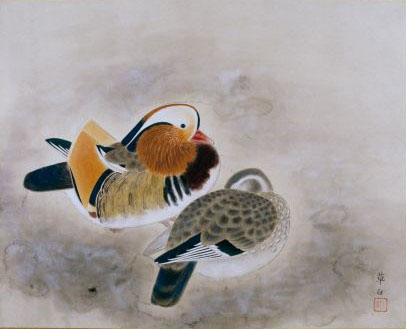
Mandarin duck
A type of bird considered to symbolize matrimonial harmony. The males’ decorative plumage features beautiful coloration.
A waterfowl species of the genus Aix in the Anseriformes order. In the kanji characters used for the Japanese name, oshidori (鴛鴦), the first represents the male of the species and the second, the female. The males, known as drakes, are about 45 cm in length, while the females (mallards) are slightly more compact in size. Distributed in areas including Northeastern China, the Korean Peninsula, Sakhalin, and Japan. Feral populations exist in parts of Europe as well, where they have been released and breed in the wild. Its natural habitat is darker locations around lakes, wetlands, and rivers in mountainous areas. While its main diet consists of aquatic insects, small animals, and other small creatures, it is known to prefer eating acorns in autumn.
During the breeding season, drakes display beautifully colored decorative plumage. Due to their shape, these are also referred to as ichoba or tsurugiba, names likening them to ginkgo leaves and swords respectively. Following the breeding season, males molt their showy plumage and take on coloration similar to females overall, though their reddish bills remain unchanged year-round. In mandarin duck flocks, males constitute the overwhelming majority, and it is thought that pressures to be selected by females during the breeding season prompted the development of their decorative displays. Females, meanwhile, are covered with gray-brown plumage featuring mottled patterns in the chest area and white around the eyes.
An old name for mandarin duck in Japanese is oshi (or woshi), a name that appears in Nihon Shoki (“The Chronicles of Japan,” 720), a historical work completed in the Nara Period (710–794). The ducks have also been considered to symbolize matrimonial harmony since antiquity due to their tendency to exhibit pair-based behavior. Phrases such as oshidori fufu (“happily married couple”) and en’o no chigiri (“vow of eternal fidelity”) use mandarin ducks as exemplars of harmonious married couples. Mandarin duck patterns and designs also have a familiar presence in Japanese traditions and are considered auspicious. From about the Momoyama to Edo periods (1558–1868), they were employed in embroidery and maki-e lacquerware decoration. The oldest artifact extant in Japan is the akaji en’o karakusa-mon nishiki (brocade with mandarin ducks and arabesque pattern on red background), a treasured item in the Shosoin Repository.
Related People, Things and Events
Books
Related Works
Japanese painting on the theme of mandarin duck
Videos
Past Exhibitions
| Title | shusai | Place | open | close |
|---|---|---|---|---|
Institutions and External Links
References
- 氏原巨雄, 氏原道昭 著,誠文堂新光社
- 日本野鳥の会 編,上田恵介 監修,山と溪谷社