White Porcelain (Hakuji)
White porcelain born in China and developed throughout Asia
Hakuji is white porcelain fired at high temperatures with a transparent glaze over a white base. It originated in China around the 6th century and was developed in various Asian countries. This section introduces white porcelain from China, the cradle of white porcelain, from Korea, where white porcelain was designated for court-ware, and from our own country, Japan.
Chinese White Porcelain
White porcelain is thought to have originated in China around the 6th century by refining celadon clay and glaze by removing impurities such as iron. During the Sui Dynasty (581-618), a period of transition from celadon to white porcelain, slightly greenish neutral colored examples can be seen. Eventually, in the Tang Dynasty (618-907), white porcelain production began in earnest at the Xing-zhou kilns in Hebei Province, and practical white porcelain was mass-produced. In the Song Dynasty (960-1279), the Xing-zhou kilns were replaced by the Ding kilns, also in Hebei province. The Ding kilns produced high-quality white porcelain with a beautiful ivory-white glaze and a variety of decorative techniques, such as one cut carving and gilding, and during the Northern Song Dynasty (960-1127), they became renowned as the premier representative of fine white porcelain kilns of the period.
In addition, in the early Northern Song Dynasty (11th century), white porcelain production began at the Jingdezhen kilns, the biggest pottery area in the country, located in Jiangxi Province in southern China. White porcelain from the Jingdezhen kilns is characterized by its bluish tint, and is also called "seihakuji (blue white porcelain)" or "inchin (shadow blue)". Eventually, white porcelain began to be fired at kilns in Fujian and Guangdong Provinces, and was widely exported to the Korean Peninsula, Japan, and Southeast Asia. From the Ming Dynasty (1368-1644) to the Qing Dynasty (1644-1912), the Dehua kilns in Fujian Province flourished, producing unique white porcelain with a smooth texture and ivory tint.
Korean White Porcelain
The production of white porcelain on the Korean peninsula is thought to have begun in the mid-10th century during the Goryeo Dynasty (918-1392), but the amount of white porcelain produced during the Goryeo period was not very large. In the Joseon period (1392-1910), white porcelain was designated as court-ware by the Joseon Dynasty, and a full-scale white porcelain era started. In the 15th century, official kilns were established in Gwangju County, Gyeonggi Province, and white porcelain was fired mainly to make tableware for the royal family and the government. In the 17th century, white porcelain production became chaotic because of warfare and the glaze became grayish-white, but as society stabilized in the 18th century, white porcelain regained its whiteness. In 1752, the official kilns, which had been moved every 10 years, were fixed in Bunwon-ri, Gwangju County, Gyeonggi Province, where a variety of high quality white porcelain was produced under stable conditions. The Joseon Dynasty, which was based on Confucianism as its governing principle, regarded thrift as a virtue, and thus often banned the use of overglaze blue and underglaze color ceramics for being too lavish. As a result, Joseon white porcelain developed its own unique decorative techniques, such as relief, slip-trailed decoration, openwork, and incised patterns.
Kiseto ware
Japanese White Porcelain
Japan has a long history of importing and prizing white porcelain from China and Korea, and Xing-zhou white porcelain and other artifacts of the Tang Dynasty have been excavated from ruins of the Nara period (710-784). Domestic white porcelain production began in the early Edo period (17th century) with Imari wares from Arita (Saga Pref.), which is the oldest porcelain in Japan. However, white porcelain tableware did not become mainstream in Japan, as Imari soon began to produce white porcelain with painted underglaze blue (sometsuke) or overglaze color (iroe). White porcelain in Japan related to ornamental ceramics, such as figurines and vases, as well as elaborate white porcelain figures, were produced at kilns of Mikawachi wares (Hirado wares) in Nagasaki Pref. and Izushi wares in Hyogo Pref. Also, highly artistic white porcelain has been produced by potters since the Meiji period.
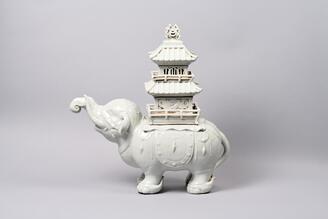
Elephant-Shaped Incense Burner
The Bodhisattva Kannon
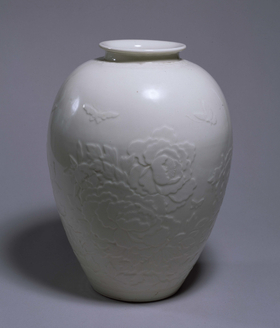
白磁蝶牡丹浮文大瓶
Jar with Grape Vines in Relief
Phoenix
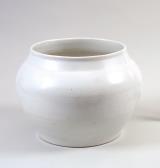
白磁大壺
Related People, Things and Events
References
- 平凡社
- 長谷部楽爾 監修,平凡社
- 赤沼多佳, 伊藤郁太郎, 片山まび 編著,講談社
- 勝見充男 監修,平凡社