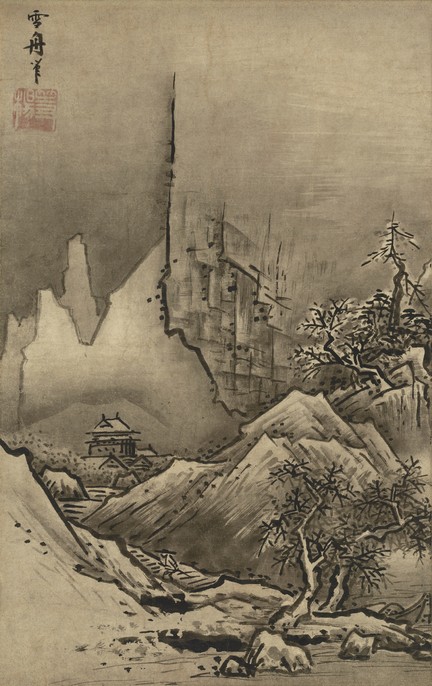
Monochrome Ink Painting (suibokuga)
An East Asian style of painting that uses ink and washes; the artist Sesshu established a style unique to Japan
Monochrome ink painting (suibokuga), colloquially called sumi-e, is an East Asian monochromatic style of painting with ink and water, sometimes with color washes added. Monochrome ink painting is believed to have originated in China during the Tang dynasty (618–907). Realistic landscape (shanshui) painting was developed from the end of the Tang dynasty and through the following five dynasties (907–960) and came into its prime during the Song (960–1279) and Yuan (1271–1368) dynasties. Monochrome ink painting (suibokuga), on the other hand, found its way to Korea and Japan and followed a different course of development. An early example of monochrome ink painting can be found in a portion of the folding screen Torige ritsujo (Ladies under Trees), created in the Tenpyo era (729–749) and currently stored in the Shosoin Repository. However, it was during the Kamakura period (1180–1333) that paintings in this style began to be created in earnest, originally in connection with Zen Buddhism. In the Muromachi period (1392–1507), such paintings were created by such scholarly priests as Josetu and Shubun. Finally, Sesshu came along and brought the Japanese medieval style of monochrome ink painting to full maturity.
Later, Masanobu Kano and other artists of the Kano school incorporated the tradition of Japanese painting (yamato-e) and contributed to the establishment of the painting on folding screens and sliding doors (shohekiga) of the Azuchi-Momoyama period (1573–1603) through the Edo period (1603–1867). Furthermore, in the mid-Edo period, techniques of the Southern School of Chinese painting (nanshuga or nanga) were imported from China, and techniques of Sotatsu Tawaraya and Korin Ogata of the Sotatsu Korin School were also incorporated into the practice of monochrome ink painting. In the Meiji period (1868–1912), Tessai Tomioka created a legacy of many free-spirited monochrome ink masterpieces.
Related People, Things and Events
Books
Related Works
Cultural properties in Japan
Videos
Past Exhibitions
| Title | shusai | Place | open | close |
|---|---|---|---|---|
Institutions Holding Related Materials
富山県富山市に所在。平成11年(1999)に開館、日本の近代以降の水墨画を中心に紹介しています。常設展示室では、竹内栖鳳や横山大観、菱田春草などの近代を代表する画家の作品を見ることができます。
As Japan’s representative museum, Tokyo National Museum collects, preserves, displays, and researches the cultural properties of Asia with a focus on Japan, and also provides educational programs.
Kyoto National Museum collects, preserves, displays, researches and provides educational programs focusing on cultural properties from Heian- through to Edo- period Japan, when the capital was located there.
Nara National Museum collects, preserves, displays, researches and provides educational programs about cultural properties with a focus on Buddhist art.
Kyushu National Museum explores how Japan’s history of cultural exchange with the rest of Asia has impacted the formation of its culture. To that end, we engage in the collection, preservation, exhibition, and research of cultural properties, in addition to providing educational outreach to the local community.
The National Diet Library (NDL), founded in 1948, is the library which belongs to the Diet. The NDL assists the activities of the National Diet. The Library collects and conserves materials and information both from Japan and abroad, serving as a foundation of knowledge and culture and providing library services to administrative and judicial entities and Japanese citizens.
The Independent Administrative Institution National Museum of Art stands as the nexus of art advancement in Japan, charged with fostering the creation and development of art and culture in Japan, and the cultivation of aesthetic awareness among the Japanese people. Through its six art museums — The National Museums of Modern Art, Tokyo and Kyoto, National Film Archive of Japan, the National Museum of Western Art, Tokyo, the National Museum of Art, Osaka, and the National Art Center, Tokyo — the National Museum of Art carries out diverse and distinctive activities that fully utilize the unique character of each member museum.
External Links
小学館が運営する日本文化の入口マガジン「和楽web」より。
株式会社クラフテリオが運営する「たのしくまなぶ電波塔 たのでん」より。
Other Materials in Japan Search
References
- 矢代幸雄 著,岩波書店
- 「水墨画」の項
- 「水墨画」の項
- 「水墨画」の項
- 歴史学研究会 編,岩波書店