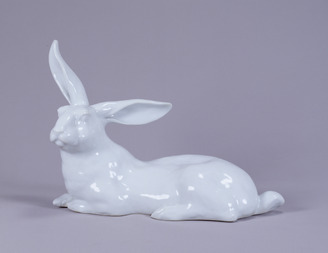
Rabbit (Usagi)
A familiar animal depicted in myths and stories since ancient times
In its broad sense, usagi is a general term for mammals belonging to the order Lagomorpha, and in its narrow sense, it refers to mammals belonging to the subfamily Leporidae. Rodents like rats and squirrels were regarded as lagomorphs, but they are now classified differently because of their serological and morphological differences.
Many rabbits have short tails, long hind limbs suitable for jumping, and long ears. They are found all over the world except in Australia and Madagascar, but in Australia, European rabbits were introduced in the early nineteenth century and have become wild. They are herbivorous and live in almost every environment, including deserts, grasslands, forests, high mountains, and tundra.
The order Lagomorpha is divided into the families Ochotonidae and Leporidae, and the family Leporidae is further divided into the subfamilies Paleolaginae and Leporinae. The Leporinae subfamily includes hares, such as Lepus timidus, and rabbits, such as Pentalagus furnessi and Oryctolagus cuniculus. The domesticated rabbit is Oryctolagus cuniculus. There are many varieties of rabbits, depending on the purpose for which they are bred. These include meat species (e.g., Belgian hare rabbits), hair species (e.g., Angora rabbits), fur species (e.g., Chinchilla rabbits), and pet species (e.g., English spot rabbits, Dutch rabbits, and Himalayan rabbits). Domestication of rabbits began on the Iberian Peninsula in Europe during the Roman period and then spread throughout the world, but it was not until the Meiji Restoration (1868), when Japan opened to the West, that rabbits began to be kept in Japan. A variety developed in Japan is the Japanese white rabbit, used for hair as well as meat.
The connection between rabbits and the moon is a global phenomenon. In ancient China, Chuci (Songs of Chu, 206 BC-8 AD), in the chapter "Tianwen," says that there is a rabbit in the moon. In ancient Africa and America, the rabbit is equated with the moon. Because rabbits are fecund, the rabbit has been regarded as a symbol of fertility and also of lasciviousness. In Japan, the story of Inaba's white rabbit in the Kojiki (Records of Ancient Matters, ca. 712) and the humorous drawings of rabbits in Choju giga (Scrolls of Frolicking Animals) show that rabbits were perceived as small animals having a close relationship with humans. On the other hand, rabbits also eat forest and farm vegetation, so farmers hate them.
In the Japanese language, rabbits are counted using the same measure word used for counting birds. This is because rabbits have long been hunted using methods similar to those for catching birds, such as nets; rabbit meat tastes light, like bird meat; and Buddhism prohibited consumption of animal meat, so people tended to identify rabbit meat as bird meat. In the Tokugawa Shogunate, rabbit soup was regarded as an auspicious dish on New Year's Day.
The rabbit as one of the twelve zodiac signs is written with the Chinese character 卯, which corresponds to the Second Month of the lunar calendar and the direction east.
Related People, Things and Events
Books
Literary works that feature rabbits
Books about keeping rabbits
Related Works
Videos
Past Exhibitions
| Title | shusai | Place | open | close |
|---|---|---|---|---|
Institutions Holding Related Materials
所在地は島根県出雲市。神話「因幡の素兎」の元になった大国主大神と兎の製銅像等がある。
所在地は鳥取県鳥取市。神話「因幡の白兎」に登場する白兎神が祀られており、神社には何体もの兎の石像がある。
広島県竹原市の忠海港から船で約15分のところにある無人島。島内には700羽以上の野生のうさぎが生息している。
彫刻家の籔内佐斗司が制作した《宍道湖うさぎ》12匹が宍道湖を眺めるように建っている。
The National Diet Library (NDL), founded in 1948, is the library which belongs to the Diet. The NDL assists the activities of the National Diet. The Library collects and conserves materials and information both from Japan and abroad, serving as a foundation of knowledge and culture and providing library services to administrative and judicial entities and Japanese citizens.
As Japan’s representative museum, Tokyo National Museum collects, preserves, displays, and researches the cultural properties of Asia with a focus on Japan, and also provides educational programs.
Aichi Prefectural Museum of Art was founded as the successor of the Aichi Prefectural Art Gallery, which originally opened in Sakae, the center of Nagoya City, Aichi Prefecture, in 1955. The museum opened in 1992 as part of the Aichi Arts Center, an urban cultural complex, and has established a wide-range collection of approximately 8,000 items, centered on works of art of the twentieth century. The Museum has also organized numerous exhibition of a wide-range of themes. The Museum has actively worked to develop and communicate new aspects of art and culture to the public, based on its core mission to serve as the primary art museum of the Chubu region.
The Tokyo Fuji Art Museum is founded on November 3, 1983, in Hachioji, a thriving university town in the western suburbs of the Japanese capital. Priding itself as “a museum creating bridges around the world” to facilitate the exchange of different cultures, our museum has forged cordial relations with art museums and cultural institutes in 32 countries and territories to date. We do so by bringing the world’s finest works of art to Japan while reciprocating in kind by introducing the finest Japanese treasures to the world through special exhibitions that showcase their beauty and wonder through a unique new set of prisms and perspectives. Our museum possesses some 30,000 pieces of artworks from various periods and cultures including Japanese, Eastern and Western works, ranging from paintings, prints, photography, sculptures, ceramics and lacquer ware to armor, swords and medallions. Especially noteworthy is its outstanding collection of Western oil paintings that spans a five-hundred-year period from the Renaissance, Baroque, Rococo, and Romanticism to Impressionism and contemporary art, as well as its exceptional collection of photographic masterpieces that can give an overview of the history of photography from the birth of the photograph to the present age.
External Links
子ども文化関連の資料を収蔵。子ども浮世絵は2,135点を公開している。キーワードやカテゴリで検索可。
絵本と児童書の情報サイト。多種多様な兎の絵本や一般書籍を検索することができる。
インターネット動物園 (動物図鑑)。検索するとニホンノウサギ、トウホクノウサギ、イエウサギ等について知ることができる。
References
- 日立デジタル平凡社,平凡社
- 棚橋正博 著,青裳堂書店