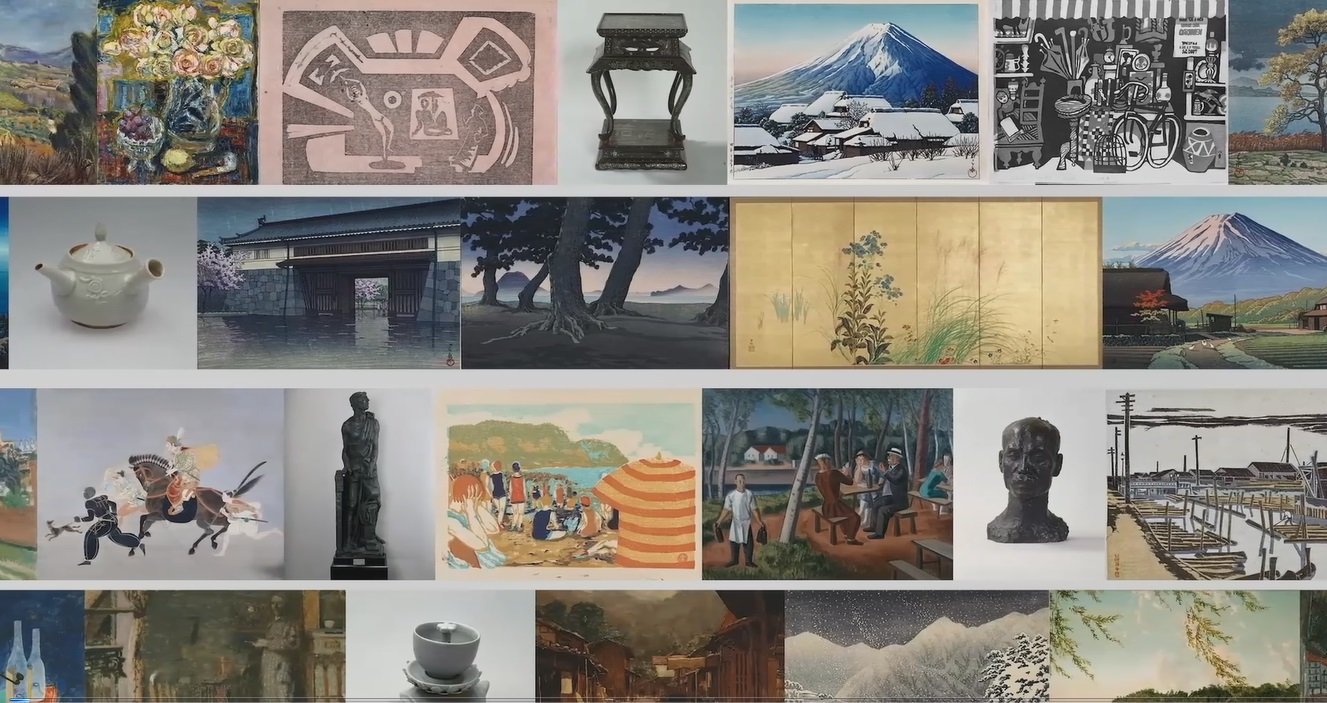
Japan Search Selection (GIF IT UP 2022)
A group dance known as furyu-odori, with dancers in brilliant attire and gay accessories, originated in Kyoto and soon spread all over Japan from the end of the Muromachi Period to the Edo Period. The term furyu originally meant dressing oneself up with cheerful clothing and other personal belongings. People vied for the extravagant decorations of their festival floats and colorful costumers as they paraded in religious festivals. Soon musicians with flutes, drums and bells and singers came to join the dancing parades, and parade dances with characteristic hand movements became a fad. These dances are known to be the origins of today’s Bon dance. Happily dancing people were often depicted on the byobu (heavy paper screen doors) and fuzoku-emaki (picture scrolls of ordinary people’s lives). This one-volume exhibit is a part of the 8-volume Comprehensive Dance Emaki, which depicts 8 different furyu-odori. The ryoshi is decorated with scattered gold foils, and the dancers are depicted in bright colors. On top of each dancing group is a description of that particular dance, the words of the song, etc. 1.Karako-odori (Chinese-Costume Boys’ Dance): Dance by small boys dedicated during autumn shrine festivals. The children are clad in Korean-style costumes, so the dance was obviously patterned after the dancing parade that accompanied Korean Envoys (Jp: Chosen Tsushinshi) to Japan when they used to pay courtesy calls to Japan’s military ruler.2.Komachi-odori (Young Town Girls’ Dance): Young and brilliantly-dressed girls dance along the town streets on July 7 (lunar calendar), the day of the popular Tanabata (Star Festival).3.Sumiyoshi-odori (Sumiyoshi Dance): One of the religious dances started at the Sumiyoshi Jinja Shrine to pray for a good harvest and often danced during the rice seedling planting season.4.Kokiriko-odori (Kokiriko Dance): The folk music instrument kokiriko was made by putting together bamboo slats. People danced to the music and rhythm of the pair of kokiriko of 20-30 cm in length. 5.Wakashu-odori (Young Men’s Dance): This dancing group is joined by young men before they celebrate their coming of age.6.Tojin Odori (Chinese-Costume Young Men’s Dance): This dance shares the same origin as the karako-odori, in which boys dance clad in ancient Korean costumes patterned after the Korean Envoys. It is also said that the dance has incorporated elements of Chinese dances brought over by the Chinese who visited Nagasaki. 7.Kake odori (Dance Relays): People in local towns and villages engage in dances slightly different from locality to locality and parade while dancing on the streets. When they reach the boundary with a neighboring town, the new townsfolk pick up the dance and thus pass on the fun and excitement. The origin of the dance relay can be traced back to chanting with music to drive away evil spirits from a community, which is then passed down to neighboring communities. Thus, the original purpose of these dances was to serve as exorcism chants and prayers for good harvests and the like. 8.Sashimono odori (Banner Dance): Dancers carry on their backs family banners on tall poles, the types often used in battles to ostensibly show the generals’ family crests. This kind of dance may have originated from the basho odori (lit. banana-leaf dance) in which dancers carried poles on their backs likened to banana leaves, loudly and wildly praying for rainfall, making it a sort of rain dance.
「唐蘭船持渡鳥獣之図」は「鳥之図」2帖、「獣類之図」「馬之図」「犬之図」各1帖の5帖からなる図譜である。江戸時代後期、寛保~嘉永年間(1741–1854)に中国船・オランダ船によって長崎に渡来した珍しい鳥獣を極彩色で描いた225図が収録されている。「獣類之図」に収められた象の図は、象使いの道具4図や種々の動きを描写した絵も一緒に収められ、当時の人々が象に対していかに大きな関心を抱いていたかを伝えている。長崎の代官や町年寄を務めた高木家は、寛文年間(1661–1673)より長崎に渡来した品々を幕府に報告する役目を命じられ、珍鳥異獣については御用絵師に正確な絵を描かせ、その絵を江戸へ送って鳥獣を届けるべきか幕府の判断を仰いでいた。高木家は手許に残した控図を巻物として秘蔵し、それを明治時代に折帖に改めたのが本図譜である。各図に鳥獣の種名、渡来年、出所(出生地)、雌雄、寸法などの情報が記され、江戸時代に渡来した動物の歴史を詳細に伝える本図譜は、博物学史上において大変貴重な資料とされている。昭和32年(1957)、松永安左ヱ門氏より寄贈された。(三田メディアセンター 倉持隆)
幕医栗本丹洲(通称は瑞見、1756-1834)は『千虫譜』で有名だが、その魚介譜はより大規模な図説で、原本は巻子本計30軸ほどだったと思われる。現在は当館(4軸)、東京国立博物館(『博物舘魚譜』などに貼付)、杏雨書屋(『栗氏魚譜』22軸)に分かれて収納されている。本資料はその一つで、クラゲ12・タコ3・イカ5(1点は卵嚢)・ヒトデ3・クモヒトデ1(原記載名、わくのて)・カメノテ(甲殻類)1の計25図から成る。うち19点は、高松藩主松平頼恭編『衆鱗図』の転写である。当館所蔵の丹洲自筆本は、これ以外に、『魚譜』(本別10-3、1軸)、『魚譜』(寄別10-38、2軸)、『王余魚図彙』(カレイずい:ち二-15、1軸)の3点がある。全貌が不明なので、正確な計算はできないが、魚介譜の総品数は1000を上まわり、その約半数が『衆鱗図』と『衆鱗手鑑』に由来するようである。:『魚譜』(り二-3)解題参照(磯野直秀)
<p>橋口五葉は鹿児島出身の画家。日本画を学んだ後、上京して洋画に転向し、装幀家@そうていか@として才能を開かせました。浮世絵研究仲間であった渡邊庄三郎の勧めで渡邊版「浴場の女」を刊行し、日本人初の新版画作家となります。本作はその後に取り組んだ私家版@しかばん@で、近代の美人画を代表する一作です。<br /></p>
「菊寿」とは、9月9日に行う重陽の節句。節句の折りには、菊花酒を飲みかわすなどして長寿を願ったとされる。また菊は長寿を寓意し、画題としても良く用いられる。本作はこの菊の宴を終えた後であろうか、菊を愛でながらくつろぐ婦人の姿が描かれる。鮮やかな黄赤色を基調とした鹿の子柄の入った着物にやや黄味がかった水色の色打掛という取り合わせが鮮やかで、白い女性の肌と菊の花を際立たせている。特に打掛の裏地に薄い黄赤色を使い、青系統とオレンジ系統という補色の色同士を組み合わせており、松園の色彩への細やかな意識を窺わせる。女性は江戸の元禄時代以降に流行ったとされる投島田を結い、鼈甲製の櫛、笄、簪で髪を飾っている。
<p>濃密でしかも細部まで緻密に描写された色とりどりの花や草木を背景に、雉に巻きついた蛇が、樹上の鷹とにらみ合い不気味な雰囲気が漂う。暁斎画の特色ともいえるあたかも時間が凍りついたような空間である。明治14年の第2回内国勧業博覧会に出品された。<br /></p>
<p>The powerful figures of a dragon and tiger dominate the large canvas of these folding screens. The theme of this painting can be summed up in a Japanese phrase that translates as 'standoff between dragon and tiger.' Though the dragon may be an imaginary beast while the tiger actually exists, they were both venerated as mighty creatures and were often painted together in a set.<br /><br />From olden times, dragons were said to cause clouds and tigers, wind, with clouds and wind associated with each beast. On the screen to your right, a sharp-clawed dragon glares down on us from the heavens. The swelling clouds seem to surge from right to left. On the left-hand screen a tiger crouches down and strikes an intimidating pose. The bamboo blades above are also depicted swaying from right to left. It seems the winds are blowing violently from the right-hand screen to the left. With its dynamic sense of movement and huge motifs that jut out of the screens, this pair of screen paintings aptly expresses the era's penchant for magnificence and grandeur.</p>
<p>This set of two folding screens features the Wind God on the right-hand screen and the Thunder God on the left. This slightly tongue-in-cheek work uses the form of two gods to depict the overwhelming power of nature, in this case wind and thunder. <br />The garments of the two deities flutter in the wind as if a fierce gale is blowing from left to right. The green-hued Wind God seems to have jumped into the screen from the right, while the white-skinned Thunder God seems poised to stop the Wind God in his tracks. The blurry, black-ink rainclouds convey a sense of depth while boldly highlighting the coloring of the two gods. The gazes of the two deities meet and they appear to be dancing together. The artist has focused on harmonizing the two gods into one unified picture.<br />Folding screens served as moveable partitions. They were used to demarcate spaces, block off breezes, and shield things from view.</p>
ラ・トゥールは、長い間スペイン派やイタリア画家などの作品群に紛れ込んでいて、20世紀初頭までは忘れ去られていた画家であったが、1930年代になって研究が進み、近年ようやく再評価がなされ、17世紀フランスの偉大な画家としての全貌が明らかになってきた(2005年3月に日本で初めてのラ・トゥール展が国立西洋美術館で開催された)。本作は1973年5月にフランス南部で発見され、同年、ピエール・ローザンベールとフランソワ・マセ・ド・レピネによって出版された『ジョルジュ・ド・ラ・トゥール』の中で、作品番号53として世に初めて紹介された作品である。ローザンベールとクリストファー・ライトは、汚れていた画面に洗浄を施した後のこの作品を実見し、二人ともラ・トゥールの最上の作例であるという点で見解が一致した。ジャック・テュイリエをはじめ、その他の研究者の意見も同様である。約40点(日本国内には2点[1点は国立西洋美術館所蔵《聖トマス》])しか現存しない真作の1点。ただし、ライトを除くほとんどの研究者が、彼の息子エティエンヌとの共同制作の可能性を指摘している。しかしながら、画面全体を支配する均衡の美しさ、立体感あふれる描写の力強さ、仕上げの繊細な質の高さ、そのどれをとっても、人はこのラ・トゥールの絵画世界に感動せずにはいられない。鋭い写実主義とカラヴァッジオ風のドラマティックな明暗法によって、煙草を吸うという風俗画のテーマでありながら、まるで宗教画のような深い精神性に満ちた表現を感じさせる。燃え木の光に照らし出された静謐な画面は、来るべき17世紀フランスの古典主義絵画の到来を感じさせてやまない。
<p>Reiko, who bears a mysterious smile in this work, was the beloved daughter of the artist. This portrait of her around the age of seven was completed in a mere ten days. <br /></p><br /><p>This oil painting presents a half-length portrait of a young girl. The bobbed hairstyle, the red obi sash and the brightly-colored kimono peaking out from the shawl are all typical clothes and accessories of Japanese girls from that time. However, there is something intriguing about the girl‘s long eyebrows, almond-shaped eyes and mysterious smile. An air of mystery pervades the picture. It is also apparent in the intricately-drawn shawl and the way her hands seem oddly small compared to her head.<br /><br />Kishida Ryusei became a Western-style painter after a thoroughgoing study of Western painting techniques. He was born in Tokyo in 1891 and he died in 1929 at the young age of 38. He studied under Kuroda Seiki, a pioneer of oil painting in modern Japan, and eagerly incorporated and assimilated Western techniques and forms of expression. In his short life, he won high acclaim for his solid, intricate portraits and expressive works that were influenced by Flemish painting from the 15th to 16th centuries.<br /><br />The model for this painting was Ryusei’s 7-year-old daughter Reiko. Throughout his life, he continued to paint his beloved daughter in oil paintings, watercolors and sketches. Depictions of Reiko changed with each painting as Ryusei‘s style evolved and his daughter grew older. This portrait of Reiko is recognized as the most representative example of these numerous depictions. With its distinctive features and mysterious aura, some have compared this portrait to Leonard Da Vinci‘s Mona Lisa. According to a diary left behind by Ryusei, he decided to eschew the solidity of Flemish painting here to imbue the portrait with more softness and charm, with some of the motifs influenced by the works of Francisco Goya, a Spanish painter active from the 17th to the 18th century.</p>
<p>宮中では、平安時代から、陰暦三月三日に鶏を闘わせて観覧した。浅井忠は、明治時代の洋画界に大きな影響を与えた画家であるが、はじめ日本画を学んでいる。本図は、古い絵巻物から図柄を抜き出し描いたもののようにも思われる。 <br />(2005/01/02_h21)<br /></p>
<p>This deity wears a brimless hat and its hands are spread out wide in a dynamic pose as it runs at top speed. The image comes from a Zen temple, where it would have protected the temple grounds. A truly frightening deity, he drives a nail into anyone neglecting their Buddhist practice. It is possible that it once held a hammer and a spike in its hands.</p><br /><p>Based on its appearance, this frenetically rushing figure with its broadly was popularly known as Running Daikoku but recent scholarship has identified it as one of the guardian deities of temple precincts. Such deities would discipline monks who neglected their spiritual training by driving spikes at them.</p><br /><p>Many are familiar with the name Hashiri Daikoku for this statue, but in recent years it has come to be understood as a generic protective deity of temple precincts (garanshin). Such deities are called kannōshisha or kansaishisha in Japanese, terms that refer to divine envoys dispatched as guards or overseers. The dynamic posture and vivid facial expression are representative of the physicality of late-Kamakura-period sculpture.</p><br /><p>The statue was finely expressed with dynamic movement and flowing garments, representing a lively style in the Kamakura period. It has been popularly attracted by the name of “Hashiri Daikoku” (Running Mahākala), however recent study suggests as “Kannō Shisha”, one of the tutelary icons in the Buddhist hall.</p><br /><p>{br=>[[]], content=>[The deity Daikoku-ten (Mahākāla) is usually enshrined in store-houses and is supposed to offer fortune in response to prayers. This deity has its origin in India and was introduced to Japan via China. In Japan, Daikoku-ten was enshrined as a principal image of the Mandokoro in Enryaku-ji temple and was respected especially in the Tendai sect. Usually, a Daikoku-ten statue has two arms and is wearing a hōi style costume and is carrying a large sack., The statue of Daikoku-ten introduced in this article was made in the method of joining hinoki wood pieces (Japanese cypress). The core of the statue was carved out, and crystal eyeballs were inserted. The outside of the statue is colored. The running pose of this statue with its swinging arms and with one leg stepping forward is classified as the Hashiri Daikoku (running Daikoku) type. Daikoku-ten statues of the same type are kept in Onjō-ji temple in Shiga prefecture and Chūzen-ji temple in Nikkō. Among all Hashiri Daikoku type statues, this one in the Nara National Museum is the oldest. The realistic expression of its face, the powerful running style and the fluttering costume reflect the lively expression of the sculptures of the Kamakura period.]}</p>
<p>Here Tamonten (Skt. Vaiśravaṇa) holds his attribute of a pagoda raised up high, a type of image that was widespread in Nara. With the strong twist of the hips to the right, it expresses dramatic movement and a powerful dynamism. It was previously part of a set of sculptures from Kōfukuji Temple along with the Zōchōten (Skt. Virūḍhaka) now in the collection of the Nara National Museum.</p><br /><p>This statue of Tamon-ten with an ornamental pagoda held high aloft is representative of a style widely seen in the Southern Capital (Jpn. Nanto), as Nara was once known. In addition to the pose in which the waist is twisted to the right, the statue has a dynamism that can only be called dramatic. Originally kept at Kōfukuji temple, it one of Four Guardian Kings (Jpn. Shitennō) and was paired with Kōmoku-ten. </p><br /><p>This work constituted as the one of the Four Guardian Kings and came from Kōfuku-ji Temple together with the Kōmokuten (Skt. Virūpāṣa) and the Zōchōten (Skt. Virūḍhaka). The waist was twisted rightward and the right hand was raised aloft holding the small pagoda, characterized a lively posture. The black eye was inlaid with different block of wood to emphasize the raging face.</p><br /><p>{i=>[Zōchōten (Skt. Virūḍhaka)], br=>[[], []], content=>[The Four Heavenly Kings guard the four cardinal directions. The deva Tamonten (Skt. Vaiśravaṇa) is the guardian of the north. This statue belongs to a set of the Four Heavenly Kings that was reportedly passed down at the Northern Round Hall of Kōfukuji Temple, but its actual origins are unknown. The three other statues in the set have also survived to present day (see the entry for , )., This statue wears a fierce expression, scowling with wrathful eyes and an open mouth. The helmeted head is turned to the viewer’s left. Its piercing gaze is focused on a jeweled stupa held in the palm of its upheld right arm. Holding a sacred staff in the lowered left hand, the statue stands with its hips twisted to the right as it tramples an evil demon’s head under its right foot and stomps down on the demon’s backside with its slightly outturned left foot. Tamonten has a vividly rendered wrathful countenance, short neck, and stocky body. The somewhat muted dynamism in the pose, however, and fullness of the figure’s form call to mind the dignified appearance of statues with their main bodies sculpted from a single block of wood during the early Heian period (794–1185). , The torso of this work is carved from a single block of Japanese cypress that was hollowed out and has had a board attached to the back. The head was made from a separate piece of wood and attached at the neck . The eyes were faced in a different material, and the work was painted. The scales in the figure’s lamellar armor are adorned with gold leaf adhered with lacquer. These features are shared with the Museum’s statue of Zōchōten, and both are thought to have been created by Buddhist sculptors in Nara in the late Heian period. As described in the commentary for the Zōchōten statue, the full-bodied and impressive life-size renderings in this set make them part of a lineage of Four Heavenly King sculptures produced in Nara from the late Heian period to the early Kamakura period (1185–1333).]}</p>
Daizenji Temple is located in the town of Katsunuma, in the heart of the grape-growing region of Yamanashi Prefecture. The temple was originally established in the 8th century for the worship of Yakushi Nyorai, the Buddhist deity of medicine and healing. Yakushi Nyorai is usually depicted holding a medicine vase in the left hand, but at this temple his statue is holding a bunch of grapes instead. Yakushi Nyorai is accompanied by statues of the bodhisattvas Nikko Bosatsu and Gekko Bosatsu, as well as statues of the Twelve Divine Generals. is usually hidden from view in a zushi miniature shrine, but every five years the image is put on public display. The practice of concealing a temple’s statue is known as hibutsu (hidden Buddha). While some hibutsu are occasionally displayed, such as at Daizenji, other hibutsu statues are never shown to the public at all.
<p>{i=>[Haniwa, Haniwa], content=>[ are ceramic funerary sculptures. , of dogs were often erected along with those of wild boars, representing a wild boar hunt. This item displays none of the tension one would expect from a hunting dog. The expression is one of innocence, suggesting the good-hearted nature of its creator.]}</p><br /><p>{i=>[Haniwa, haniwa, haniwa], content=>[ of dogs were often accompanied by , of wild boars and deer; these were lined up outside of tombs to represent hunting scenes. Yet this example of a dog , is not the fierce creature one would expect to find participating in a hunt: there is no tension to his form, and his expression is perfectly innocent, almost childlike. One senses the benevolent spirit of the person who made it.]}</p>
旧暦4月1日におこなわれる古堅のミーミンメー。昼には弥勒の登場する道ジュネ―がおこなわれ、夜には公民館の舞台で多彩な芸能が披露される。南城市の無形民俗文化財。
These are stuffed brown bears from Hokkaido. A brown bear migration route between Mt. Tarumae and the Yufutsu Wilderness is known to exist in Tomakomai.
The form of this large jar began to appear in the Yuan dynasty, and they have been decorated using various media, including qingbai glaze, celadon glaze, or underglaze copper-red paint. Known in Japan as shukaiko, meaning jar for wine gatherings, such jars originally had a lid and contained liquor or other liquid. The center of the body bears a decoration of several types of fish swimming spontaneously in the lotus pond. A combined design of fish and water plants is a common motif found in Yuan ceramics, also popularly adopted in folk paintings of the Jiangnan region (the southern area of the Yangzi River). The Chinese word for fish is yu, which is homonymous with the word for abundance, making the fish an auspicious motif symbolizing abundance of wealth. It is also a symbol of prosperity of posterity as fish lay many eggs. This is undoubtedly one of the masterworks of the Yuan blue-and-white porcelain in terms of the outstanding workmanship in every element, including the form, decoration, and the color of the cobalt blue.
<p>At first glance, there seems to be two real crabs, one climbing atop the other, clinging to this bowl. Their shapes were molded out of clay and fired, with a glaze containing large amounts of crystalline substances then applied, and the crabs fired again to create an approximate color. More detailed colors were then painted on top using a variety of pigments, with the crabs fired a final time to create the finished product. In contrast, the bowl itself is significantly warped, with the glaze applied in a slapdash fashion. This serves to accentuate the realism of the crabs. Miyagawa Kozan was born in Kyoto and he moved to Yokohama during the Meiji era. He produced many objects for European and American markets. As with this bowl, many of these exported ceramics feature realistic motifs. Japanese craft works like this were exported in volume and became very popular overseas at the start of the Meiji era, in the second half of the 19th century.</p><br /><p>Two crabs cling to the bowl, one climbing atop the other. Everything is made of clay, but the rough texture of the bowl emphasizes the realism of the crabs. The artist, Miyagawa Kōzan (1842–1916), made intricate pieces like this for export to Europe and America, where he became Japan’s most famous ceramic artist.<br /></p>