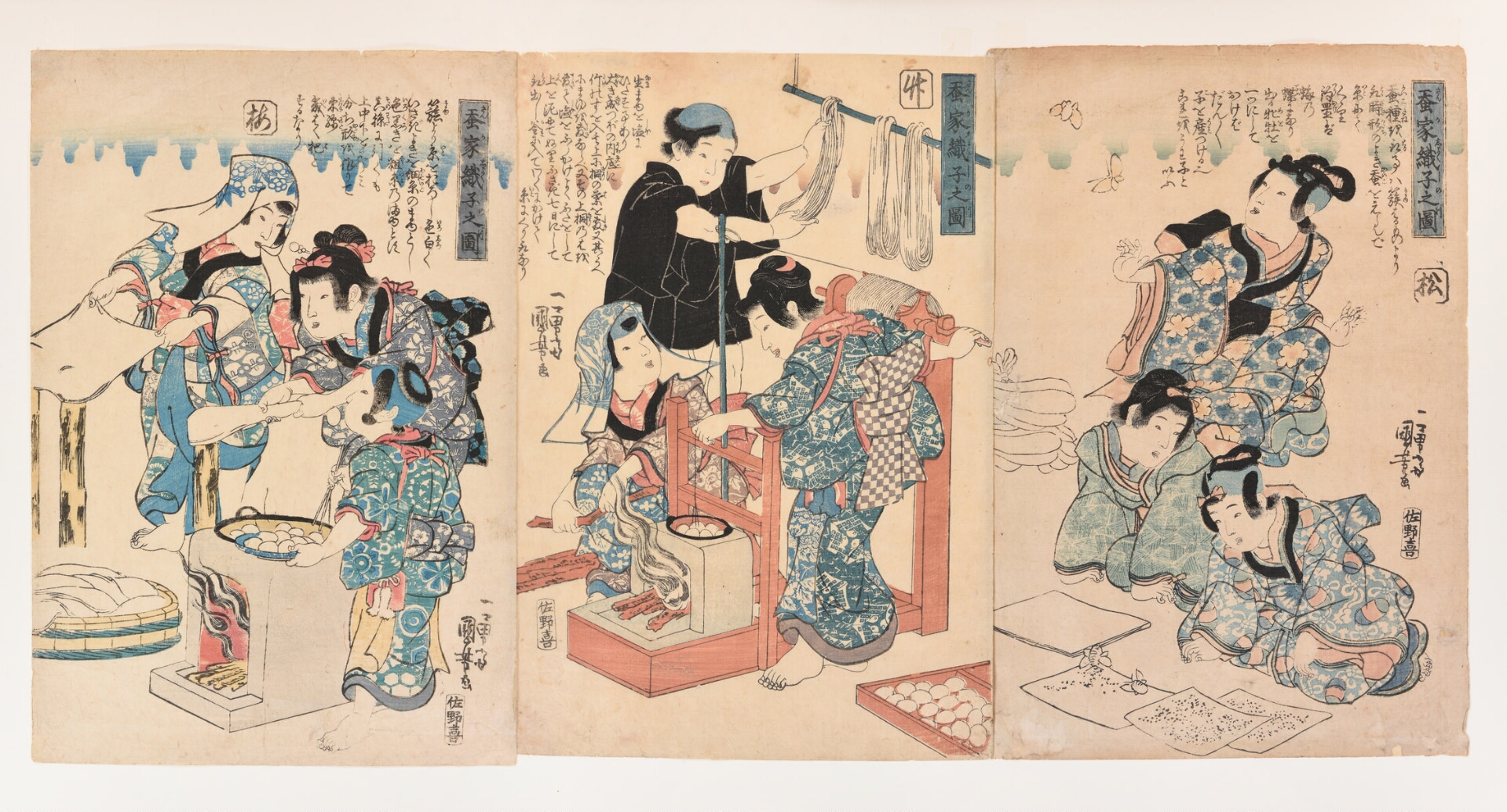
Sericulture
A practice with origins in the Shang dynasty (c. 1600–1046 BC), ancient China’s oldest ruling dynasty. In Meiji-period Japan, it came to be an important industry in the acquisition of foreign currency.
The practice of raising silkworms and producing raw silk thread from their cocoons. Silkworms (kaiko in Japanese) are moths of the Bombyx genus in the Lepidoptera order. Japan has approximately 600 varieties. The effect of many years of selective breeding has made them unable to fly or find food on their own, meaning they require human care. Bodies of newly hatched larvae are only about 1 cm in length. About 25 days later, after molting four times, their body weights increase by about 10,000 times. Subsequently, they spend about two to three days engaged in a cocoon-spinning process. Silkworms hatched in spring are called harugo (spring silkworms), and those hatched in summer and autumn, natsugo (summer silkworms) and akigo (autumn silkworms). Currently, new varieties are also being developed through genetic modification.
The origins of sericulture are ancient, stretching back to China’s oldest ruling dynasty, the Shang dynasty (c. 1600–1046 BC). Due to the existence of characters with meanings of “silkworm,” “mulberry tree,” and “thread” in oracle bone script at the time and the fact that fabric attached to buried items was made of silk, the practice of raising silkworms is thought to have originated in the Yellow River basin during the Shang dynasty. At the same time, it can also be deduced that sericulture had spread to Japan from ancient times as well, from records such as an account appearing in the Gishi Wajinden (“Records of Wei: An Account of the Wa People”), a Chinese historical chronicle completed in the second half of the 3rd century BC, describing a gift of silk offered to the Wei emperor by Queen Himiko of Yamatai-koku thought to correspond to Japan.
With the establishment of the Code of Taiho in 701 after the Taika Reforms, allotments of land (kubunden) were given to the populace by the government, where they were expected to cultivate crops including mulberry and lacquer trees, and silk was stipulated as the general form in which tributes were to be paid. As a result, by the Nara Period (710–794), silkworm cultivation had spread from the Kinki region to Kanto and Tohoku, and by the Heian Period (794–1185), throughout virtually all of Japan. In the Edo Period (1603–1868), the shogunate encouraged sericulture as a countermeasure against financial strains, and increased demand led to the development of specialization within the silk industry into trades such as silkworm egg-card production, silk-reeling, and weaving.
In 1859, with the opening of the Yokohama port, silk thread was made a key commodity in the acquisition of foreign currency as a representative export item. A lively export trade ensued, primarily with Europe, then following World War I (1914–1918), the United States came to be Japan’s number-one export counterpart. In the interim period, the Meiji government, with its aims of increasing national wealth and military power, had placed an emphasis on expanding the sericulture industry. In 1872, the first mechanical silk-reeling factory in Japan, the Tomioka Silk Mill, was established in Tomioka, Gunma Prefecture, and in 1909, Japan ascended to the position of top producer of silk thread in the world.
However, factors including sluggish demand stemming from the global financial crisis of 1929, the outbreak of World War II (1939–1945), and the popularization of inexpensive synthetic fibers caused the production of silk thread to gradually plateau, and the sericulture industry came to follow a course of decline.
In expression of how beneficial silkworms have been to people since ancient times, in Japanese, the counter suffix often used for them is -to (literally “head”) — a counter generally used for larger animals including livestock, though it may extend to smaller forms of life with particular value — rather than the expected -hiki, which is used for smaller animals and pets. In regions where sericulture has a history of flourishing, customs showing familiar or affectionate attitudes toward silkworms extend to the present day, such as referring to silkworms honorifically as “o-kaiko-sama.”
Related People, Things and Events
Books
日本書紀7
皇室における養蚕の歴史は古く、「日本書紀」の462年の項には、雄略天皇が皇后に桑を摘ませ,養蚕を勧めたという記述が見られる。
聖徳皇太子御選十七条憲法
推古12年(604)聖徳太子によって制定された「十七条憲法」では、第16条にて農耕とともに養蚕の必要性が説かれている。
蚕飼養法記
野本道玄は江戸時代前期〜中期の茶人。元禄6年(1693)から弘前藩に仕え、養蚕の奨励をおこなった他、紙漉きの指導をおこなったことで知られる。元禄15年頃に刊行された本書は、蚕の飼い方や桑の育て方などが記述された本格的な養蚕指導書であり、版本では最も古いものといわれる。
蚕養育手鑑
馬場重久は江戸時代前期〜中期の養蚕家、医師。医業のに携わる一方、養蚕技術の改良にも尽力し、正徳2年(1712)に養蚕技術書「蚕養育手鑑」を江戸で出版した。農学者として養蚕を科学的に研究した。
新撰養蚕秘書
塚田与右衛門は、江戸時代中期〜後期の養蚕家。信濃の養蚕農家に生まれ、蚕種の販売、養蚕の研究・改良をおこない、宝暦7年(1757)に「新撰養蚕秘書」を著した。
養蚕後篇 後篇
塚田与右衛門は、江戸時代中期〜後期の養蚕家。宝暦7年(1757)に著した「新撰養蚕秘書」に続いて刊行された本書は、信州上田周辺で行われていた養蚕技術をまとめたもので、涼飼という火力をあまり使わない蚕の飼育法を強調した点に特徴がみられる。
画本宝能縷
勝川春章及び北尾重政画の養蚕図集。天明6年(1786)、江戸前川六左衛門刊。合計12図によって構成される本書の制作意図については、序文にて、養蚕に携わる農村の婦人たちの「千辛万苦」を知らせることにあると記されている。
千蟲譜 3巻 [1]
江戸時代中期の本草学者、栗本丹洲(1756〜1834)が著した日本初の虫類図譜。蚕は益虫として第1巻で紹介されている。
養蚕精議
中井閑民が生まれ育った福島県伊達市は、江戸時代に蚕種本場の称号を与えられた養蚕業の盛んな町であった。祖父も養蚕業を営み、安政5年(1858)に本書を刊行。他、蚕種屋仲間を集めて養蚕講を組織し、同地の養蚕業発展を支えた功績でも知られる。
養蚕検査表例言
蚕種検査表の例言集である。まず始めに「養蚕において不備・過ちがおこらないよう養蚕検査の項目を設け、その例を記すことで粗悪な偽物を排除したい」と本書作成の深意を述べ、「養蚕各家がこれをしっかり実践すれば、損失を招くことはない」としている。なぜこのような言葉を記していたのかというと、当時は国内蚕種製造の質が落ちていた時代だったからである。この書が作成された明治初期ごろの欧米では微粒子病という蚕病が流行っており、生糸産業は壊滅的な状態に陥ってしまっていた。そこで無病の蚕種の需要が増え、日本の蚕種は“作れば売れる”状態となり、にわかに蚕種製造を行う者が多くなっていったため繭の質がどんどん低下していたのであった。そのため、各養蚕家のレベルを一定に維持できる検査表のようなものが必要であり、それを実践することが養蚕の質を上げることにつながると考えたのであった。この書は、その役割を担った1冊なのである。内容としては、養蚕を行うのに必要な条件を検査表の項目にしており、実際の表こそないが項目ごとにどのように記していくのかを細かく示しながら分かり易くまとめ上げている。また、当時は租税寮が検査表全般についての取り調べを行っていたが、蚕が卵を産みつけるための紙である種紙の偽製取り締まりも行っていたため、違反者は県庁へ申し立ての上、蚕種製造の差し止めになるということも最後には記されている。
秋蚕法講義
明治33年(1900)7月に発行された秋蚕法の講義をまとめた一冊である。当時、秋蚕の飼育法は様々で“標準”というものがなかったため、知識の乏しい秋蚕家や未経験者が投機的事業として誤認しがちであったようである。このことは著者らにとって非常に残念な事であった。そのため、秋蚕業改良の指針を分かりやすく示すことにしたと著者は述べている。講義内容としては、総論で養蚕に必要な要素を4つ(気候・蚕種・桑・飼育)挙げ、このどれか1つでも揃わなければ良い養蚕は期待できず、しかし4つ全て揃うのは10年に1度くらいであり、その時だけが非常の豊作で、通常の繭収穫量は少しであることが前提であると断っている。そのため、人為的なことは完全の方法をとるべきだとした後、大きく蚕種・飼育・蚕病予防の3項目に分けて詳しく解説している。その中でも飼育については最も重要な項目のため、さらに掃立・給桑の事・分箔・除抄の事・室内気候の加減・蚕児の鑑定・上簇法・熟蚕の拾い方などの作業ごとに分けて詳細に記している。
蚕飼話 全
私は、長野県小県郡秋和村(上田市)の出で、明治15(1882)年より21年まで当武州西多摩郡(東京都)で、蚕種商に従事しております中島蔵太郎です。蚕飼の話に入ります。繭は清涼で、空気の流通のよい部屋を選んで吊るし、華氏60度以上5,6度に至ると、蚕が発生しますので、収蚕します。美濃紙を4枚続き合わせ、その中央に種をおき、左右から表へ折り、又上下に折り、午後2時ごろ包み紙を開きます。種の上に糠7、8匁を散布し、其の上に巾3厘、長さ3歩位に刻んだ桑を、蚕の出具合を見計らい5~10匁位与えて、又元の如く包んで置きます。5分を経て包み紙を開き、種をひっくり返して箒の柄にて叩き落し、はき集め量を改める。蚕は、尺坪・二坪に広げて飼育します。飼育は、67~68度で養うのがよい。さて、蚕は少しずつ大きくなりますので、給桑の量を増してゆきます。平均で申しますと、1昼夜に8回位といわれています。日によって寒暖の差がありますので給桑の回数も差が出ます。また、給桑は蚕の成長度に応じても違います。蚕は1齢から5齢までありますからそれに応じて給桑を考えます。因みに、1齢とは、蚕の発生から第1回の脱皮が終わって飼食をなす前までをいいます。1齢間に1分6厘から1分8厘2毛位大きくなります。蚕が繭をかける間は、空気の流通を能くする。結繭中とはいえ、成長のときと同じく、温度の調節が必要となります。純良な繭を求めるには70度位を保属する必要があります。また、繭を結ぶ間は、その室を乾燥しないと、繭の光沢と解舒を妨げます。最終的には、五齢に至るまでは当初の繭は3割位減じ、さらに上簇までに百分2,3は減じ、成繭は8,000~8,700位にはなります。なお、養蚕には、一家が油断なく協業することが肝要であります。 (摂氏と華氏の換算は、F(華氏)=(9÷5)C(摂氏)+32)

Related Works
Paintings of sericulture
Sericulture tools
Videos
Past Exhibitions
| Title | shusai | Place | open | close |
|---|---|---|---|---|
Institutions and External Links
References
- 沢辺満智子 著,慶應義塾大学出版会
- 日本蚕糸学会 編,朝倉書店
- 鈴木芳行 著,吉川弘文館