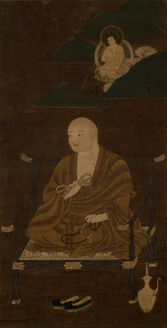
Kukai
A monk of the early Heian period who established Shingon Esoteric Buddhism and left a mark on Japanese culture with his many great achievements
774–835
Kukai, posthumously known as Kobo Daishi, was a monk of the early Heian period who founded Shingon Esoteric Buddhism. He originally belonged to the Saeki clan in Sanuki Province, and his childhood name was Mao. In 788 he followed his uncle Otari Atono to Kyoto and studied Confucianism and other subjects. While studying the Confucian classics, he was introduced to the method reciting the mantra of Bodhisattva Akasagarbha to gain improved memory. Subsequently he underwent ascetic training in Awa, Tosa, and Iyo Provinces and Mount Kinpu in Yoshino. In 797 he authored the Sango shiiki (Indications of the Goals of the Three Teachings), another version of which, Roko shiiki (Indications of the Goal for the Deaf and the Blind), is a National Treasure). In this work he expounds on the relative merits and demerits of Confucianism, Taoism, and Buddhism. Studying Nara Buddhism as well, he entered the Buddhist priesthood in the 4th month of 804 and took the monastic name Kukai. In the 7th month of the same year, he traveled aboard the ship of a Japanese delegation to Tang China. Studying esoteric Buddhism under Huiguo at Qinglong Temple in at Chang’an, he received the esoteric title of Henjo Kongo. Returning to Japan in 806 with a great deal of texts and items for use in esoteric Buddhist practice, he traveled to Kyoto in 809.
In 816, with permission from the Emperor, he began the work of establishing Kongobu Temple on Mount Koya. Skilled in civil engineering as well, he helped with repair work at Manno Pond in 821. The next year, he built the Kanjo Training Hall at Todai Temple in Nara for training in esoteric rites, to protect the country. In 823 he was entrusted with To Temple in Kyoto, which he made the head temple for his branch of esoteric Buddhism. In 828 he founded Shugei Shuchi-in, a school for educating commoners. He performed the Latter 7-Day Rite at Shingon hall in the Imperial Palace during the 1st month of 835 and passed away on the 21st day of the 3rd month in the same year on Mount Koya. His doctrinal views are revealed in Ben kenmitsu nikyo ron (Differences between Exoteric and Esoteric Buddhism) and Ju jushin ron (The 10 Stages of Consciousness), and his literary views in Shoryo shu (Collected Works of Prose and Poetry) and Bunkyo hifu ron (Secret Storehouse of a Mirror on Literature). An exceptional calligrapher, he is considered one of the era’s three greats. Fushin-jo (a group of letters he addressed to Saicho) and Kanjo rekimei (a list of names), both National Treasures, are well known examples of his writing. In regions throughout Japan there are sacred sites where Kukai once tread, including the henro, a religious tour of 88 sacred sites, many related to him, located in Shikoku.
Related People, Things and Events
Books
Bibliographies
Related Works
空海の生涯
Cultural Properties of Japan
Videos
Past Exhibitions
| Title | shusai | Place | open | close |
|---|---|---|---|---|
External Links
和歌山県伊都郡高野町高野山にある。金剛峯寺をはじめ、高野山内の文化遺産を保存展示する施設として大正10年(1921)に開設された。国宝21件、重要文化財148件、和歌山県指定文化財17件など、総数およそ5万点に資料を収蔵。
高野山大学(和歌山県伊都郡高野町)が所蔵する仏教や密教、高野山に関する歴史資料をデジタル化し、世界中に公開するアーカイブ。空海の著作や真言密教について閲覧できる。
2019年3月26日から6月2日まで東京国立博物館で開催。『FASHION PRESS(ファッションプレス)』の記事。
Other Materials in Japan Search
References
- サンプルページ「空海」の項。
- サンプルページ「空海」の項。
- サンプルページ「空海」の項。
- サンプルページ「空海」の項。
- 加藤友康 [ほか]編,吉川弘文館
- 歴史学研究会 編,岩波書店
- 対外関係史総合年表編集委員会 編,吉川弘文館