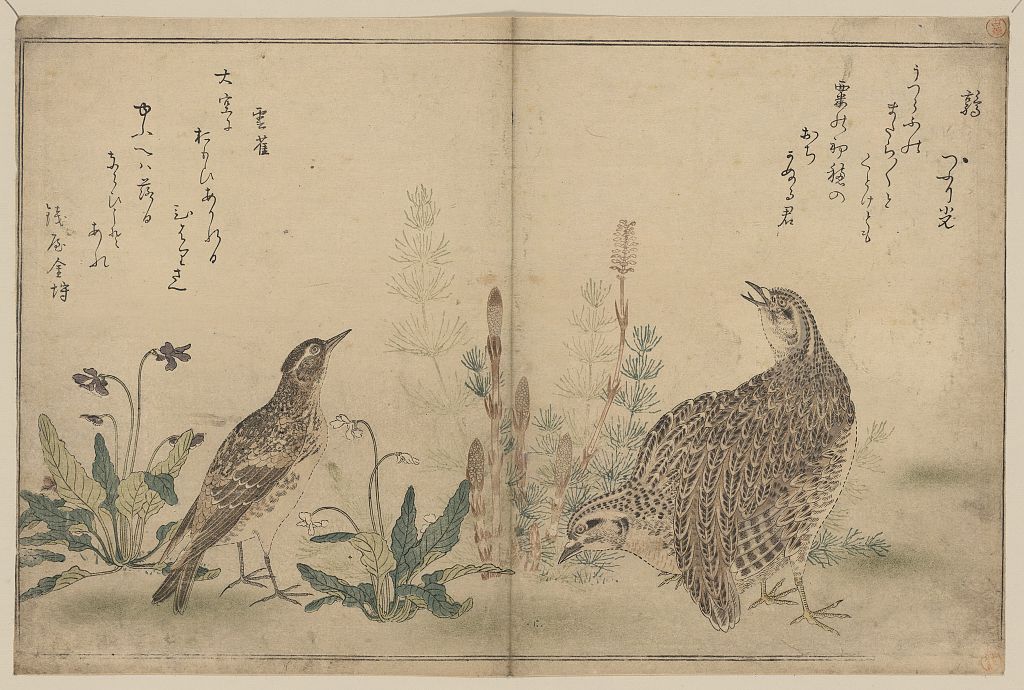
Hibari (Skylark)
Bird representative of springtime, adored for its beautiful, twittering song.
Species of bird with a total length of about 17 cm in the family Alaudidae of order Passeriformes in class Aves. Feather color is plain overall. With blackish brown lengthwise markings on brown-colored backs, plumage is yellowish brown at the edges. Undersides are pale, with dark-colored specks on the breast. They do not tend to stay perched on tree limbs, and can be seen soaring high in the skies in March and April delivering warbling songs.
A well-known poem by Yakamochi Otomo appearing in the Manyoshu (“Collection of Ten Thousand Leaves”) is:
uraura ni
tereru haruhi ni
hibari agari
kokoro kanashi mo
hitori shi omoeba
into the softly
radiant sunshine of spring
the skylark ascends —
yet what sorrow I still feel,
absorbed in my thoughts alone
After appearing as a theme associated A well-known poem by Yakamochi Otomo appearing in the Manyoshu (“Collection of Ten Thousand Leaves”) is:
uraura ni
tereru haruhi ni
hibari agari
kokoro kanashi mo
hitori shi omoeba
into the softly
radiant sunshine of spring
the skylark ascends —
yet what sorrow I still feel,
absorbed in my thoughts alone
After appearing as a theme associated with the scenery of springtime in the Roppyaku-ban Uta-awase (“Poetry Match in Six Hundred Rounds”) held in the early Kamakura period (c. 1185 – c. 1199), instances of skylarks featured in waka poems became increasingly widespread in medieval times and the early modern period. Many haiku poets including Basho Matsuo and Buson Yosa included them in their poems as fixtures of springtime in serene, pastoral landscapes, and their name even came to be a kigo seasonal word associated with spring in haikai poetry.
Long appreciated for the melodic beauty of their complex, variegated song, skylarks were often kept as pets, as well. Also eaten, it seems that even amid the spread of the Buddhist concept of sessho kindan, a prohibition on the taking of life, small birds such as skylarks were sometimes consumed as food. Found in the second volume of Honcho Shokkan (“Reference Book on Cooking and Medicinal Herbs”), an Edo-period herbal manual of dietary therapy published in 1697, is a passage concerning a way to eat and preserve skylarks that describes salting their entrails and bones to ferment them into a paste.
Related People, Things and Events
Books
Skylarks in bird field guides
Skylarks in history books and poetry anthologies
About skylark cuisine
Related Works
Hibari (Skylark) specimens and photographs
Institutions Holding Related Materials
The National Diet Library (NDL), founded in 1948, is the library which belongs to the Diet. The NDL assists the activities of the National Diet. The Library collects and conserves materials and information both from Japan and abroad, serving as a foundation of knowledge and culture and providing library services to administrative and judicial entities and Japanese citizens.
As Japan’s representative museum, Tokyo National Museum collects, preserves, displays, and researches the cultural properties of Asia with a focus on Japan, and also provides educational programs.
Established in 1877, the National Museum of Nature and Science (Kahaku) is one of the oldest museums in Japan. It is also the only national museum in the country that offers a comprehensive exhibition of natural history and the history of science and technology. It collects and preserves a variety of collections, such as natural history specimens, historical objects, and scientific and technical documents, and so on.
所在地は新潟県新潟市。雲雀などのほか、220種以上の野鳥が確認されている。
大阪府大阪市住之江区にある面積19.3haの野鳥園。四季を問わず様々な野鳥を観察できる。渡り鳥の飛来地としても有名。
External Links
SUNTORYが運営する鳥の百科事典。フリーワードや特徴、鳴き声で検索できる。イラストや写真も豊富。
日本野鳥の会が運営するサイト。野鳥に関する様々な情報を知ることができる。膨大な数の投稿写真は、検索しやすいように分類されている。
弦楽四重奏曲第67番ニ長調(String Quartet in D major, Hob.III:63)。「ひばり」。ハイドン作曲。第一楽章にひばりの鳴き声に似た旋律が出てくる。
References
- 堀田正敦 著,鈴木道男 編著,平凡社江戸期最大・最高の鳥類図鑑『観文禽譜』(堀田正敦編・宮城図書館蔵)を解読・解説を行う。江戸期の鳥類500種を切抜図で紹介。(日本児童図書出版協会)