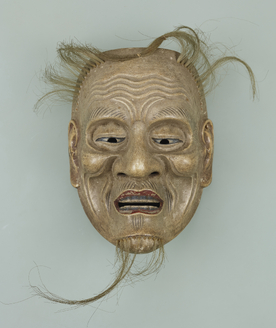
Saigyo-zakura (Saigyo’s Cherry Blossoms)
A Noh play of the Muromachi period written by Noh performer Zeami; in it, “the profound subtlety of growing old in body” is seen in a spirit of the cherry blossoms
Saigyo-zakura (Saigyo’s Cherry Blossoms) is a third-act Noh play (the act performed third when a formal five-act Noh program is presented). This work from the Muromachi period (1392–1507) was written by Zeami. The content of the play concerns Saigyo (in Noh, the waki, or counterpart of the protagonist), whose enjoyment of life in seclusion is disturbed by crowds of cherry blossom viewers. He recites a poem in which he states that the fault for this lies with the cherry blossoms. He is then met by the spirit of the cherry blossoms in the form of an old man (the Noh shite, or protagonist), who rebuts Saigyo’s poem and describes famous sites in Kyoto for cherry blossom viewing, then performs an elegant dance before vanishing with the break of dawn. In this work, the cherry blossom spirit is thought to embody “the profound subtlety of growing old in body.” We find a hint of this embodiment in a waka poem of Saigyo’s found in his Sanka shu (Poems of a Mountain Hermitage): “To view the blossoms, people come along in throngs. Sadly, the fault, I find, lies with the cherry trees.” A late-Edo local song composed by Saichi Kengyo Kikuzaki also refers to this complaint.
Related People, Things and Events
Books
Related Works
Institutions Holding Related Materials
東京都渋谷区に所在。『西行桜』に関わる史資料を所蔵しています。
As Japan’s representative museum, Tokyo National Museum collects, preserves, displays, and researches the cultural properties of Asia with a focus on Japan, and also provides educational programs.
The National Diet Library (NDL), founded in 1948, is the library which belongs to the Diet. The NDL assists the activities of the National Diet. The Library collects and conserves materials and information both from Japan and abroad, serving as a foundation of knowledge and culture and providing library services to administrative and judicial entities and Japanese citizens.
The National Archives is an organization for preserving, as historical materials, public records and archives of importance transferred from state organs, and providing them for public use, with the aim of achieving appropriate preservation and use of such public records and archives that are kept in the National Archives or state organs as historical materials.
With the aid of supporters from a range of fields, The Tsubouchi Memorial Theatre Museum, Waseda University, familiarly known as "Enpaku", was founded in October 1928 to commemorate the 70th birthday of Professor Tsubouchi Shoyo and the completion by him of the translation into Japanese of all 40 volumes of the "Complete Works of Shakespeare", a task to which the Professor had devoted half his life. Since then, as Asia's only museum dedicated solely to the theatre, Enpaku has been engaged in collecting works relating to the theatre and motion pictures both in Japan and all around the world. Its extensive collection of about one million works that has been amassed over 85 years may be termed as "the history of theatre" itself. Meanwhile it also contributes to researchers from a wide range of fields, extending from the theatre and motion pictures to other areas such as literature, history, clothing and construction.
The Art Research Center was established in 1998. Since then, the Center’s mission has been not only to conduct historical and social research and analyses of both tangible and intangible human cultural properties such as visual and performing arts and craftsmanship, but also to record, organize, preserve, and disseminate the research outcomes. To make the vast amount of database of resources on Japanese culture kept at the Art Research Center available to joint researchers in and outside of Japan, while providing the hitherto accumulated digital archiving and database management technologies as the basis for research project activities to promote information archiving and the circulating of joint research on knowledge. Through these undertakings, the Center aims to “become a world class research center” in the field of Digital Humanities.
External Links
日本芸術文化振興会が運営するサイト「文化デジタルライブラリー」より。『西行桜』のあらすじと解説を紹介している。
観世銕之丞家を中心とした演能団体「銕仙会(てっせんかい)」」のHPに載る「能楽事典」より。登場人物、ストーリーと舞台の流れ、舞台写真などを紹介している。
一般財団法人・観世文庫が運営するサイト「KANZE.net」より。『西行桜』についての検索も可能。
References
- 「西行桜」の項
- 「西行桜」の項
- 「西行桜」の項