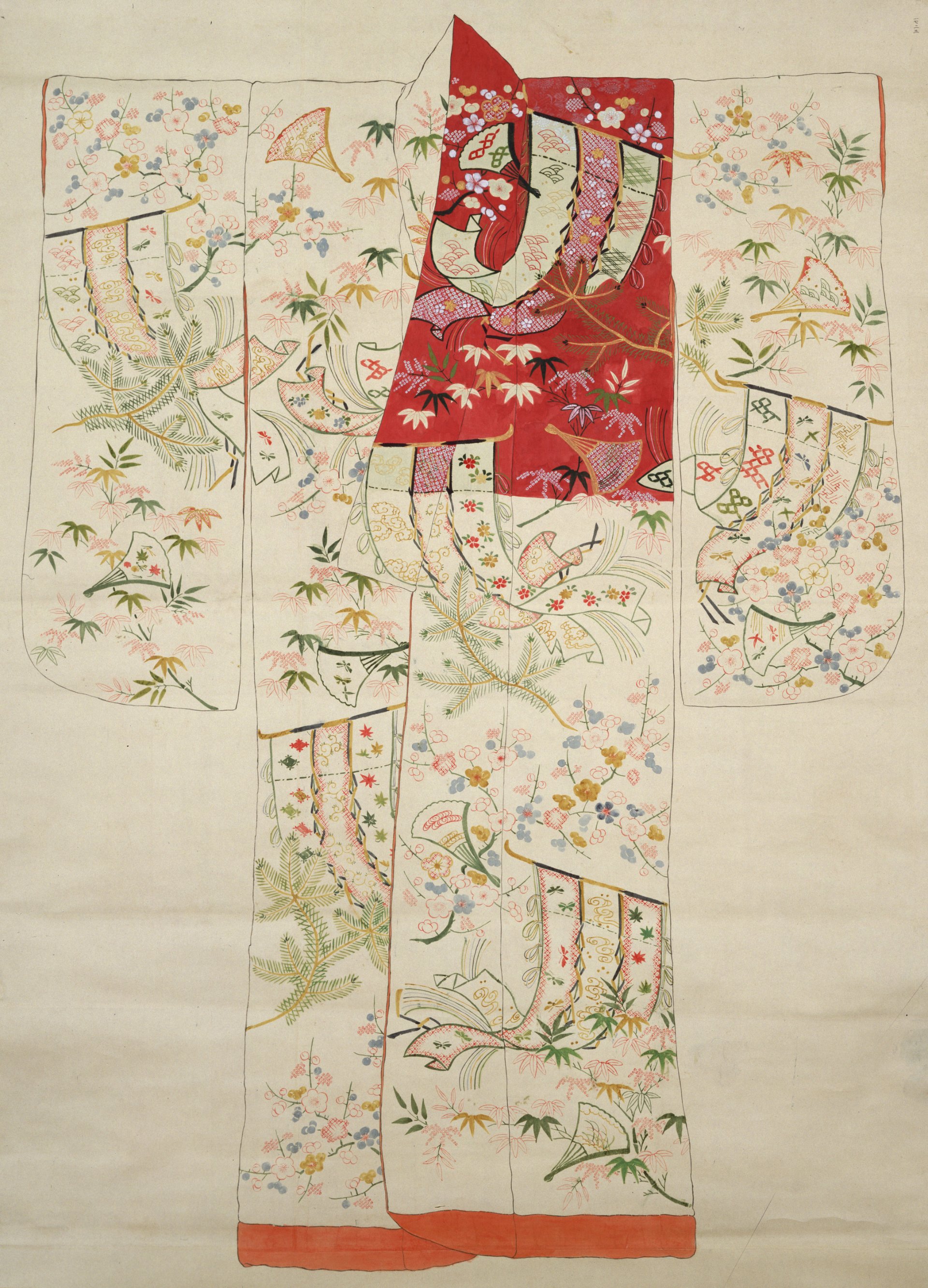
Furisode (Long-Sleeves)
A type of kimono worn, during the Edo period, by boys, girls, and young women before their coming-of-age ceremony and now worn by young women as festive dress
Furisode are the open long sleeves of some kimono. The term also refers to kimono with such sleeves. During the Edo period (1603-1867), furisode kimono were worn by boys, girls, and young women before their coming-of-age ceremony. Furisode sleeves are also known as wakiake (sleeves open at the armpit). Various sleeve shapes were created during the Edo period. Since small sleeves open at the armpit swung when worn, sleeves of this type were called furisode (swinging sleeves), and kimono with this type of sleeves were worn by young women before their coming-of-age ceremony. In contrast, sleeves that cover the armpits are called tomesode, and kimono with this type of sleeves were worn by women after their coming-of-age ceremony.
The length of a furisode sleeve was 45.5 centimeters early in the Edo period, but it gradually became longer, becoming 60.6 centimeters in the Jokyo era (1684-1688) and 90.9 centimeters in the Horeki era (1751-1764). As the obi became wider around the Bunka era (1804-1818), it became difficult to tighten the obi with completely attached sleeves, so people began to wear kimono with sleeves open at the armpits even after their coming-of-age ceremony. With this development, the name furisode came to be applied according to the length of the sleeves, not according to whether they were open at the armpits. Thus, long sleeves became called furisode, and short sleeves tomesode. Since the Meiji era (1868-1912), furisode kimono have been used as formal or festive dress for girls and young women. Today, young women wear this type of kimono for such special occasions as coming-of-age ceremonies and weddings.
Another name for the great fire of the Meireki era (1655-1658) is the furisode fire. On January 18th and 19th, 1657 of the lunar carrender, most of the castle town of Edo was destroyed by a large fire. It is said that the cause of the fire was a furisode sleeve that caught fire during the Segaki ritual (feeding-the-hungry-ghosts ritual) at Honmyo Temple in Maruyama, Hongo, Edo.
The puppet drama Nihon furisode hajime by Chikamatsu Monzaemon takes its title from a myth concerning Susanoo no Mikoto. In the incident titled "Furisode hajime" (The Origins of Furisode), when Kushinadahime (Lady Kushinada) was suffering from a fever, Susanoo no Mikoto cut open her sleeves at the armpits to cool her down.
Related People, Things and Events
Books
Related Works
Drawings of furisode (long-sleeved kimono) in paintings
Past Exhibitions
| Title | shusai | Place | open | close |
|---|---|---|---|---|
Institutions Holding Related Materials
東京都渋谷区にある。「衣」をテーマとした専門博物館として、学術研究資料の目的で収集された衣服や染織品などを広く社会一般に公開。
東京都青梅市にある。皇室衣装・江戸時代衣装・振袖等収集。
The National Diet Library (NDL), founded in 1948, is the library which belongs to the Diet. The NDL assists the activities of the National Diet. The Library collects and conserves materials and information both from Japan and abroad, serving as a foundation of knowledge and culture and providing library services to administrative and judicial entities and Japanese citizens.
As Japan’s representative museum, Tokyo National Museum collects, preserves, displays, and researches the cultural properties of Asia with a focus on Japan, and also provides educational programs.
Kyoto National Museum collects, preserves, displays, researches and provides educational programs focusing on cultural properties from Heian- through to Edo- period Japan, when the capital was located there.
External Links
用語辞典が収められている。そのか着物の文様、着物のTPO、京友禅などについても詳しく解説している。
文化学園服飾博物館所蔵の貴重な資料約600件をデジタル化し公開。国や地域、年代から検索することができる。
収蔵品は約15,000点。世界の染織品が多数コレクションされている。美術館収蔵品データベースでは染織に関する資料が公開されている。
References
- 「袖」の項。
- 日立デジタル平凡社,平凡社