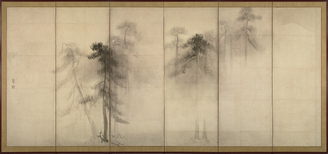
Pine Tree (Matsu)
A symbol of longevity and integrity, the pine is considered essential to scenic spots
Matsu (pine tree) is a general term for trees belonging to the genus Pinus in the family Pinaceae. Pines are usually evergreen trees, but some are shrubs, such as the dwarf stone pine. Widely distributed in the Northern Hemisphere, about 100 species of pine are known.
The "leaves" of pines are needle-like, and pines can be roughly divided into five-needle pines and two-needle pines. In Japan, there are four species of five-needle pines, such as the Japanese white pine and the dwarf stone pine, and three species of two-needle pines, such as Japanese red pine and Japanese black pine.
Pines are planted as garden trees, and the wood is used for construction, civil engineering, furniture, and woodworking. Korean pine seeds are edible. Also, resin can be taken from red pine and black pine to make turpentine, pine resin, and tar. Amber is the underground fossilized resin of coniferous trees such as pine and cedar.
In Japan, matsu often refers to Japanese red pine and Japanese black pine, both of which are two-needle pines. The red pine, also called mematsu (female pine), has bark that is reddish brown. Growing mostly inland, it likes lots of sun and can withstand dry and barren conditions. It often forms forests solely of red pine on mountain ridges and lake and river embankments. Since pines contain a lot of resin, pine oil was taken from the roots during World War II and distilled for use as engine fuel. Since matsutake mushrooms grow on red-pine forest floors, many matsutake-mushroom-producing areas can be found where red pines are abundant. In contrast, black pine, also called omatsu (male pine), has a dark gray bark. It is often found on the coast, but in cold regions red pines come to dominate, even on the coast. At Amanohashidate in Miyazu, Kyoto Prefecture, black pine coexists with red pine, but in Matsushima, Miyagi Prefecture, there are only red pines. Hybrids are also found where the two species coexist, and these are called ainoko matsu (hybrid pines) or akakuro matsu (red-black pines).
Black pines are often used as gate pines and are an essential feature in such coastal scenic spots as Miho no Matsubara in Shimizu in Shizuoka Prefecture, admired for its white sand and green pines and designated as a World Heritage Site. As an object of aesthetic appreciation, pine trees are an auspicious decoration for New Year’s and other holidays and ceremonies, and they appear as a symbol of longevity and integrity in such classic works as Kojiki (Records of Ancient Matters, ca. 712), the Man'yoshu (Collection of Myriad Leaves, after 759), and Kaifuso (Fond Recollections of Poetry, 751).
In the Heian period, wild pine saplings were planted in the garden at the beginning of spring, a custom that later became the custom of placing pines in front of one's gate. During the Muromachi period (1336-1573), pine sprigs were used in the New Year's ikebana arrangements, and pines were also cultivated as bonsai trees. A pine bonsai is depicted in the picture scrolls Kasuga gongen genki (Miracles of the Kasuga Deity, 1309). Also, pine resin torches are used in religious events. The Shuni-e (Second-Month Service) of Todai Temple is famous for this. The custom of using pines, bamboo, and plum trees, along with the crane and turtle, as a symbol of auspiciousness was introduced to Japan from China.
Related People, Things and Events
Books
Literary works that feature pines
Related Works
Pine drawings on clothing
Videos
Past Exhibitions
| Title | shusai | Place | open | close |
|---|---|---|---|---|
Institutions Holding Related Materials
静岡県清水区の沿岸約5kmに続く松林。
植樹会でクロマツの苗を植栽し、高田松原の復活をめざす。岩手県陸前高田市。
世界初の公立の盆栽の美術館。旧髙木盆栽美術館が所有していた盆栽、盆栽用の植木鉢である盆器、水石と呼ばれる鑑賞石、盆栽が描かれた浮世絵などを展示している。
The National Diet Library (NDL), founded in 1948, is the library which belongs to the Diet. The NDL assists the activities of the National Diet. The Library collects and conserves materials and information both from Japan and abroad, serving as a foundation of knowledge and culture and providing library services to administrative and judicial entities and Japanese citizens.
As Japan’s representative museum, Tokyo National Museum collects, preserves, displays, and researches the cultural properties of Asia with a focus on Japan, and also provides educational programs.
Kyoto National Museum collects, preserves, displays, researches and provides educational programs focusing on cultural properties from Heian- through to Edo- period Japan, when the capital was located there.
The Tokyo Fuji Art Museum is founded on November 3, 1983, in Hachioji, a thriving university town in the western suburbs of the Japanese capital. Priding itself as “a museum creating bridges around the world” to facilitate the exchange of different cultures, our museum has forged cordial relations with art museums and cultural institutes in 32 countries and territories to date. We do so by bringing the world’s finest works of art to Japan while reciprocating in kind by introducing the finest Japanese treasures to the world through special exhibitions that showcase their beauty and wonder through a unique new set of prisms and perspectives. Our museum possesses some 30,000 pieces of artworks from various periods and cultures including Japanese, Eastern and Western works, ranging from paintings, prints, photography, sculptures, ceramics and lacquer ware to armor, swords and medallions. Especially noteworthy is its outstanding collection of Western oil paintings that spans a five-hundred-year period from the Renaissance, Baroque, Rococo, and Romanticism to Impressionism and contemporary art, as well as its exceptional collection of photographic masterpieces that can give an overview of the history of photography from the birth of the photograph to the present age.
External Links
植物・花の基本情報、育て方などを「趣味の園芸」講師陣の専門家が執筆。園芸相談Q&Aや特集コーナーがある。「NHKみんなの趣味の園芸」(NHK出版)公式サイト。
国立科学博物館附属自然教育園内に生息している生物の種名や写真を調べることができる。
国立科学博物館筑波実験植物園内の植物を検索することができる。研究者ノートなど専門的な解説もあり。
トドマツ、エゾマツ、ハイマツが美しいイラストで紹介されている。
References
- 日立デジタル平凡社,平凡社