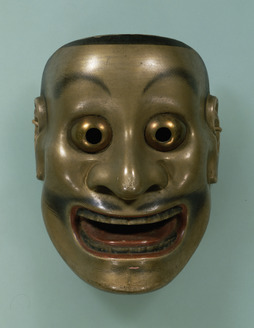
Zeami
A Noh actor, playwright, and theoretician of the early Muromachi period
c. 1363–1443
Zeami was a Noh actor and playwright of the early Muromachi period and theoretician of Noh. He was the oldest son of Kan’ami and the second head of the Kanze school. His childhood names were Oniyasha and Fujiwaka, and his adult name was Saburo Motokiyo Kanze. His stage name was Zeamidabutsu, with Zeami being an abbreviation of that. At the age of 12 (in 1374 or 1375), he performed Noh together with his father in Imakumano, Kyoto, and came to receive the patronage of Yoshimitsu Ashikaga, the third Ashikaga shogun, who had been in attendance. The court noble Yoshimoto Nijo, who had given him the name Fujiwaka, professed Zeami to be a youth of exceptional beauty, and Yoshimitsu must no doubt have found him handsome, as well. With Yoshimitsu’s sudden death in 1408, however, Zeami lost his backer. Then, in a later stroke of misfortune, he seems to have incurred the wrath of the sixth shogun, Yoshinori Ashikaga, regarding his succession to head of the Kanze school and was exiled to Sado Province (presently Niigata Prefecture) in 1434. Zeami pursued a refined aesthetic called yugen (profound subtlety) and left us with over 20 treatises on Noh, including Fushikaden (Transmission of the Flower of Acting Style) and Kakyo (Mirror of the Flower). The “flower” in both titles is taken to be a theory in Noh advocating the retention of a sense of charm or fascination. In addition, he theorized that the best Noh techniques (ran’i ) were not only profoundly subtle but also effortless and unconscious. Representative Noh plays he wrote include Takasago, Yorimasa, Atsumori, Izutsu (The Well Cradle), Saigyo-zakura (Saigyo’s Cherry Blossoms), Hanjo, and Kinuta. The embodiment of Noh playwright, performer, and theoretician in one, he had an exceptional impact on the entire history of Noh theater.
Related People, Things and Events
Books
Books by Zeami
Bibliographies
Related Works
能楽の動画を探す
能楽に関わる展覧会を探す
| Title | shusai | Place | open | close |
|---|---|---|---|---|
歴史的音源で聞く世阿弥の謡曲
Institutions Holding Related Materials
東京都渋谷区に所在。観世家に関わる能に関する貴重な資料が保存されています。
新潟県佐渡市真野に所在。800年前の世界へタイムスリップし、佐渡ヶ島の歴史を体感できるミュージアム。「佐渡の歴史と伝説(歴伝)」は全十二景からなり、世阿弥だけでなく順徳天皇・日蓮聖人ら流罪となった人々の歴史と、佐渡の人々が受け継いできた伝統のルーツを展示しています。
With the aid of supporters from a range of fields, The Tsubouchi Memorial Theatre Museum, Waseda University, familiarly known as "Enpaku", was founded in October 1928 to commemorate the 70th birthday of Professor Tsubouchi Shoyo and the completion by him of the translation into Japanese of all 40 volumes of the "Complete Works of Shakespeare", a task to which the Professor had devoted half his life. Since then, as Asia's only museum dedicated solely to the theatre, Enpaku has been engaged in collecting works relating to the theatre and motion pictures both in Japan and all around the world. Its extensive collection of about one million works that has been amassed over 85 years may be termed as "the history of theatre" itself. Meanwhile it also contributes to researchers from a wide range of fields, extending from the theatre and motion pictures to other areas such as literature, history, clothing and construction.
住所:104-0061 東京都中央区銀座6-10-1 GINZA SIX地下3階。
住所:113-0033 東京都文京区本郷1-5-9
住所:141-0021 東京都品川区上大崎4-6-9
日本芸術文化振興会が運営するサイト「文化デジタルライブラリー」より。「世阿弥のいた環境」「世阿弥と能作者たち」「世阿弥の業績」について紹介している。
一般財団法人・観世文庫が所蔵する能楽関係史料を、インターネット上で検索・閲覧することができるデジタル・アーカイブ。
Other Materials in Japan Search
References
- 岩波書店 久松潜一・西尾実 校注 『風姿花伝』『申楽談義』などを所収。
- 岩波書店 表章・ 加藤周一 校注。
- 中央公論社 山崎正和 編訳
- サンプルページ「世阿弥」の項
- 「世阿弥」の項
- 「世阿弥」の項
- 「世阿弥」の項
- 歴史学研究会 編,岩波書店
- サンプルページ「風姿花伝」の項