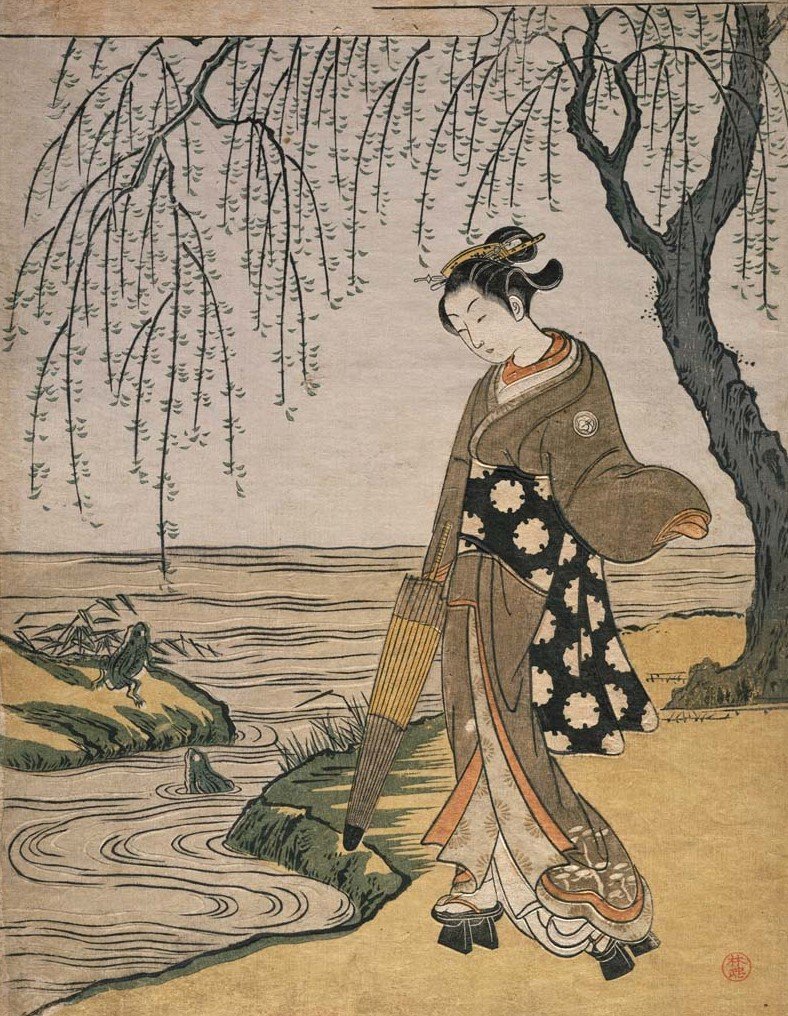
Willow (Yanagi)
A tree known since ancient times for its beautiful colors and supple branches
Yanagi (willow) is a general term for trees of the Salix genus in the Salicaceae family, but in a narrow sense, it often refers specifically to the weeping willow. Willows are deciduous trees mainly distributed in the northern hemisphere, and more than 300 species are known in the world. About 30 species, such as the pussy willow and osier, are known in Japan. Willows, which bloom in spring, have flowers that bloom as catkins in a row on spikes. They are dioecious (that is, have unisexual male and female flowers on separate plants) and are entomophilous (which is to say, are pollinated by insects).
The weeping willow is native to China and came to Japan in premodern times. Its branches are flexible, long, and drooping, and the leaves are long and narrow, with white backs. From March to April, the spikes bud, and many yellow-green florets bloom on the catkins before the leaves grow. It is often planted in rows on riverbanks and along streets and is used as a garden tree. Its branches are used for medicinal purposes.
Willows grow quickly and become large trees, but because the wood is soft, it is used only for special purposes, such as the production of paper pulp, match sticks, and wooden boxes for luxury items. However, the branches of osier, the basket willow, are used to make wicker baskets and suitcases.
Willows, full of vitality, sprout at the beginning of spring, so it is customary to pray for a good harvest and health by putting rice-cake flowers on willow branches as decorations for New Year's. Also, as a sacred tree with the power of casting spells on intruders, willows were sometimes planted on the border of a village as a landmark. They were also planted near a bridge and at the entrance to the brothel district to mark the boundary between two worlds. Such willows, called mikaeri yanagi (looking-back willow), sought to remind a person to look back to see what he is leaving behind. Because willows mark the boundary between two worlds, they often appear in legends about spirits and ghosts returning from the netherworld.
In addition, both poplars and willows like moist riverside environments. So to pray for rain, people would pray to Yoryu Kannon, a manifestation of the Kannon bodhisattva with a willow branch in hand.
Related People, Things and Events
Books
Related Works
柳に関わる国宝・重要文化財などを探す
Willow drawings in paintings
Willow drawings on craft works
Willow drawings on clothing, etc.
Videos
Past Exhibitions
| Title | shusai | Place | open | close |
|---|---|---|---|---|
| 津南町農と縄文の体験実習館なじょもん | 2006/4/15 | 2006/4/15 |
Institutions Holding Related Materials
The National Diet Library (NDL), founded in 1948, is the library which belongs to the Diet. The NDL assists the activities of the National Diet. The Library collects and conserves materials and information both from Japan and abroad, serving as a foundation of knowledge and culture and providing library services to administrative and judicial entities and Japanese citizens.
As Japan’s representative museum, Tokyo National Museum collects, preserves, displays, and researches the cultural properties of Asia with a focus on Japan, and also provides educational programs.
Kyoto National Museum collects, preserves, displays, researches and provides educational programs focusing on cultural properties from Heian- through to Edo- period Japan, when the capital was located there.
Aichi Prefectural Museum of Art was founded as the successor of the Aichi Prefectural Art Gallery, which originally opened in Sakae, the center of Nagoya City, Aichi Prefecture, in 1955. The museum opened in 1992 as part of the Aichi Arts Center, an urban cultural complex, and has established a wide-range collection of approximately 8,000 items, centered on works of art of the twentieth century. The Museum has also organized numerous exhibition of a wide-range of themes. The Museum has actively worked to develop and communicate new aspects of art and culture to the public, based on its core mission to serve as the primary art museum of the Chubu region.
The Tokyo Fuji Art Museum is founded on November 3, 1983, in Hachioji, a thriving university town in the western suburbs of the Japanese capital. Priding itself as “a museum creating bridges around the world” to facilitate the exchange of different cultures, our museum has forged cordial relations with art museums and cultural institutes in 32 countries and territories to date. We do so by bringing the world’s finest works of art to Japan while reciprocating in kind by introducing the finest Japanese treasures to the world through special exhibitions that showcase their beauty and wonder through a unique new set of prisms and perspectives. Our museum possesses some 30,000 pieces of artworks from various periods and cultures including Japanese, Eastern and Western works, ranging from paintings, prints, photography, sculptures, ceramics and lacquer ware to armor, swords and medallions. Especially noteworthy is its outstanding collection of Western oil paintings that spans a five-hundred-year period from the Renaissance, Baroque, Rococo, and Romanticism to Impressionism and contemporary art, as well as its exceptional collection of photographic masterpieces that can give an overview of the history of photography from the birth of the photograph to the present age.
The Art Research Center was established in 1998. Since then, the Center’s mission has been not only to conduct historical and social research and analyses of both tangible and intangible human cultural properties such as visual and performing arts and craftsmanship, but also to record, organize, preserve, and disseminate the research outcomes. To make the vast amount of database of resources on Japanese culture kept at the Art Research Center available to joint researchers in and outside of Japan, while providing the hitherto accumulated digital archiving and database management technologies as the basis for research project activities to promote information archiving and the circulating of joint research on knowledge. Through these undertakings, the Center aims to “become a world class research center” in the field of Digital Humanities.
External Links
東京都目黒区白金台に所在する国立科学博物館の附属施設。HPのトップ画面右端の「自然教育園の生物データベース」をクリックし、「自然教育園の写真データベース」を選択。キーワードに「ヤナギ」と入力して検索すると、写真の閲覧ができる。
茨城県つくば市天久保に所在する国立科学博物館の付属施設。HPのトップ画面右端の「園内の植物を調べる 植物図鑑」をクリックし、「キーワードで探す」に「ヤナギ」と入力して検索すると、柳の写真を閲覧できる。植物名などで検索することも可能。
地方独立行政法人北海道立総合研究機構(道総研)が運営するウェブサイトより、森林研究本部林産試験場のページから。
上記と同じ。和名ヤマナラシ、別名ハコヤナギ。
国立国会図書館 電子展示会のサイトより。動物・植物・鉱物そのものの記述から、衣食住や医薬・文学・趣味などの面からの叙述も含め、広く「博物誌」として学ぶことができる。
References
- 大橋広好, 門田裕一, 邑田仁, 米倉浩司, 木原浩 編,平凡社新しい系統分類体系APG?を採用、旧版の知見をもとに新しい情報を付加し、カラー写真も一新。バラ科からセンダン科を収載。 (日本児童図書出版協会)。本データは2016年9月刊行の改訂新版 第3巻で、ヤナギ科が収録されている。
- 「ヤナギ」の項
- 「ヤナギ」の項
- 「やなぎ【柳】」の項