Hasegawa Tohaku
One of the finest painters of the Azuchi-Momoyama period; founder of the Hasegawa School who established painting styles in the areas of gold and green painting on sliding doors and ink wash painting 1539-1610
Hasegawa Tohaku was a painter of the Azuchi-Momoyama and early Edo periods. He was born in Nanao in Noto Province (present-day Nanao, Ishikawa Prefecture). His childhood name was at first Matashiro and later Tatewaki. His biological father was Okumura Bunnojo, a retainer to the Hatakeyama family, and his adoptive father was Hasegawa Munekiyo, a dyer, a pupil of Sesshu, and one of Toshun's students.
During his days in Noto Province, Tohaku painted images of Buddha and portraits, using the signature Hasegawa Shinshun. His works can still be found in the Noto region. In 1572 he painted Nichigyo shonin zo, a portrait of the Buddhist priest Nichigyo of Honpo Temple in Kyoto. It would appear that he visited Kyoto prior to painting this portrait. Around the middle of the Tensho era (1573-1592), he changed his signature to Tohaku. The paintings Den Nawa Nagatoshi zo (According to Tradition, a Portrait of Nawa Nagatoshi) and Takeda Shingen zo (A Portrait of Takeda Shingen) appear to belong to this period.
Before long, Tohaku came to devote himself to ink washes in the style of Song and Yuan China and Muromachi Japan as a result of his interactions with the monk Nittsu of Honpo Temple and Sen no Rikyu, master of tea ceremony. In 1852, Toyotomi Hideyoshi built Soken-in of Daitoku Temple to mourn the death of Oda Nomunaga, and Tohaku painted ink washes on its sliding doors (later destroyed). Then in 1589 he painted sliding doors of Sangen-in of the same temple. In 1593 Hideyoshi built Shounzen Temple to mourn the death of his eldest son Tsurumatsu (also known by his childhood name Sutemaru), and Tohaku led his son Hasegawa Kyuzo (1568-1593) and other painters of his school, the Hasegawa School, in creating gorgeous paintings on the sliding doors. These paintings, in the collection of Chishaku-in, are thought to be some of the finest paintings of Momoyama art.
Tohaku established painting styles in both ink wash painting and gold and green painting on sliding doors, creating the Hasegawa School, which opposed the Kano School even though both schools claimed to derive from the painter Sesshu. Indeed, Tohaku claimed to be this tradition's fifth generation after Sesshu.
In 1604 Tohaku attained the Buddhist rank hokkyo (master of the dharma bridge), and in the next year he became hogen (dharma eye). In 1610 he headed to Edo at the invitation of Tokugawa Ieyasu. He became ill on the way there, and shortly after arriving, he died on the 24th of the Second Month. His bones are buried at Kyogyo-in in Honpo Temple, and his posthumous Buddhist name is Gonjo-in Tohaku Nichimyo Koji (Tohaku Nichimyo Buddhist layman of Gonjo Chapel).
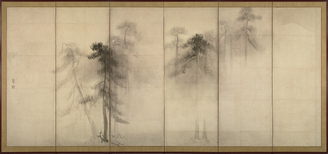
His principal works, in addition to those mentioned above, are Shorin zu byobu (Pine Trees screen) and Koboku enko zu (Old Tree and Monkeys). In addition, Tohaku gasetsu (Tohaku's Theory of Painting), written down by Nittsu of Honpo Temple, is an important work as Japan's earliest treatise on painting.
The life of Hasegawa Tohaku
Related People, Things and Events
Books
Related Works
Art works of the Hasegawa School
Past Exhibitions
| Title | shusai | Place | open | close |
|---|---|---|---|---|
Institutions Holding Related Materials
長谷川等伯の出身地、石川県七尾市に所在。信春時代の「善女龍王図」「愛宕権現図」などの作品を所蔵。 館内のハイビジョンコーナーで作品を見ることができる。
京都市上京区にある日蓮宗寺院。長谷川等伯は本法寺10世・日通と交友があり、等伯の作品やゆかりの品が伝来する。
京都東山区の智積院の宝物館には、長谷川等伯一門による桃山時代の障壁画が収められている。「桜図」「楓図」「松に秋草図」「松に黄蜀蔡図」「松に梅図」「雪松図」で、国指定重要文化財の「松に梅図」を除き、すべて国宝。
As Japan’s representative museum, Tokyo National Museum collects, preserves, displays, and researches the cultural properties of Asia with a focus on Japan, and also provides educational programs.
Kyoto National Museum collects, preserves, displays, researches and provides educational programs focusing on cultural properties from Heian- through to Edo- period Japan, when the capital was located there.
長谷川等伯の作品を所蔵。年に何度か展示を行う。
長谷川等伯の京都ゆかりの地を紹介。
References
- 日立デジタル平凡社,平凡社