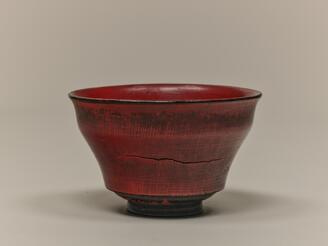
Shikki (Lacquerware)
A representative Japanese craft in use since the Jomon period. Came to be known as “japan” in Europe.
Items such as implements, tools, and other wares with lacquer coatings or adhesives applied to them for practical and decorative purposes. While produced broadly throughout the Asian region, Japanese lacquerware in particular came to be known simply as “japan” in Western Europe, where exports of the wares in the early modern period were much appreciated. Lacquerware is considered a representative handicraft of Japan. With a history of use in Japan dating to the Jomon period (c. 14,000BC – c.1,000 BC), many finds have been made of earthenware with lacquer applied to it. In particular, lacquered burial accessories from around 9,000 years in the past unearthed at the Kakinoshima “B” Excavation Site in Hokkaido are thought to be the oldest ornamental items found in the world. Nihonshoki (“The Chronicles of Japan”) contains a passage describing Nuribe no Miyatsuko Ani being sent to Umako Soga by Moriya Mononobe in 587, and from this it can be deduced that by that period there already existed a group of lacquerware producers (to which Nuribe refers) and an official supervising them.
While applied to a wide range of materials, including bamboo, paper and cloth, lacquer is most often applied to wooden materials. Items with lacquer coatings applied to them are often further decorated. From maki-e, which features patterns and pictures drawn with metal powders of gold, silver, tin and so on, to raden, which has mother-of-pearl from seashells cut into designs and affixed or inlaid, a range of different techniques are employed, giving the craft a high degree of artistic value.
Related People, Things and Events
Books
Related Works
Lacquerware in the primitive era (Jomon, Yayoi, and Kofun periods (4000 BC-c.700 AD))
Lacquerware in the ancient era (Asuka, Nara, and Heian periods (592-1185))
Lacquerware in the medieval era (Kamakura, Muromachi, and Azuchi-Momoyama periods (1185-1603))
Lacquerware in the early modern era (Edo period (1603-1868))
Videos
Past Exhibitions
| Title | shusai | Place | open | close |
|---|---|---|---|---|
Institutions Holding Related Materials
The National Diet Library (NDL), founded in 1948, is the library which belongs to the Diet. The NDL assists the activities of the National Diet. The Library collects and conserves materials and information both from Japan and abroad, serving as a foundation of knowledge and culture and providing library services to administrative and judicial entities and Japanese citizens.
As Japan’s representative museum, Tokyo National Museum collects, preserves, displays, and researches the cultural properties of Asia with a focus on Japan, and also provides educational programs.
General Museum and Research Institute of Japanese History / A member of National Institutes for the Humanities, Inter-University Research Institute Corporation
Kyoto National Museum collects, preserves, displays, researches and provides educational programs focusing on cultural properties from Heian- through to Edo- period Japan, when the capital was located there.
Nara National Museum collects, preserves, displays, researches and provides educational programs about cultural properties with a focus on Buddhist art.
石川県輪島市にある、漆芸専門の美術館。様々な漆器が常時展示されている。
茶人中村栄俊氏が収集した美術品を中心とした所蔵品を持つ。年4~6回の展覧会あり。
主に漆工品を中心にしたカザールコレクションを持つ。本館陳列室ではコレクション展が随時開催されている。
External Links
国立文化財機構の4つの国立博物館 (東京国立博物館、京都国立博物館、 奈良国立博物館、九州国立博物館)と研究所(奈良文化財研究所)が 所蔵する国宝・重要文化財の高精細画像をみられる。
日本の伝統工芸作品を紹介するサイト。漆芸の技法や産地、種類などを解説している。
日本工芸会は、重要無形文化財保持者(いわゆる人間国宝)を中心に伝統工芸作家、技術者等で組織する団体。漆芸分野で人間国宝に指定された作家と作品を紹介している。
青森県の津軽塗や和歌山県の紀州漆器など、全国各地の漆器を見ることができる。それぞれの特徴、作業風景、作り方など各地の漆器の魅力を伝えている。
各地の漆器の紹介、手入れの仕方などのほか、漆自体の歴史や特徴も併せて載せている。
References
- 四柳嘉章 著,岩波書店
- 山本勝巳 著,丸善