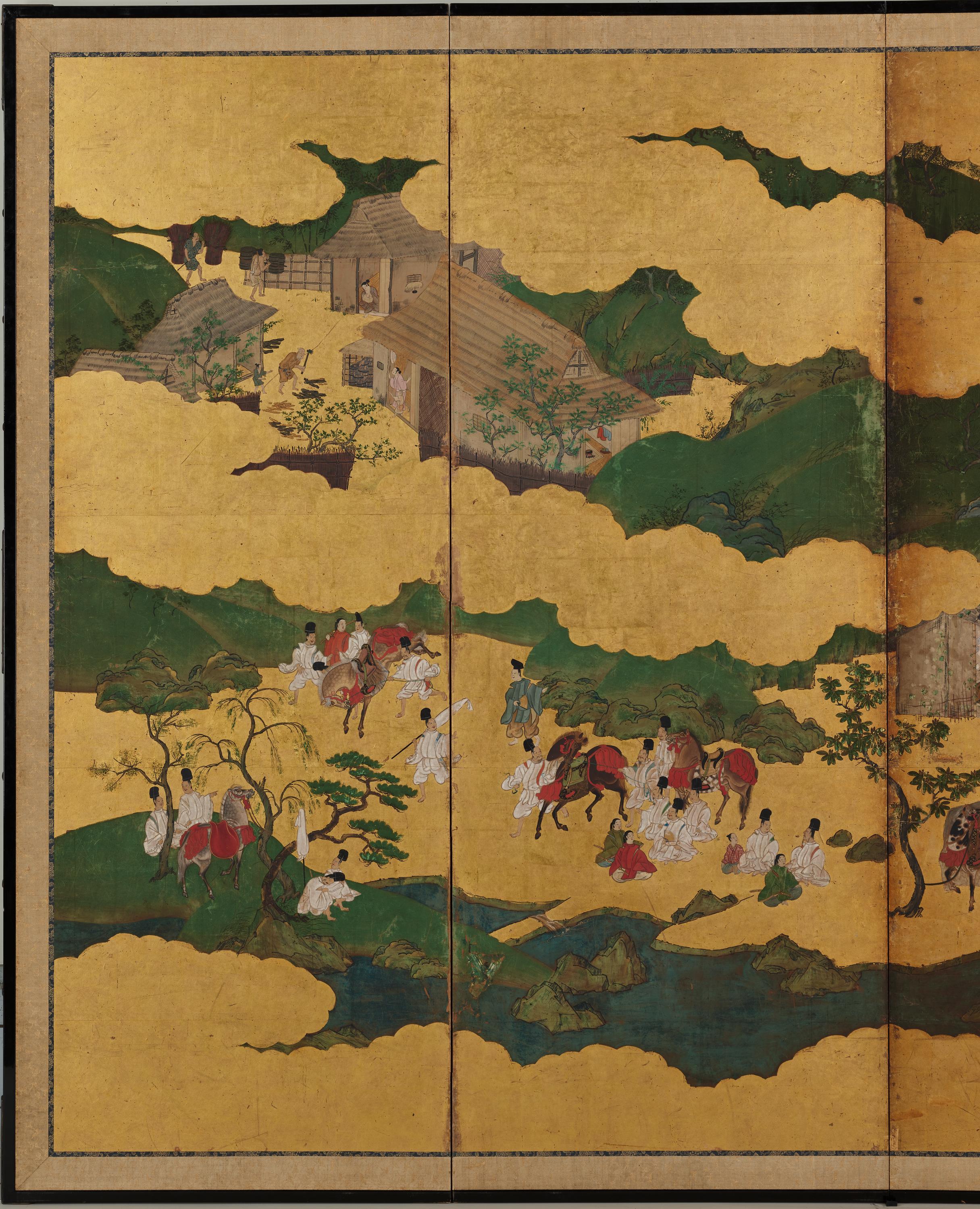
Heike Monogatari (The Tale of Heike)
Heike Monogatari, or The Tale of Heike, is a war chronicle that narrates the rise and fall of the Taira clan.
“Jetavana Temple bells ring the passing of all things. Twinned sal trees, white in full flower, declare the great man’s certain fall.”
Beginning with these famous sentences, a war chronicle, Heike Monogatari, or ‘The Tale of Heike’, narrates the rise and fall of the Heike (Taira clan) during the end of the Heian era. The story is divided into three sections ? the first part is about Taira no Kiyomori, the middle is about Yoshinaka Kiso and the latter is about Minamoto no Yoshitsune. As is stated in the very first part of the story, the central themes of Heike Monogatari are the Buddhist precepts, “nothing is permanent” and “even the mighty must fall.”
Gaining a political foothold after his father’s death (Taira no Tadamori), Taira no Kiyomori won the battle of Hogen Heiji no Ran (Hogen and Heiji Wars) and seized control of the government. Afterwards, Kiyomori married his daughter, Tokuko, to the Emperor Takakura to whom she bore a son, Emperor Antoku. However, their advancement within the court created a conflict with the cloistered Emperor Go-Shirakawa. In 1180, Minamoto no Yorimasa raised an army by the command of Prince Mochihito, and started the Minamoto clan’s counteroffensive. During this time, Kiyomori unexpectedly died of a fever and the Taira clan, forced to flee Kyoto by Yoshinaka Kiso, was later destroyed by Minamoto no Yoshitsune at the battle of Dan-no-ura.
Heike Monogatari tells the rise and fall of the Taira clan with lyricism and a touch of melancholy. Although the cloistered Emperor Go-Shirakawa and Minamoto no Yoritomo were highly influential people in their time, they were passive characters in the tale. Instead, Taira no Kiyomori, Yoshinaka Kiso, and Minamoto no Yoshitsune take center stage. Despite the three main characters achieving success, they all meet with sad endings: Kiyomori died of illness, Yoshinaka was overthrown by his own clan, and Yoshitsune was murdered by his older brother, Yoritomo.
The story was passed down through oral tradition by the Biwa-hoshi, Japanese lute players and storytellers – as a result, many different versions of the story exist. Although the original author is unknown, one theory from Tsurezuregusa (Essays in Idleness), Section 226 states that Shinano no Zenji Yukinaga created the tale, and instructed a blind Biwa-hoshi, Shobutsu, who was very knowledgeable about samurai in the Kanto region to tell the story.
Related People, Things and Events
Books
Ancient books
Emaki
Research books and other references
Related Works
Videos
Past Exhibitions
| Title | shusai | Place | open | close |
|---|---|---|---|---|
| 林原美術館 | 2010/8/1 | 2010/9/26 | ||
| 林原美術館 | 2005/6/12 | 2005/7/17 | ||
Institutions Holding Related Materials
東京都台東区に所在。多数の『平家物語』写本を所蔵している。
京都府京都市に所在。「平家物語絵巻」のほか、国宝の手鑑「藻塩草」 平家物語断簡(長門切)を所蔵。
岡山県岡山市に所在。国内で唯一完本として揃っている『平家物語絵巻』全36巻(越前松平家伝来)を所蔵。
明星大学が所蔵する『平家物語』絵本についての解説やコラム、画像などを見られる。