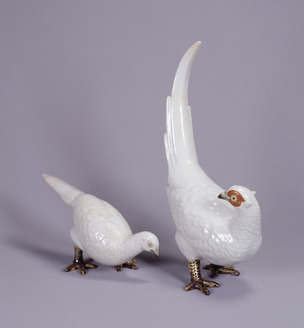
Pheasant
Japan's national bird, admired since ancient times for its beautiful feathers and appreciated for its delicious game meat
The pheasant (kiji in Japanese) is Japan's national bird (so designated in 1947). It is also called known as kigisu and kigishi in Japanese, and it has been a familiar presence in the life of Japan the Japanese people since ancient times. The male and female differ significantly in appearance. Most male pheasants have a long tail, beautiful coloring, and stunning ornamental feathers. They Pheasants produce a distinctive high-pitched, two-syllable call that sounds like kenken to the Japanese ear, and their beating their wings crow expressed in Japanese with the onomatopoeia "ken-ken," followed by a flurry of wing beats which sounds like "hororo." There are records of pheasants screeching loudly crying vigorously before an earthquake. This has led to the belief that pheasants can have the ability to predict earthquakes, —an ability which came to be considered a feature of great scientific interestsignificance. The white pheasant (hakuchi in Japanese), in particular, was construed was seen as a good omen, as seen from the fact that back in the seventh century when the period spanning the years from 650 through to 654 was were given the era name Hakuchi. (The circumstances surrounding the change in the era name of the era are explained in detail in the Nihon shoki ("The Chronicles of Japan", 720).) The Kojiki ("Records of Ancient Matters", ca. 711) tells the story of the divine pheasant Kigishi no Nanakime, who was sent dispatched from the heavens to bring back supervise the deity Amenowakahiko, but who then shot and killed Nanakime. This legend myth is believed to be the origin of the saying proverb "Kigishi no hitatsukai" ("a messenger who doesn't come back," lit. "A pheasant messenger that does not return"). Today, the pheasant is a ubiquitous part of Japan's popular culture and appears in a variety of stories, from the beloved folktale of "Momotaro" to the legend of the human pile pillar (the ancient practice of human sacrifices at construction sites to protect them from natural disasters) at the Settsu Nagara Bridge. According to this legend, a human sacrifice was made to protect the bridge from natural disasters, and this sacrifice was called a "human pile." In this legend we encounter the saying, in relation with the proverb "Kiji mo nakazuba utaremai," ("There is safety in silence," lit. "The pheasant would not be shot but for its cries").
Since prehistoric times, the pheasant has been a popular favorite game bird due owing to its ample and delicious meat and because, as a terrestrial birdspecies, it is relatively easy to hunt. One hunting method was chasing pheasants, which involved a group of people chasing a pheasant on the snow until it was exhausted and easily caught. kiji oi (lit. "pheasant chasing") was a hunting method in which, during the winter months, pheasants were chased in flocks until they were unable to move anymore on the snow, and were then caught. In Japan, ever since the Nara period (710-784)dynastic period, pheasant meat has been considered the best delicacy among all poultry choice meat, and during the Heian period (794-1185), pheasants caught using falcons (the so-called takagari or Japanese falconry hunting method) were the finest treat at the imperial banquets. Late in the late Kamakura period (1180-1333around 1330), it became commonly accepted that the choicest most refined fish was the sea bream and the choicest fowl most refined poultry was the pheasant. In Shijo-ryu hocho sho ("Shijo Style Cookbook of the Shijo School"), compiled in the Muromachi period (1336-1573), the word tori (fowl) poultry referred exclusively to pheasant meat. Pheasant dishes are also featured in Goke shidai ("The Ritual Protocol of the Oe House"), from the late the late Heian period (around 1156-1185),; Imagawa ozoshi, a record from the Muromachi period,; Ryori monogatari ("A Tale of FoodNarrative of Actual Food Preparation") from early in the early Edo period (1603-1867); around 1603-1700), and many other cookbooks and books on ancient practices.
To this day, pheasants remain designated as game birds, and approximately 100,000 captive-bred pheasants are released into the wild each year.
Related People, Things and Events
Books
Pheasants in Momotaro (“Peach Boy”) illustrations
About pheasant cuisine
Related Works
Craft works that feature pheasants
Institutions Holding Related Materials
The National Diet Library (NDL), founded in 1948, is the library which belongs to the Diet. The NDL assists the activities of the National Diet. The Library collects and conserves materials and information both from Japan and abroad, serving as a foundation of knowledge and culture and providing library services to administrative and judicial entities and Japanese citizens.
As Japan’s representative museum, Tokyo National Museum collects, preserves, displays, and researches the cultural properties of Asia with a focus on Japan, and also provides educational programs.
Kyoto National Museum collects, preserves, displays, researches and provides educational programs focusing on cultural properties from Heian- through to Edo- period Japan, when the capital was located there.
Kyushu National Museum explores how Japan’s history of cultural exchange with the rest of Asia has impacted the formation of its culture. To that end, we engage in the collection, preservation, exhibition, and research of cultural properties, in addition to providing educational outreach to the local community.
The Tokyo Fuji Art Museum is founded on November 3, 1983, in Hachioji, a thriving university town in the western suburbs of the Japanese capital. Priding itself as “a museum creating bridges around the world” to facilitate the exchange of different cultures, our museum has forged cordial relations with art museums and cultural institutes in 32 countries and territories to date. We do so by bringing the world’s finest works of art to Japan while reciprocating in kind by introducing the finest Japanese treasures to the world through special exhibitions that showcase their beauty and wonder through a unique new set of prisms and perspectives. Our museum possesses some 30,000 pieces of artworks from various periods and cultures including Japanese, Eastern and Western works, ranging from paintings, prints, photography, sculptures, ceramics and lacquer ware to armor, swords and medallions. Especially noteworthy is its outstanding collection of Western oil paintings that spans a five-hundred-year period from the Renaissance, Baroque, Rococo, and Romanticism to Impressionism and contemporary art, as well as its exceptional collection of photographic masterpieces that can give an overview of the history of photography from the birth of the photograph to the present age.
The National Archives is an organization for preserving, as historical materials, public records and archives of importance transferred from state organs, and providing them for public use, with the aim of achieving appropriate preservation and use of such public records and archives that are kept in the National Archives or state organs as historical materials.
所在地は京都府京都市左京区。園内の「京都の森エリア」では、ニホンキジが飼育展示されています。
所在地は金沢市。隣には兼六園、および旧美術館(現・県立伝統産業工芸館)があり、野々村仁清作「色絵雉香炉」(国宝)を所蔵。
栃木、群馬、埼玉、茨城県にわたる日本最大の遊水地。キジやその他の野鳥を観察することができる。
東京都品川区にある神社。「雉子(きじ)神社」の名は、慶長年間に三代将軍・徳川家光がこの地に鷹狩りに訪れた時に、一羽の白雉がこの社地に飛び入ったのを追って社前に詣で、「以後雉子宮と称すべし」と言ったことによるものと伝わる。
京都市上京区にある寺院。円山応挙による杉戸絵「桜雉図」がある。
External Links
SUNTORYが運営する鳥の百科事典。フリーワードや特徴、鳴き声で検索できる。イラストや写真も豊富。
日本野鳥の会が運営するサイト。野鳥に関する様々な情報を知ることができる。膨大な数の投稿写真は、検索しやすいように分類されている。
日本国内唯一の全国的な狩猟団体。狩猟鳥獣の項目でキジについても説明されている。
環境省の東北地区の地方環境事務所のアクティブ・レンジャー日記。2008年4月14日、2009年11月5日、2011年1月7日の記事に、キジについての記述がある。
References
- 堀田正敦著 ; 鈴木道男編著,平凡社,堀田, 正敦(1758-1832)||ホッタ, マサアツ <AU00329450> 鈴木, 道男(1958-)||スズキ, ミチオ <AU00329451>